
Ask a practice how marketing is going and you usually get a number of enquiries. Ask how many of those became patients and the room goes quiet.
That gap is the whole subject. Most practices do not have a lead generation problem in the sense the phrase implies. They have enough people trying to reach them. What they do not have is a reliable way of catching those people, answering them quickly, and following up with the ones who go quiet.
So the healthcare lead generation strategies below are deliberately operational. Not a list of channels, which you have read before, but the mechanics: what counts as a lead, what your form should ask, who picks up the phone at one o’clock, how fast you have to reply, and how to tell a source that produces patients from one that just produces noise.
One note before we start. This is about patient enquiries. If you sell products or services to healthcare organisations rather than treating patients, the buying process is completely different, and our guide to B2B healthcare marketing best practices is the right place to go instead.
Why most healthcare lead generation strategies fail inside a real practice
Because it is written for businesses with a sales team. The advice assumes somebody whose only job is to chase enquiries, a system that logs every touch, and a prospect who is happy to be called three times.
A practice has none of that. The person answering the phone is also checking in a patient, taking a delivery and fielding a question from a nurse. There is no sales team. There is a front desk, and the front desk is busy.
So any strategy that depends on sustained human attention will fail quietly within a month. The ones that work are the ones that need a decision once and then run: a rule about who answers, a form that captures the right thing automatically, a follow-up sequence somebody actually owns.
It helps to know where you are losing people before you change anything. Our guide to where enquiries are lost maps the stages and shows which losses are marketing and which are operational. This article is the operational half.
What actually counts as a lead
A person who contacted you and could plausibly become a patient. Not a session, not a click, not a form submission.
That definition matters because the usual one inflates everything. Somebody rings on Monday, gets voicemail, fills in the form on Tuesday, then rings again on Wednesday and books. Most reporting counts that as three leads and one patient, which makes your conversion rate look like a disaster and your cost per lead look wonderful. Both numbers are wrong.
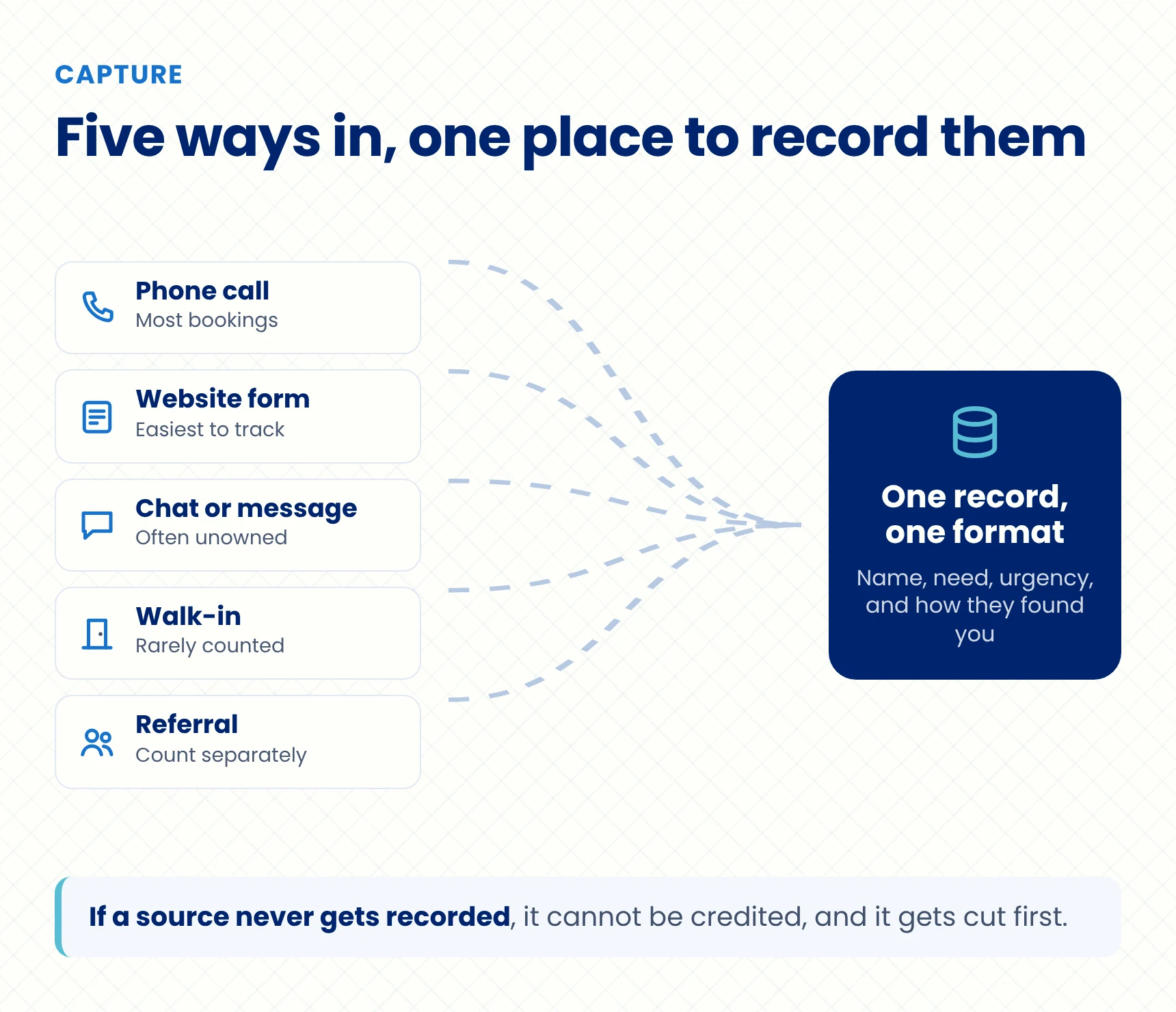
It also matters for the opposite reason. Practices often undercount, because a patient who walked in after seeing a sign, or who was recommended by a neighbour, never appears anywhere. If it only counts when it arrives through a form, your best source will be invisible.
Deduplicate before you believe any trend
Match on phone number first, then email, then name. It is dull work and it takes an afternoon a month. Practices that do it routinely discover their real lead volume is ten to twenty percent lower than reported, and their conversion rate is considerably better than they thought.
Decide what does not count
Write the exclusions down once so everyone applies them the same way. Existing patients rebooking are not new leads. Suppliers, job applicants and sales calls are not leads. Someone outside your area asking a general question is not a lead unless you can actually treat them.
If you skip this, your team will quietly decide for themselves, differently, every month.
The enquiry form, field by field
Short forms get more submissions. Forms that ask the right three or four extra things get more patients. Both are true, and the resolution is to be ruthless about which fields earn their place.
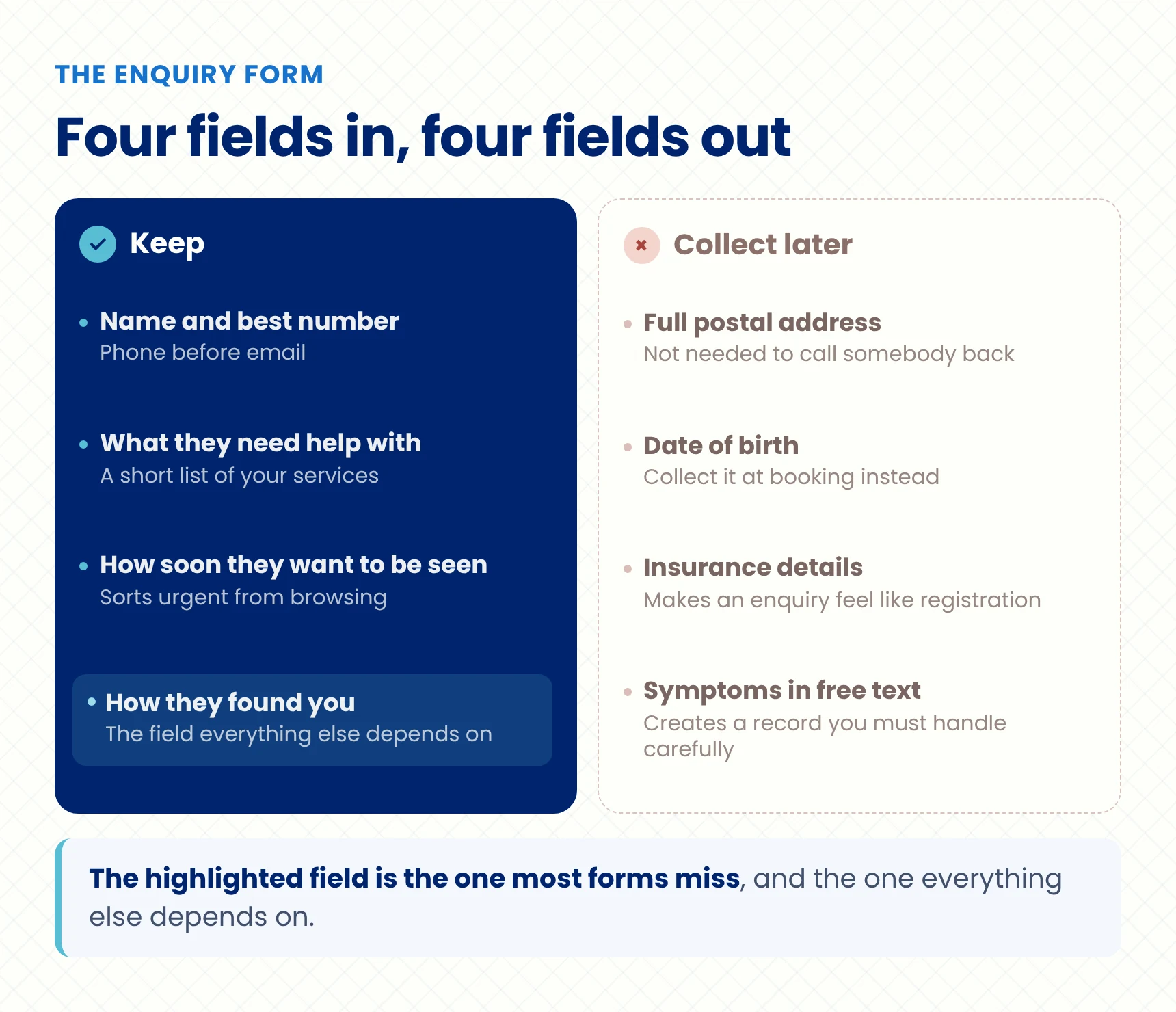
Keep these
- Name and the best number to call. Phone before email. In healthcare the booking usually happens on a call, so collect what you will actually use.
- What they need help with, as a short list of your services plus an other box. This is what lets you route the enquiry and judge quality later.
- How soon they want to be seen. One question that sorts urgent from browsing, and tells your front desk who to ring first.
- How they found you. The field almost nobody includes and the single most useful thing on the form.
Cut these
- Full address. You do not need it to call someone back, and it is the field people abandon on.
- Date of birth and insurance details. Collect at booking, not at enquiry. Asking for them upfront makes a simple question feel like registration, and raises a privacy question you do not need yet.
- Anything clinical in free text. Do not invite people to describe symptoms in a web form. It creates a record you then have to handle carefully, and you will ask properly on the call anyway.
- Optional fields nobody reads. If no one acts on an answer, the field is costing you submissions for nothing.
That fourth field in the keep list deserves its own sentence. If your form does not record how the person found you, you cannot tell which marketing works, and every other number in this article becomes guesswork. Add a simple dropdown, ask the same question on the phone, and record both the same way.
The phone is a lead generation channel
In most practices the phone produces more bookings than everything else combined, which makes an unanswered call the most expensive event in your marketing. You paid to make it ring.
Patients increasingly start online and finish on the phone. National survey data shows 58.5 percent of adults looked up health or medical information online in the second half of 2022, with 41.5 percent using the internet to communicate with a doctor or doctor’s office. The research happens on a screen. The booking still tends to happen in a conversation.
This is also why call tracking earns its place before most other software. Until you can see which marketing produced each call, the largest part of your lead generation is simply unmeasured, and you end up judging the whole operation on the smaller, more visible half that arrives by form.
Decide who answers, by name and by hour
Not “reception answers the phone”. A named person for each block of the day, including lunch, which is when practices miss most calls and when working patients most often ring.
Make missed calls visible
Most phone systems report unanswered calls during opening hours. Pull that number monthly and put it next to your enquiry count. It is usually the most uncomfortable figure in the report and the cheapest one to improve.
Call back every missed call the same day
A simple rule with no technology required. Somebody checks the missed call list twice a day and rings back. Practices that start doing this often find it is worth more than the campaign they were about to commission.
Give the front desk permission to book
If every enquiry has to wait for a clinician to approve it, your response time is no longer in your control. Agree in advance which appointment types the desk can book outright.
How fast do you have to respond?
Faster than you are now, and the honest answer is that nobody can tell you the exact number for healthcare.
You will see a widely repeated claim that responding within five minutes makes you dramatically more likely to convert a lead. It traces back to research published in Harvard Business Review in 2011 by Oldroyd, McElheran and Elkington, which concluded that most companies are not responding nearly fast enough to online enquiries. Worth knowing: that study looked at business sales leads, not patients, and it is now well over a decade old. The dramatic multipliers quoted in marketing articles are not in the abstract.
So treat speed as a principle rather than a benchmark. Nobody has published a credible healthcare equivalent, which means the useful target is your own.
A workable standard for a practice
- Phone enquiries: answered live, or called back within two working hours.
- Form and message enquiries: a human reply within one working hour, even if the reply is only to agree a time to talk.
- Out of hours: an automatic acknowledgement that says when you will be in touch, then contact before lunch the next working day.
Measure it for a month before you argue about the target. Most practices discover their average is measured in days, not hours, and that one or two enquiries each week were never answered at all.
The follow-up sequence for enquiries that go quiet
Most practices contact an enquiry once. If nobody picks up, the enquiry is effectively abandoned. That is the cheapest lost revenue in the building, because you already paid to generate it.
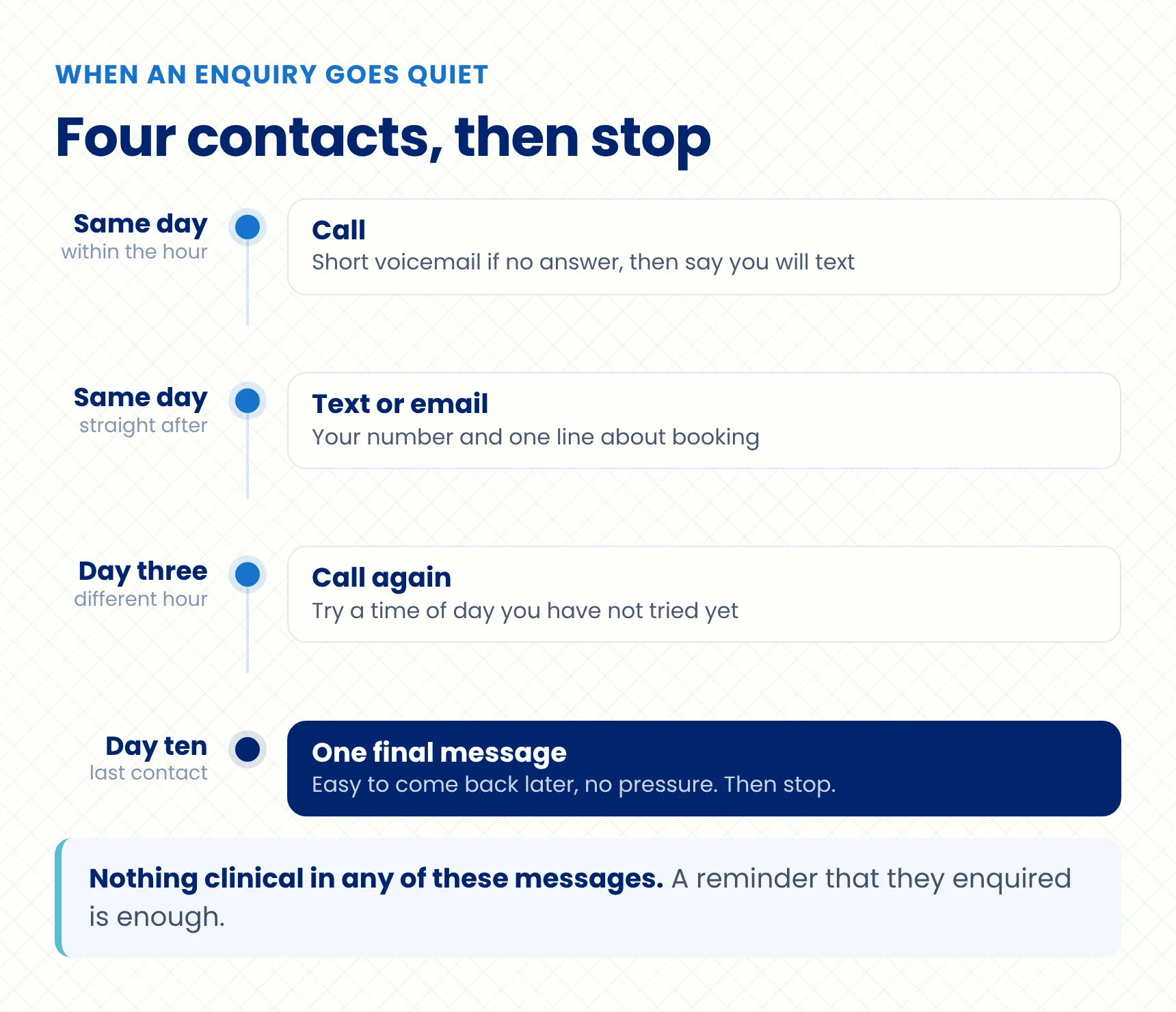
A sequence that works for a busy front desk looks like this.
- Same day: call. If no answer, leave a short voicemail saying who you are and that you will text.
- Same day, immediately after: a text or email with your number and one line about booking. People who ignore voicemail will often reply to a message.
- Day three: call again, at a different time of day from the first attempt.
- Day ten: one final message that makes it easy to come back later, with no pressure. Then stop.
Two things make this work. The variation in timing, because somebody unreachable at ten in the morning may answer at five. And the stopping rule, because a sequence with no end quietly becomes nagging, which is a poor look for a healthcare business.
Keep the content of these messages free of anything clinical. A reminder that somebody enquired is fine. A message naming a condition or treatment is not, especially by text.
Telling a good lead source from a loud one
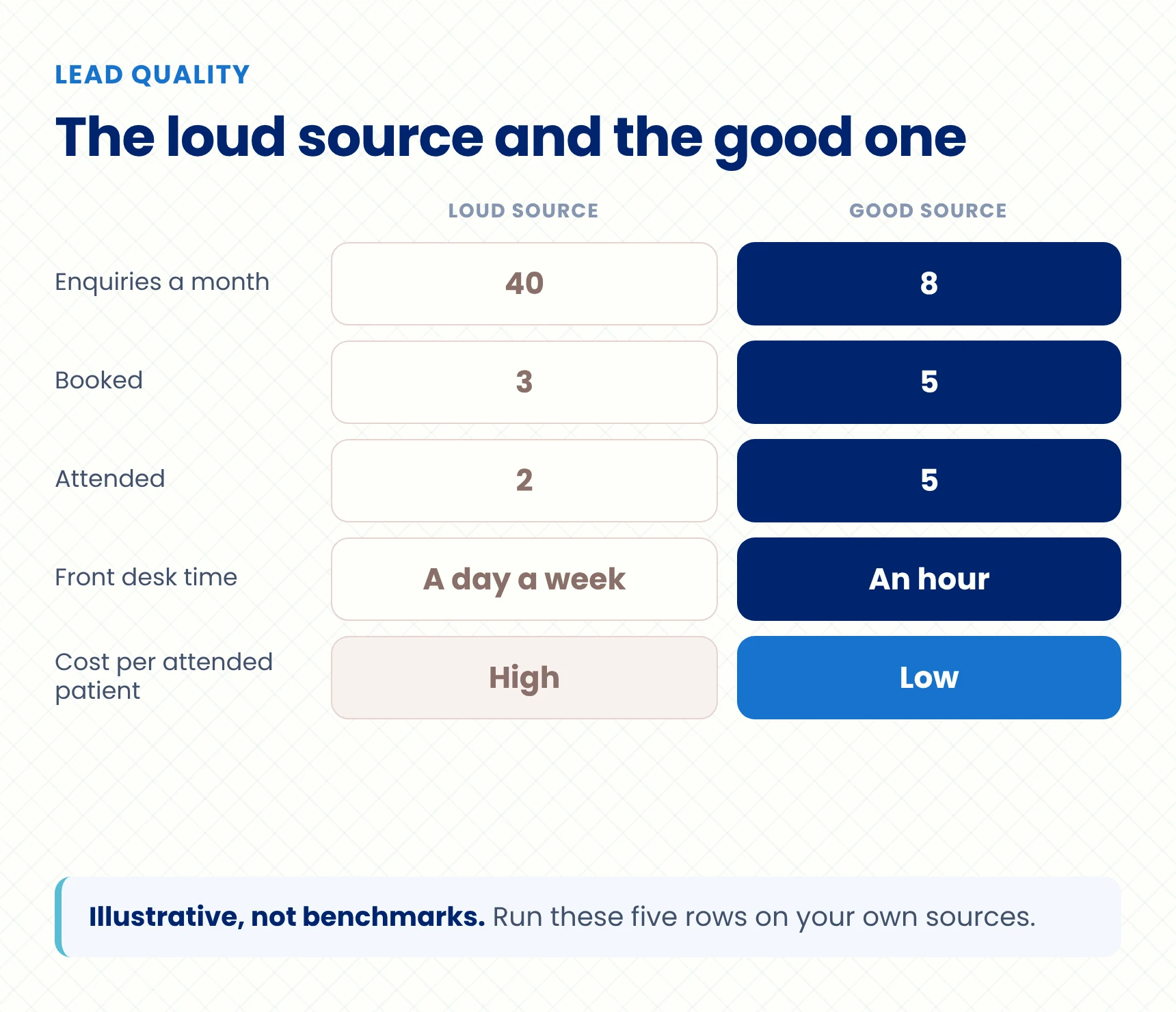
Volume is the easiest thing to measure and the least useful. A source that sends forty enquiries and books three is worse than one that sends eight and books five, and it also costs your front desk a day of work.
Judge every source on four things, in this order.
- Booked appointments, not enquiries.
- Attended appointments, because some sources produce people who book and never arrive.
- Service match, meaning the enquiries are for treatments you actually want more of.
- Effort per enquiry, which is the hidden cost. Forty unqualified enquiries is a part-time job.
Ask your front desk which source sends the best enquiries before you look at any dashboard. They will tell you immediately, and they are usually right. The data then confirms or corrects it.
Run this review quarterly, not monthly. Healthcare enquiry volumes are small enough that a single month tells you very little, and reacting to noise is how budgets get moved for no reason.
Where the leads actually come from
Kept short on purpose, because the capture side above matters more than the channel mix. What follows is what each source needs from you in order to produce bookable enquiries rather than traffic.
Local search
The highest intent source most practices have. It needs an accurate listing, real photos, current hours and a phone number that works. People searching this way are ready now, so the only thing that loses them is friction.
Worth checking yours the way a patient would. Search your main service plus your town on a phone, logged out, and see what comes back. Practices are often surprised by how far down they sit, or by an old listing with a disconnected number sitting above them.
Organic search
Slower, and it compounds. Service pages that answer cost, recovery and what the first visit involves generate better enquiries than condition explainers, because people reading them are closer to acting. Handled properly, healthcare SEO becomes the source that keeps producing after you stop paying.
It is slow enough that people give up on it too early. Six months is a fair first review, and the right measure at that point is enquiries by page, not rankings. A page sitting at position four that produces four calls a month is doing more than a page at position one that produces none.
Paid search
It is the slowest channel to start and the hardest to stop benefiting from, which is an awkward combination for a practice that needs patients this quarter. Run it alongside something faster rather than instead of it.
The fastest way to test whether a service has demand. It is also the easiest place to waste money on broad terms. Keep it tight to treatment and location terms, and judge healthcare PPC on booked patients rather than on clicks or even on enquiries.
Set a floor on quality before you scale the spend. If a campaign produces enquiries your front desk describes as time wasters, more budget makes the practice worse, not better. Pause, tighten the targeting and the landing page, then increase.
Referrals and word of mouth
Usually the largest source and the one nobody manages. Count referrals separately, make it easy for referrers to send someone, and tell them what happened afterwards.
The practical version is simple. Keep a short list of who refers to you, make sure their staff know how to send someone, and close the loop afterwards with a note on what happened. That last step is the one almost nobody does and the one referrers notice.
Your existing patient list
Not technically lead generation, which is why it gets ignored. A recall message to lapsed patients will normally outperform any acquisition channel on cost per appointment, and the list is already sitting in your practice management system.
The reason this belongs in a lead generation article is cost. A recall message costs a fraction of an acquisition campaign and reaches people who already chose you once, which makes it the highest return work available to most practices in any given quarter.
Whichever mix you run, the same enquiry should get the same experience from all of them. Keeping that consistent is the job covered in omnichannel healthcare marketing.
Cost per lead versus cost per booked patient
Cost per lead is the number that gets reported and the number that misleads. It treats a price shopper and a ready patient as identical.
The number to run on is cost per booked patient, and ideally cost per attended patient. Take everything you spent on a source in a month, including agency fees, and divide by the patients from that source who actually turned up.
Two campaigns can show the same cost per lead and a threefold difference once you reach attendance. That difference is invisible until you connect your enquiries to your schedule, which is the work covered in our guide to tracking marketing performance.
This also changes how you set a healthcare marketing budget. Once you know what a booked patient costs from each source, the spending decision stops being a guess and becomes arithmetic.
What to fix first
In this order. Most healthcare lead generation strategies start at step five, which is why they disappoint. The first three cost nothing and usually produce more than the fourth.
Steps one to three are free and take about a week of attention. Practices regularly find they do not need step five at all, because fixing the first three solved the problem they were going to spend money on.
Software helps once the process exists, and not before. A tool bought to fix an undefined process just adds a login nobody uses, which is the pattern described in our guide to the tools clinics use.
Eight lines, and most practices can tick three of them. The gap between three and eight is usually worth more than the next campaign.
Common mistakes
- Buying more traffic to fix a conversion problem. If half your enquiries never get a reply, doubling enquiries doubles the waste.
- Judging a month. Practice volumes are small. A bad month is usually weather, holidays or one staff absence.
- Letting everyone define a lead differently. Two people counting different things produces a report nobody trusts.
- Chasing cost per lead down. The cheapest leads are usually the least qualified, and the saving disappears at the booking stage.
- Treating the website as the whole funnel. For most practices the website starts the conversation and the phone finishes it.
- Running campaigns before fixing capture. Worth seeing how the planning and measurement fit together in healthcare marketing campaign examples.
The thread running through all six is the same. Each one substitutes something measurable and visible, such as traffic, leads or a monthly figure, for something slower and more awkward, which is whether a person ended up in a chair.
Worth rereading that list once a quarter with your front desk in the room. They will recognise two or three of them immediately, and they usually know which one is costing you most.
If you want the broader picture rather than the enquiry mechanics, the channel level view sits in marketing ideas for practices.
Enquiries you cannot help
Some proportion of every practice’s enquiries are people you genuinely cannot treat. Wrong area, wrong service, wrong insurance, or a problem that needs somebody else entirely. How you handle them matters more than the volume suggests.
Answer them anyway, briefly, and point them somewhere useful. It costs a minute and it is the right thing to do for someone who is unwell and lost. It also tends to come back to you, because people remember the practice that helped when it had nothing to gain.
Then record them as unqualified rather than deleting them. If one source produces a steady stream of people you cannot treat, that is not a front desk problem, it is a targeting problem, and you will only see it if those enquiries are counted somewhere.
Good healthcare lead generation strategies reduce this group over time rather than hiding it. A rising share of unqualified enquiries is an early warning that a campaign has drifted.
With the mechanics in place, the remaining question is direction: which services to grow, which to leave alone, and what the whole thing should cost. That belongs in your healthcare marketing plan rather than in the enquiry process.
Where The Healthcare Marketing fits
We work only with healthcare organisations, which means we start with the enquiry rather than the campaign. The first thing we do for most clients is find out what currently happens to people who try to get in touch, and that answer alone usually changes the plan.
Sometimes the honest finding is that the marketing is working and the problem is a phone rota. We will say so, and it is a cheaper conversation for you.
When the capture side is sound and you want more of it, our lead generation services for healthcare cover the sources, the tracking and the reporting that connects an enquiry to an attended appointment.
Frequently asked questions
What are the best healthcare lead generation strategies for a small practice?
Capture and speed beat extra channels. A source field on every form, a rule for answering the phone and a written follow-up sequence will produce more patients than a new campaign.
What counts as a lead in healthcare marketing?
A person who contacted you and could plausibly become a patient. Not a click or a form submission, and not the same person counted twice because they called and also filled in a form.
How quickly should a practice respond to a patient enquiry?
Within one working hour for messages and the same day for missed calls. No credible healthcare-specific study sets the exact number, so measure your own average and improve on it.
Why do patient enquiries never turn into appointments?
Usually because nobody replied fast enough, the first available appointment was too far away, or the enquiry was never followed up after one attempt.
How many fields should a healthcare enquiry form have?
Four or five. Name, best number, what they need help with, how soon they want to be seen, and how they found you. Collect everything else at booking.
Should a medical practice ask for symptoms on a web form?
Better not to. Free text about symptoms creates a record you then have to handle carefully, and you will ask properly on the call anyway.
Do paid ads or organic search produce better patient leads?
Paid is faster and easier to test, organic compounds and costs less over time. Judge both on booked patients rather than enquiry volume, because the ranking changes by that measure.
How do I know which marketing source produces real patients?
Record how each person found you, then match enquiries against your schedule once a month. Without that one field, every answer is a guess.
How many times should you follow up a patient enquiry?
Four contacts over about ten days, mixing calls and messages at different times of day, then stop. A sequence with no ending turns into nagging.
What is a good cost per lead in healthcare?
The wrong question. Cost per lead treats a price shopper and a ready patient as equal. Work out cost per booked patient instead and compare that against what a patient is worth.
Where to start if you only do one thing
Add one dropdown to your enquiry form asking how the person found you, and have reception ask the same question on every call for the next thirty days.
It takes ten minutes to set up, and it is the field that makes every other number in this article possible. Healthcare lead generation strategies all depend on knowing where people came from. Most practices have been running marketing for years without it, which is why the honest answer to what is working has always been a shrug.