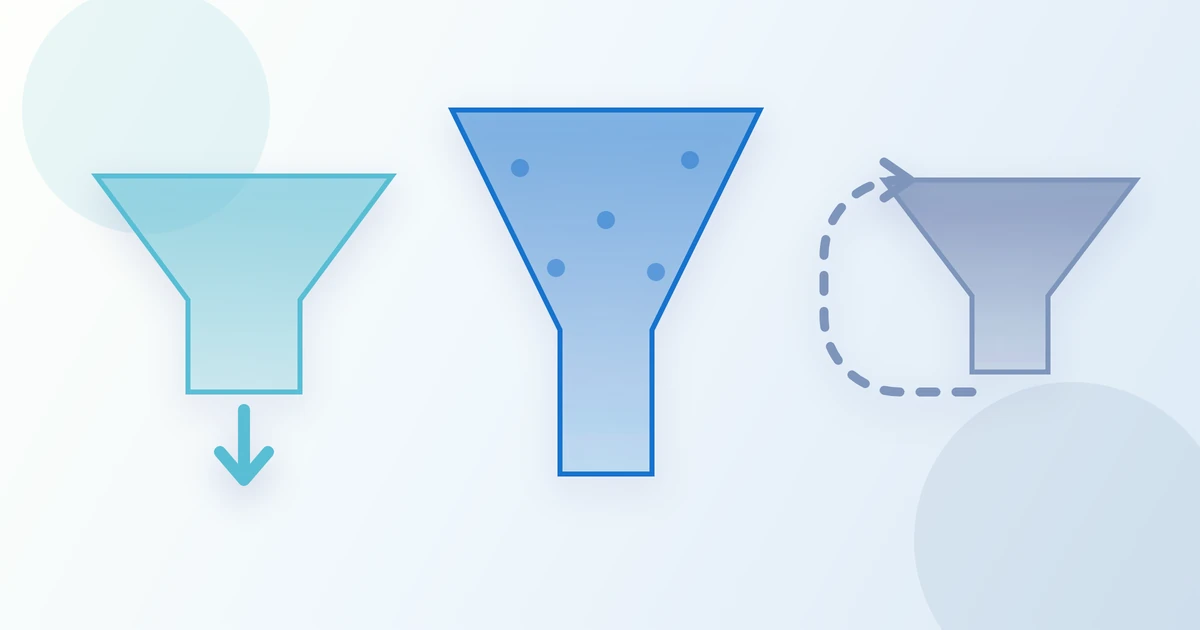
Someone drew you a triangle. Awareness at the top, consideration in the middle, decision at the bottom, and a tidy arrow pointing down through all three. Then you looked at how patients actually reach your practice and none of it matched.
That is not your fault. The standard marketing funnel was built for products people choose at leisure. Healthcare does not work that way. A patient with chest pain does not have an awareness stage. A patient considering a knee replacement might think about it for two years without ever telling you they exist. A patient managing diabetes is not in a funnel at all, they are in a loop.
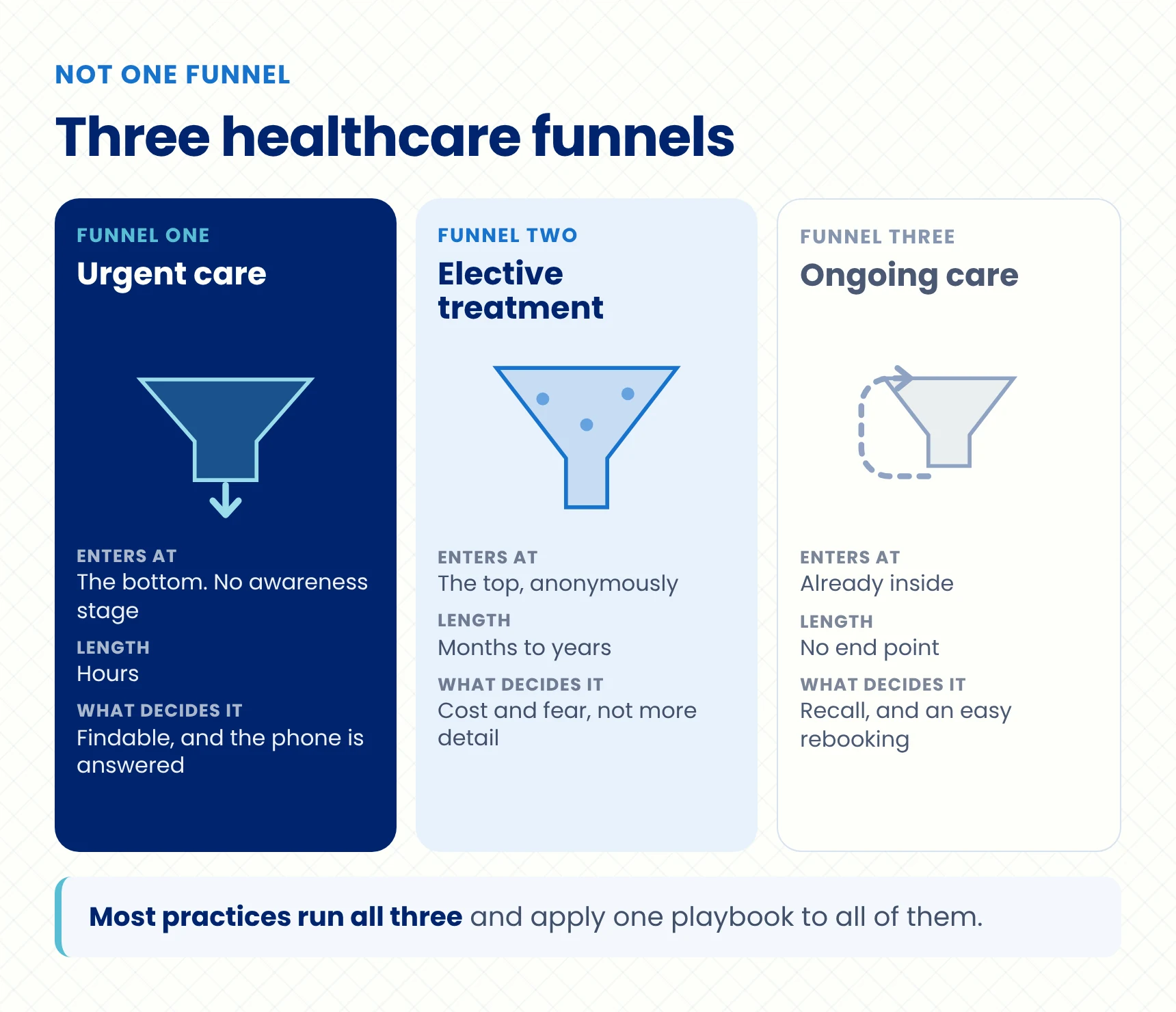
So before you build anything, work out which of the three you are actually running. Most practices run all three at once and apply a single playbook to all of them, which is why the stages never seem to line up with reality.
This guide covers the stages of each one, where patients fall out along the way, and how to build a healthcare marketing funnel that matches the care you actually deliver.
Why the standard marketing funnel does not fit healthcare
Because it assumes the buyer has time, choice and no gatekeeper. Remove any one of those and the shape changes.
Time disappears in urgent care. Choice disappears when the insurance network decides who the patient can see. The gatekeeper appears whenever a referral is required, which means the person choosing is often not the patient at all.
There is also the visibility problem. Most of a healthcare funnel happens where you cannot see it. People research conditions privately, long before they contact anyone. The most recent national figures show that 58.5 percent of adults used the internet to look for health or medical information in the second half of 2022, and 41.5 percent used it to communicate with a doctor or doctor’s office. Those searches are the top of your funnel, and almost none of them appear in your analytics as anything you can act on.
That is why funnel diagrams make practice owners uneasy. The diagram implies you control the journey. For most of it, you do not. What you control is whether you are present when the patient is ready, and whether the path from ready to booked is short.
Funnel one: urgent and acute care
This funnel is almost entirely bottom. The patient has a problem today, searches for a solution today, and books with whoever answers. Awareness campaigns do nothing here because the need did not exist last week.
What matters, in order: showing up in local search and maps, opening hours that are accurate, a phone that gets answered, and an appointment available soon. That is the whole funnel. Content marketing, nurture sequences and brand campaigns are close to irrelevant.
The practices that win urgent care are not the ones with the best marketing. They are the ones that are findable and reachable. A competitor with a worse website who answers on the second ring will take the patient every time.
There is one filter urgent patients apply before they even call: whether you take their insurance. If that is not obvious within a few seconds of landing on your page, some of them leave to check a competitor who made it clear. Accepted plans listed in text, not buried in an image or a PDF, removes a step from the shortest funnel you have.
If this is most of your business, your marketing budget should be weighted heavily toward local search, and your biggest improvement is probably operational rather than promotional. More on the practical side in our guide to getting more patients to your practice.
Funnel two: elective and high-consideration treatment
This is the only one that looks like a traditional funnel, and even then it is longer and quieter than marketers expect. Think cosmetic surgery, fertility treatment, orthodontics, joint replacement, bariatric surgery, hearing aids.
Here the patient genuinely does move through stages. They notice a problem. They live with it. They start reading. They compare options and providers. They worry about cost, recovery and whether it will work. Eventually something tips them into acting.
Three things make this funnel different from a normal consumer one:
- The timeline is measured in months or years. Somebody who enquires today may have first read about the procedure three years ago. Attribution will credit the last click, which tells you almost nothing about what actually did the work.
- Most of it is anonymous. They read, they leave, they come back six times. You see six unconnected sessions, not one patient deciding.
- The barrier is usually fear or money, not information. More detail about the procedure rarely moves someone who is frightened of the recovery or unsure what it costs.
That last point changes what you publish. Honest pricing guidance, recovery timelines, what the first appointment involves and who is not a good candidate will outperform another clinical explainer. The content that converts here reduces fear rather than demonstrating expertise.
It also changes how you judge a page. Something that generates no enquiries may still be doing the work, because it was read eighteen months before the person was ready to act. Judge early-stage content on whether people move to the next page, not on whether they book.
Funnel three: chronic and ongoing care
This one is not a funnel. It is a loop, and treating it like a funnel is how practices end up buying new patients while quietly losing the ones they have.
The stages are recall, attendance, follow-up and the next appointment. The work is reminders that arrive at the right time, a booking process that does not require a phone call, and somebody noticing when a patient has not been seen in eighteen months.
The economics are better here than anywhere else in marketing, and it is the part most practices neglect because it feels like administration rather than growth. A recall system that brings back lapsed patients will usually beat any acquisition campaign on cost per appointment, and it is less affected by what competitors do.
The mechanics are simple and almost always missing. A list of patients due or overdue, a message that goes out on a schedule rather than when somebody remembers, and a way to rebook without phoning. Most practice management systems can already produce the list; the gap is that nobody owns the job.
If you run all three funnels, this is normally where the fastest return sits, and it is worth fixing before you increase advertising. Which patients to approach first is a healthcare marketing plan question rather than a channel question.
How the three funnels change where the money goes
Once you know which funnel produces your revenue, the spending decisions get much simpler, because each one rewards completely different work.
Urgent care rewards presence. Local search, accurate listings and whatever it takes to answer the phone. Content budgets are close to wasted here, and so is most social advertising.
Elective treatment rewards patience. Content that answers cost and recovery questions, search advertising on treatment terms, and enough follow-up capacity to handle enquiries that take months to mature. This is the only one of the three where brand building genuinely pays.
Ongoing care rewards systems rather than spend. A recall list, a message schedule and an easy rebooking path cost very little and return more per appointment than any campaign.
The common mistake is spending elective money on an urgent service, or urgent money on an elective one. A practice that promotes emergency dental care with educational articles, or sells implants purely through local search, will underperform at both and never quite understand why. Mapping your healthcare marketing funnel service by service is what prevents it.
Where patients actually fall out
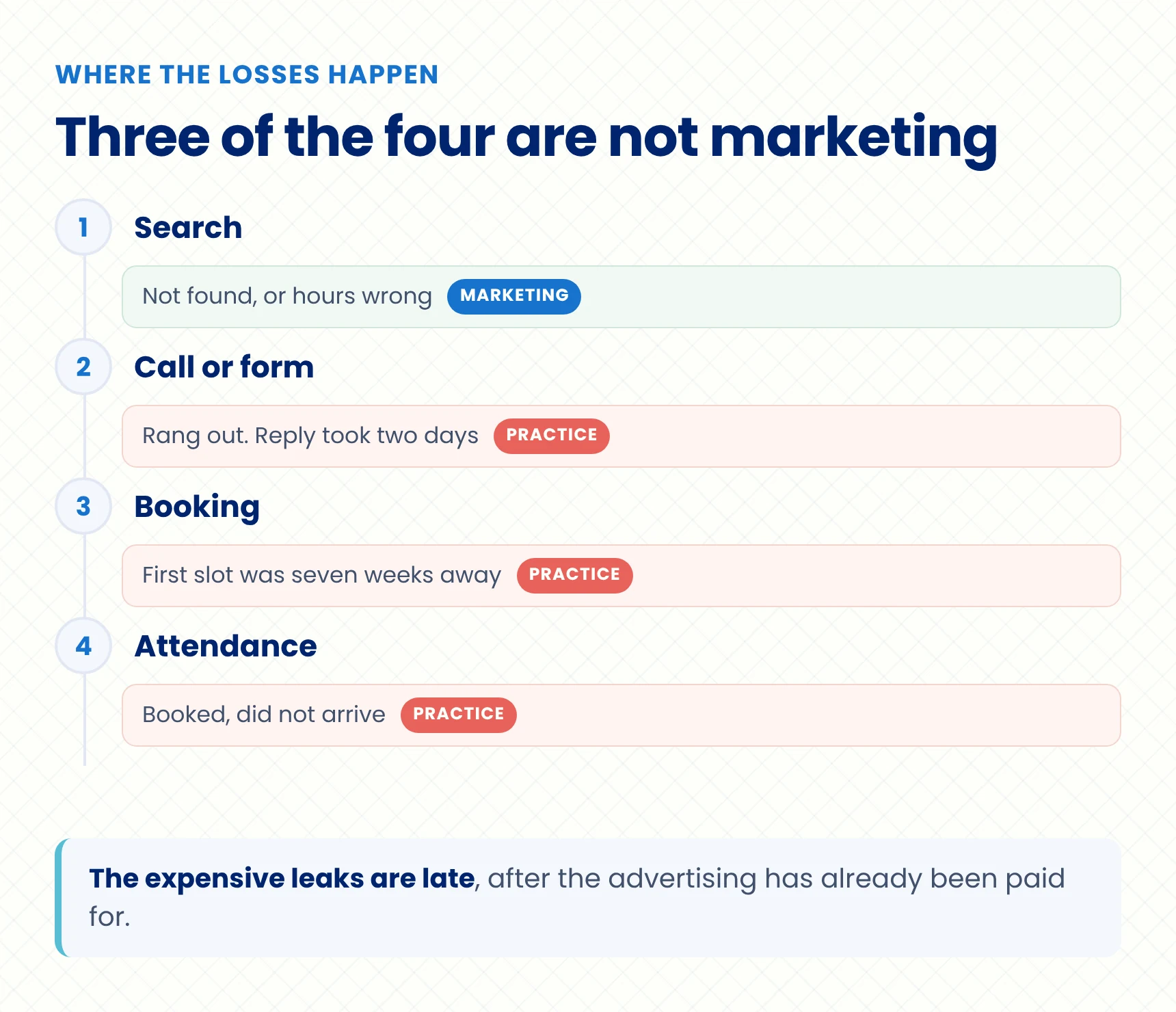
Not where marketers assume. Every healthcare marketing funnel leaks somewhere, and the expensive leaks are late in the journey, after the advertising has already done its job and been paid for.
The call that rang out
The single biggest loss in most practices, and the easiest to fix. A patient who was ready to book, who you paid to reach, who rang during opening hours and got voicemail. They do not leave a message. They ring the next practice on the list.
Measure it before you argue about it. Most phone systems will report how many calls went unanswered during opening hours last month, and the number is almost always higher than the front desk believes it is.
The appointment that was too far away
Ready to book, offered a slot in seven weeks, decides to think about it. For urgent needs this is fatal. For elective work it is survivable but only if somebody follows up, which usually nobody does.
If you cannot shorten the wait, shorten the silence. A short message a week before the appointment, confirming the patient still wants the slot, recovers people who would otherwise quietly drift to somebody with earlier availability.
The enquiry nobody answered
Web forms and messages that sit for two days. By then the patient has booked elsewhere. Speed of response predicts booking rate better than almost anything in the marketing itself.
Set a rule rather than an aspiration. Every enquiry answered within one working hour, with a named person responsible each day, moves this further than any software you could buy for it.
The booking that never attended
The last stage, and a real one. One twelve year review at a United States veterans medical centre found a mean no-show rate of 18.8 percent across ten clinics, ranging from 12.6 percent in audiology to 25.7 percent in gastroenterology, and noted that published rates across the wider literature run anywhere from 3 percent to 80 percent.
Treat that range as the lesson rather than the numbers. A veterans population is not a private practice, and a spread that wide means no published benchmark can tell you whether your own rate is good or poor.
What does help is knowing your own figure and what moves it. Reminders close to the appointment, an easy way to reschedule rather than cancel, and a quick call to anyone who has missed twice will shift it further than any change to your advertising.
Count the gaps in order as well. Enquiries to bookings first, then bookings to attendance. Practices regularly find the second gap is the larger one, and that nobody had ever looked at it.
Which stages to count, and how to connect them back to your schedule, is covered in our guide to measuring each stage.
Notice how many of these are practice problems rather than marketing problems. That is the usual finding, and it is good news, because fixing a phone rota costs nothing compared with buying more traffic.
What belongs at each stage
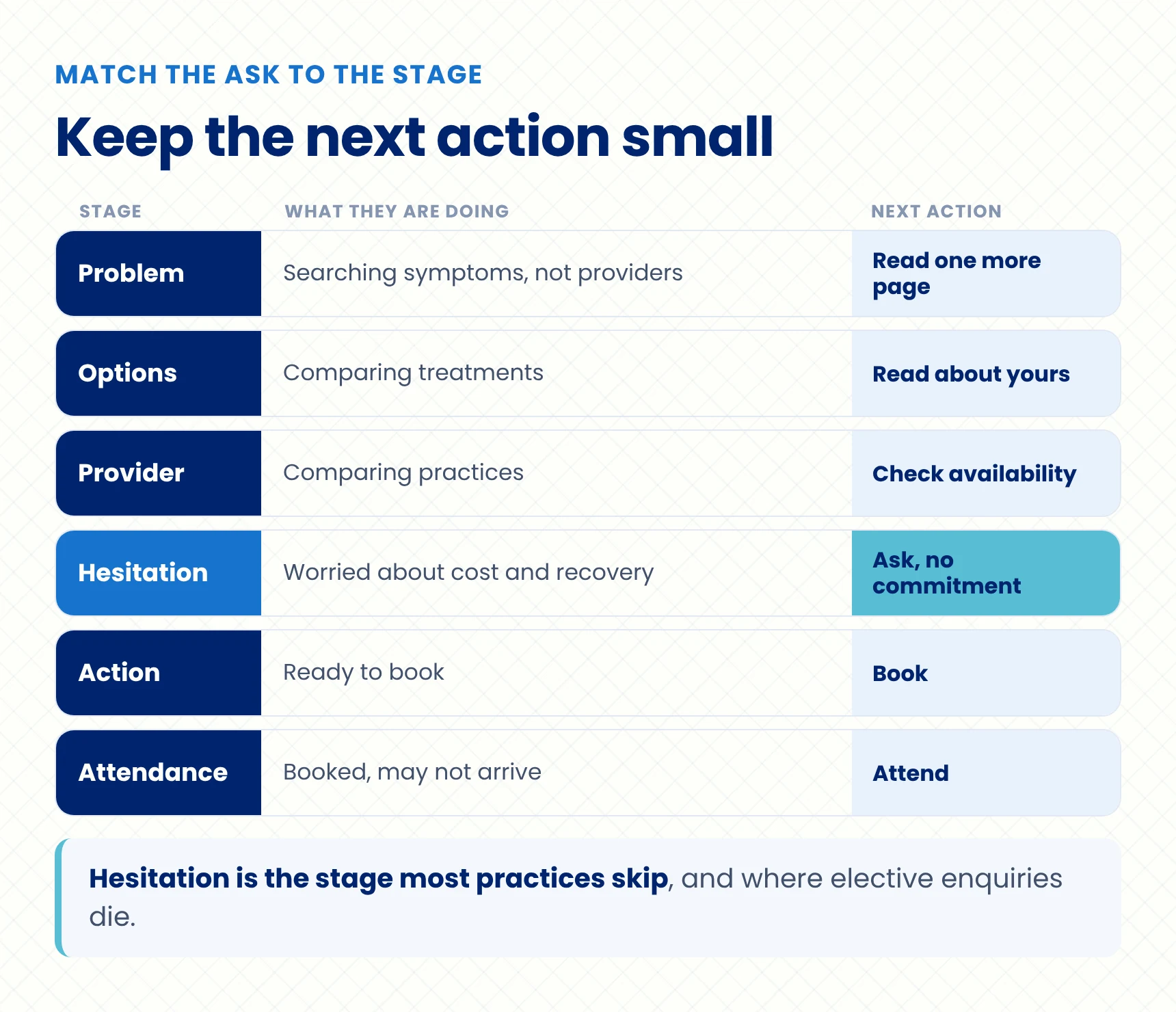
Match the content and the channel to what the patient is doing, and keep the next action small. Asking someone researching a condition to book surgery is the commonest mistake in healthcare content.
| Stage | What the patient is doing | What you provide | Realistic next action |
|---|---|---|---|
| Problem | Searching symptoms, not providers | Plain answers about the condition | Read one more page |
| Options | Comparing treatments | What each involves, who it suits | Read about the treatment you offer |
| Provider | Comparing practices | Team, reviews, location, insurance accepted | Check availability |
| Hesitation | Worrying about cost and recovery | Price guidance, recovery timelines, risks | Ask a question, no commitment |
| Action | Ready to book | Short booking path, answered phone | Book |
| Attendance | Booked, may not arrive | Reminders, directions, what to bring | Attend |
The hesitation stage is the one most practices skip, and it is where elective enquiries die. If your website never mentions cost, patients assume the worst and quietly leave.
Price is the hardest of those to publish, and the usual objection is that it depends. Say that, then give a range and explain what moves it. A range with an explanation beats silence, because silence gets read as expensive.
Channels matter less than consistency. A patient who reads one thing on your website, hears another on the phone and sees a third on your Google listing will trust none of them. Keeping those aligned is the job covered in omnichannel marketing.
What replaces retargeting when the rules restrict it
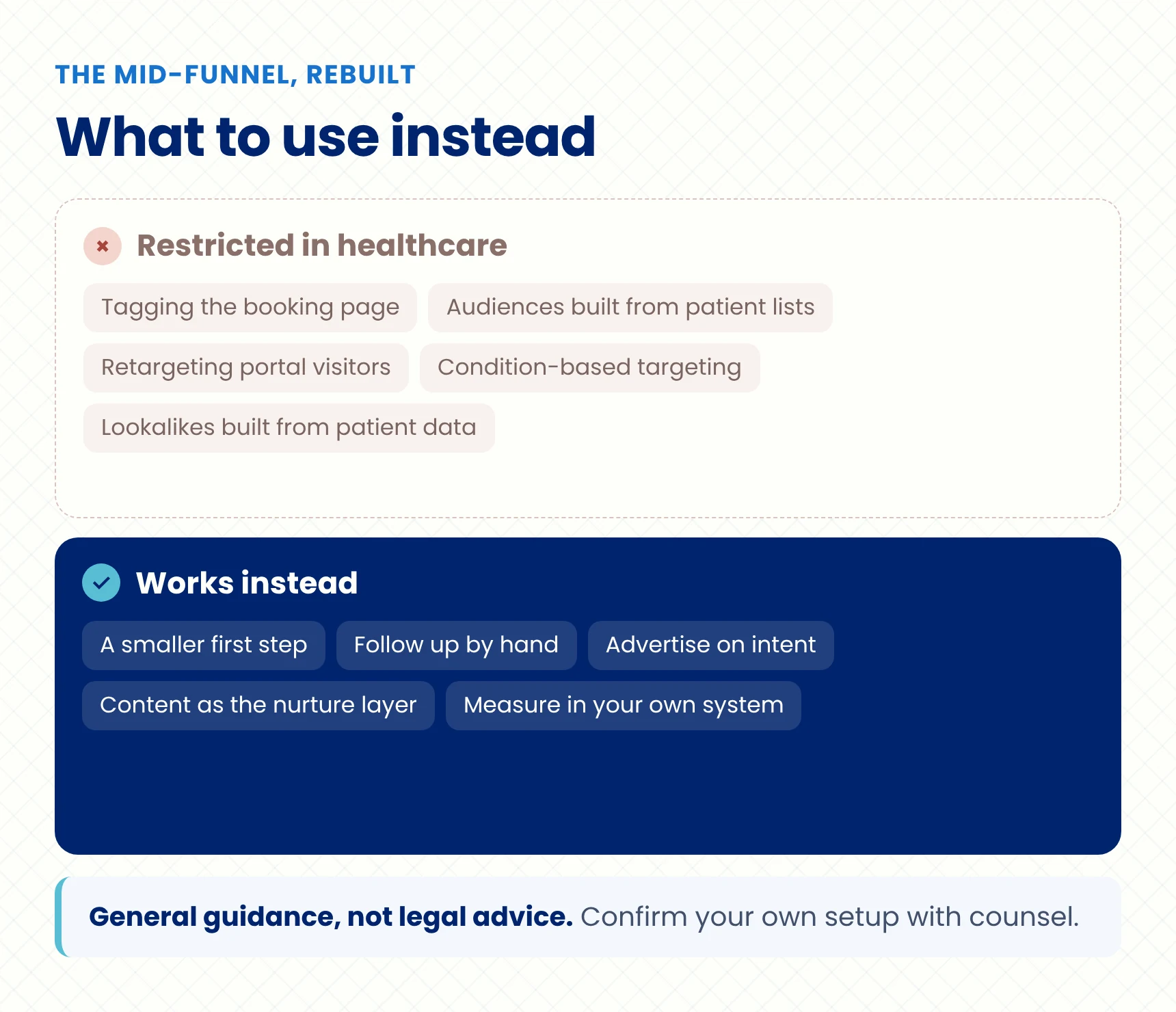
Standard funnel advice says to retarget everyone who visited and did not convert. In healthcare that advice is partly unavailable, and the gap it leaves is real.
Start by being clear about what is actually restricted, because the usual advice swings between ignoring the rules entirely and assuming no measurement is allowed at all. Neither is right.
The federal guidance on online tracking technologies used by covered entities treats appointment scheduling pages as an area where patient information is involved, which is exactly where you would place a conversion tag. A court decision in June 2024 narrowed part of that guidance around ordinary information pages, but the booking and portal pages were left untouched. This is general guidance rather than legal advice, and your own setup is worth checking with counsel.
So the mid-funnel has to be rebuilt without the usual tool. Four things work in its place.
- Make the first step smaller. If you cannot chase people later, capture intent earlier. A question form, a cost guide request or a callback option converts people who are not ready to book, and gives you permission to follow up.
- Follow up by hand, properly. Elective enquiries that go quiet are usually never contacted again. A two-call, two-message sequence over ten days recovers more than any pixel would have.
- Advertise on intent rather than on audience. Search advertising reaches people at the moment of need without needing to know anything about them beforehand.
- Use content as the nurture layer. Someone who is not ready will come back if there is something worth coming back for, and that costs you nothing per visit.
Some of this is getting easier to do well as tooling improves, and our guide to how AI is changing healthcare marketing covers what is genuinely useful there rather than what is being sold.
Referrals bypass the funnel entirely
For many practices, particularly specialist ones, the largest source of new patients never touches the marketing funnel at all. A doctor refers, the patient arrives, and no amount of funnel analysis explains it.
This matters for two reasons. Your funnel maths will not add up if a third of your patients entered through a side door, and your marketing will look worse than it is. Count referrals separately from the start.
Referral relationships also need their own work, which is a different discipline from patient marketing. It is closer to B2B healthcare marketing best practices than to anything in this article: identify the referrers who matter, make referring easy, and close the loop by telling them what happened to their patient.
Be careful with one number here. You will see claims about what share of new patients come from referrals, and they vary so wildly by specialty that no general figure is meaningful. Count your own.
How to build your healthcare marketing funnel
In this order. Each step is cheap and tells you whether the next one is worth doing.
Step four is the one people skip because it is unglamorous. It is also the one that pays.
Software can help once the process exists, and not before. A healthcare CRM is worth it when decision cycles are long enough that follow-up has to be organised rather than remembered. What else fits where is covered in our guide to marketing software for practices.
Common funnel mistakes in healthcare
Most healthcare marketing funnel problems are not subtle. These seven account for the bulk of wasted spend we see.
- One funnel for every service. Running awareness campaigns for urgent care and expecting same-week bookings from elective content. Both waste money in opposite directions.
- Asking for too much, too early. A booking button on a symptoms page converts nobody and makes the page feel like a sales pitch.
- Treating the phone as outside marketing. It is the conversion point for most practices, so it is the single most important part of the funnel.
- Counting leads instead of patients. Enquiries look healthy right up until you compare them with the schedule.
- Buying volume to fix conversion. If half your callers never book, doubling calls doubles the cost of the same problem.
- Ignoring existing patients. Patient lead generation gets the budget while the recall list sits untouched, even though the recall list is cheaper.
- Grouping all patients together. Healthcare market segmentation sounds academic until you notice that two services in the same practice need opposite marketing.
Running a specific push for one service is a different exercise again, with its own timing and measurement, which we cover in healthcare marketing campaigns.
Where The Healthcare Marketing fits
We work only with healthcare organisations, so the first thing we do is usually map which of the three funnels actually produces your revenue. It is often not the one receiving the budget.
That mapping takes an afternoon and usually changes the conversation. A practice convinced it has a traffic problem often turns out to have a Tuesday afternoon problem, or a seven week wait problem, and both are cheaper to solve than a campaign.
From there the work is unglamorous and effective: close the leaks, build the missing stage, then increase volume once the funnel holds. If you are weighing whether to hire help at all, our questions to ask a marketing agency are worth reading first, including the ones we would rather you asked us.
We also review funnels somebody else built, including ones we had no hand in.
If the honest answer is that your marketing is working and the problem is operational, we will say that. It is a shorter conversation and it costs you less.
Our healthcare marketing services cover the whole path: local search, advertising, website and booking, call tracking, recall and the reporting that connects them to your schedule.
Frequently asked questions
What is a healthcare marketing funnel?
It is the path from someone noticing a health problem to attending an appointment with you. In healthcare it takes three different shapes depending on whether the care is urgent, elective or ongoing.
How long does a healthcare marketing funnel take?
Urgent care takes hours. Elective treatment often takes months and sometimes years. Ongoing care has no end point, because the goal is the next appointment rather than the first one.
Does a small practice need a marketing funnel?
You already have one, whether or not it is written down. Writing it down just shows you where patients are falling out, which is usually the phone rather than the website.
Where do most patients drop out of a healthcare funnel?
Between being ready to book and actually booking. Unanswered calls, slow replies to enquiries and appointments offered too far ahead account for most of the loss in most practices.
Do referrals count as part of the marketing funnel?
Count them separately. Referred patients skip the funnel entirely, and mixing them in makes your marketing look either better or worse than it really is.
Can I retarget patients who visited my website?
Only carefully, and not from booking or portal pages, where the guidance treats the information as protected. Most practices are better served by capturing enquiries earlier and following up directly.
What content works best in the middle of a healthcare funnel?
Anything that reduces fear rather than adding clinical detail. Cost guidance, recovery timelines and what the first appointment involves move more people than another explainer.
How do I know which funnel stage is failing?
Count enquiries, bookings and attendances for one month and compare the drop between each pair. The biggest gap is your weakest stage, and it is rarely the first one.
Is the marketing funnel different for urgent care?
Very. Urgent patients enter at the bottom with no awareness stage, so being findable and answering the phone is almost the entire funnel.
What is a good conversion rate at each funnel stage?
There is no trustworthy published figure, because rates vary enormously by specialty and setting. Measure your own for ninety days and improve on that instead.
Where to start if you only do one thing
Ring your own practice tomorrow morning at nine, and again at lunchtime, from a number nobody recognises. Count the rings. See what the voicemail says, if you reach one.
For most practices that single test reveals more about the funnel than any analytics report, and it costs nothing to run. The stage that loses the most patients is almost never the one the marketing conversation is about.