
If you sell to healthcare rather than to patients, almost none of the usual marketing advice applies to you. You are not trying to get a phone to ring. You are trying to get a device onto a formulary, a software platform through an IT security review, a supply contract onto a group purchasing agreement, or a service in front of a department head who has eleven other priorities this quarter.
This guide is for the companies on that side of the table: medical device and diagnostics manufacturers, pharmaceutical and biotech, healthcare SaaS and health tech, medical supplies and distribution, healthcare staffing, revenue cycle and billing vendors, and consultancies serving providers. Your buyer is a committee, not a person. Your sales cycle is measured in quarters. Your total market might be four hundred accounts.
Everything below assumes that reality.
The short version
- 1Your buyer is a group. Plan for clinical, financial, IT, legal and procurement reviewers, each with a different question.
- 2Most of your category has almost no search volume. Target the problem your product solves, not the product name.
- 3Clinical buyers want evidence and workflow fit before they want features.
- 4Procurement and group purchasing contracts decide whether the deal is even possible. Find that out early.
- 5Sales cycles of nine to eighteen months break normal attribution. Measure pipeline influence, not last click.
- 6Legal and compliance review will slow your content. Build the review step into the calendar instead of fighting it.
- 7Trade shows generate lists, not pipeline. The follow up system is where the money is.
What is B2B healthcare marketing?
B2B healthcare marketing is how companies sell products and services to healthcare organizations instead of to patients. The buyers are hospitals, health systems, clinics, physician groups, dental practices, labs, pharmacies, payers and the government bodies that fund them. The products range from surgical implants and imaging equipment to scheduling software, staffing contracts, billing services and bulk consumables.
The thing that makes it its own discipline is the approval chain. In most industries a single budget holder can say yes. In healthcare, a purchase touches clinical safety, patient outcomes, reimbursement, data privacy, system integration and contract compliance. Each of those has a gatekeeper who can say no on their own.
How is it different from patient marketing?
Patient marketing works on volume and proximity. You want a lot of people near a location to find you and book. The decision is personal, fast and emotional, and you win by being easy to find and easy to trust.
B2B healthcare marketing works on precision and patience. You may only have a few hundred realistic accounts in the whole country. The decision is institutional, slow and evidence driven, and you win by being the vendor that has already answered every objection before the committee meets. Healthcare market segmentation matters far more here, because a 900 bed academic medical center and a 40 bed rural hospital are not the same buyer even when they need the same product.
Who actually makes the buying decision in a hospital or health system?
Nobody, on their own. That is the honest answer, and it is the single thing most vendors get wrong. Marketing gets built around one persona, usually the clinical user, and then the deal dies in a review that persona was never going to attend.
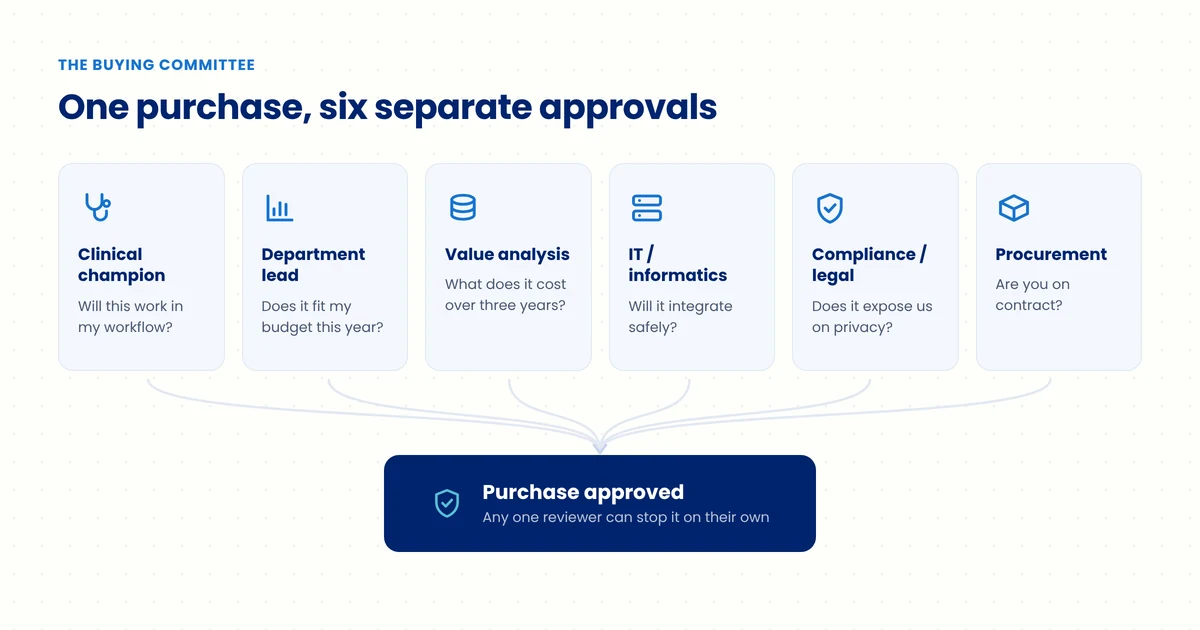
A realistic healthcare purchase involves a clinical champion who wants the product, a department or service line leader who owns the budget line, a finance or value analysis reviewer who checks the cost case, an IT or informatics reviewer if anything touches data or the EHR, a compliance or legal reviewer who checks privacy and contract terms, and a supply chain or procurement lead who checks whether you are on contract at all.
| Reviewer | The question they are really asking | What satisfies them |
|---|---|---|
| Clinical champion | Will this work in my hands, with my patients, in my workflow? | Peer evidence, hands on trial, training plan |
| Service line or department lead | Does this fit my budget and my priorities this year? | Cost case, staffing impact, implementation timeline |
| Value analysis or finance | What does this replace, and what does it actually cost over three years? | Total cost model, comparison against incumbent |
| IT or informatics | Will this integrate, and will it create a security problem? | Integration documentation, security questionnaire, references |
| Compliance or legal | Does this expose us on privacy or contract terms? | Data handling detail, agreement templates, audit history |
| Supply chain or procurement | Are you on contract, and can we buy you without a new process? | Contract status, pricing structure, vendor credentials |
Why is one internal champion never enough?
Because a champion can advance a deal but cannot complete one. Your champion will carry you to the review stage and then face questions they cannot answer, about security architecture, three year cost or contract vehicle. If you have not given them the material for those questions, the deal stalls and nobody tells you why.
The practical fix is to build a document for every reviewer, not just the user. Most vendors have excellent clinical material and nothing for IT or finance. If your champion has to invent the security answer themselves, you have made their job harder than the incumbent’s.
Why is B2B healthcare marketing harder than other B2B marketing?
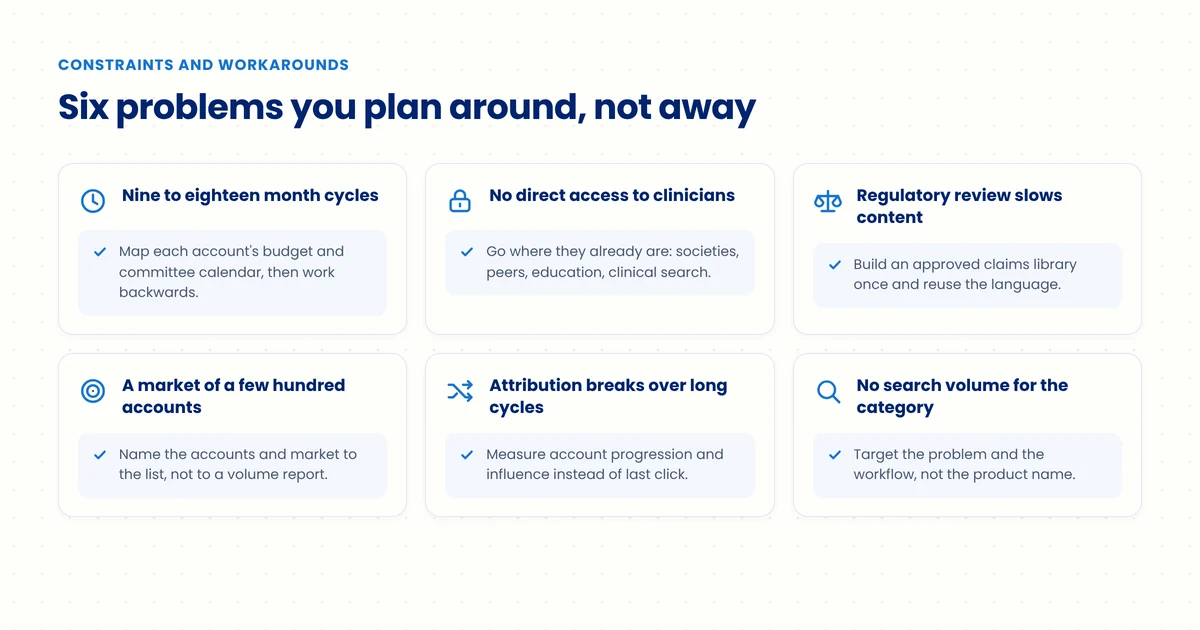
The constraints are real and most of them cannot be removed, only planned around. These are the b2b healthcare marketing challenges that come up in almost every engagement, and what to do about each one.
Why does the sales cycle take so long?
Because the reviews are sequential, not parallel, and each one has its own meeting schedule. A value analysis committee may meet monthly. A security review may sit in a queue for six weeks. Capital purchases may only be approved in a specific budget window once a year.
What to do: map the actual calendar of the accounts you want, including budget cycles and committee schedules, and work backwards. A campaign that lands two months after the capital budget closed is wasted, no matter how good it is. This is also why healthcare marketing lead generation targets that reward speed will push your team toward the wrong accounts.
What do you do when you cannot reach clinical buyers?
Many physicians have no public work email, do not answer vendor calls, and sit behind systems designed specifically to keep vendors out. Cold outreach performs badly and can damage your reputation inside an account.
What to do: go where they already are instead of trying to get through. That means specialty society content, peer reviewed and conference channels, clinician communities, CME adjacent education, and search for the clinical problem they are trying to solve. Your content has to be useful enough that a clinician would read it without being sold to.
Why does compliance and legal review slow everything down?
Because in regulated categories, claims have consequences. Device and pharmaceutical marketing claims are subject to regulatory review, promotional material may need internal medical, legal and regulatory sign off, and anything touching patient data brings privacy obligations into the conversation. If you handle protected health information on behalf of a provider, you are likely acting as a business associate under HIPAA and need the agreement in place before the work starts, not after.
What to do: stop treating review as an obstacle and build it into the production schedule. Agree a claims library with your regulatory team once, so that approved language can be reused without a fresh review for every asset. Write content in two layers, with the clinical claims separated from the surrounding copy, so review only touches what it needs to.
What if your total addressable market is tiny?
Plenty of healthcare vendors have fewer than five hundred realistic buyers worldwide. Volume based tactics make no sense at that scale. You cannot optimize for traffic when your entire market would not fill a stadium.
What to do: name the accounts. Build a target list, find the five to eight people inside each account who matter, and run marketing against that list rather than against a keyword volume report. At this scale, one named account moving from unaware to evaluating is a better result than ten thousand sessions.
How do you attribute a deal that took fourteen months?
You cannot, not in the way a last click report wants you to. The first touch may be a conference badge scan, the middle may be six months of silence while an internal business case gets written, and the final touch may be a direct visit from somebody who was never in your CRM.
What to do: switch from attribution to influence. Track which accounts engaged, how many people inside each account engaged, and which content appeared in deals that closed. A simple account level view beats a sophisticated attribution model that is lying to you.
Why are sales and marketing so often misaligned here?
Because they are measured on different clocks. Marketing is usually judged quarterly. A healthcare rep is working deals that will close next year. So marketing produces volume to hit its number, sales calls the leads unqualified, and both are right.
What to do: agree on a shared definition of a qualified account rather than a qualified lead, and judge marketing on account progression. If your healthcare CRM cannot show account level engagement across multiple contacts, that is the first thing to fix, because the reporting gap is what causes the argument.
What if nobody searches for your product category?
This is the most common of the b2b healthcare digital marketing problems and the most misdiagnosed. A company sells a specialized perfusion component, searches the exact product name, sees forty monthly searches, and concludes search does not work for them.
What to do: stop targeting the product and target the problem, the workflow and the decision. Nobody searches your brand name, but people do search how to reduce a specific complication rate, what a certain integration costs, how to compare two approaches, or what a regulation means for their department. That is where the demand lives. The same logic applies whether you are working on pharmaceutical SEO or selling capital equipment: the searchable intent sits one step before the purchase.
Are trade shows still worth it?
Yes, but not for the reason most companies budget for them. A show gives you compressed access to people you cannot otherwise reach. It does not give you pipeline. The list you come home with is raw, mostly unqualified, and decays fast.
What to do: treat the event as the beginning of a sequence, not an outcome. Decide before you go which accounts you are trying to meet, book meetings in advance rather than hoping for booth traffic, and have the follow up built and scheduled before the first day. Most of the value of a show is created in the three weeks after it.
What B2B healthcare marketing strategies actually work?
These are the b2b healthcare marketing strategies that hold up against long cycles and committee buying. None of them are fast, which is the point.
Build marketing around named accounts, not keyword volume
Pick the accounts that can actually buy, then work out who inside each one has to agree. Run content, ads, outreach and events against that map. This is more work upfront and far less wasteful afterwards, and it is the only approach that makes sense when your market is small and your deal sizes are large.
Start with the segmentation you already have. Health system versus independent practice, academic versus community, integrated delivery network versus single site: these groups buy through different processes and respond to different proof. Treating them as one audience is the fastest way to produce content that convinces nobody. If you do not have that picture internally, healthcare market research companies can supply the account and segment data, but the committee mapping still has to be done by someone who knows your product.
Target the problem, not the product
Your searchable demand sits upstream of your product. If you sell sterilization equipment, your buyers are searching about turnaround times, compliance failures and staffing constraints. Write for that, then connect it to what you sell. This is the mechanism that makes search work in categories with no obvious volume, and it builds the topical depth that gets you cited when buyers use AI assistants to shortlist vendors.
The broader principle is the same one behind effective marketing strategies for healthcare organizations, applied to an institutional buyer rather than a patient. You earn the right to the commercial conversation by being useful before it.
Produce proof, not promises
Healthcare buyers discount marketing claims by default, and they are right to. What moves a committee is evidence: clinical data, published outcomes, implementation case detail with real timelines, reference customers who will take a call, and honest total cost comparison against what they use today.
Produce the unglamorous documents too. A security and integration overview, a three year cost model, an implementation plan, a training outline. These never win awards and they close deals, because they are what your champion needs when they are not in the room with you.
Use LinkedIn for reach into named accounts, not for volume
LinkedIn is the one channel where you can reliably reach administrators, procurement leads, informatics staff and executives by title and employer. Use it narrowly: target your account list, accept that your audience sizes will look alarmingly small, and judge it on whether the right accounts engaged rather than on cost per lead.
Build nurture that survives a twelve month silence
A contact who downloaded something in March and goes quiet until November has not gone cold. They are writing a business case. Most vendors give up on them in week six.
Your email and content program needs to stay useful across that gap without asking for a meeting every time. Think in terms of a healthcare marketing funnel that is measured in quarters, where the job of month four is to still be relevant in month eleven. Omnichannel marketing in healthcare works here, as long as the channels are coordinated around the same account rather than competing for the same click.
Make your website survive a procurement review
At some point somebody in security, legal or supply chain will open your site and look for specific things: who you are, where you are, who you already serve, how you handle data, what your contract terms look like, and whether you look like a company that will still exist in three years. A site built purely for lead capture fails that inspection.
Publish the credibility layer. Real company detail, named leadership, certifications and compliance posture, documentation, and a clear description of what happens after someone signs.
Free audit
Want to know why your pipeline stalls after the first meeting?
We will review your site, search visibility, content and the material your champions have to work with, then tell you which reviewer in the buying committee you are currently failing. No charge, no obligation.
What is changing in how healthcare buyers buy?
Rather than a list of annual predictions, here is what has actually shifted in buyer behaviour, and what each shift means for you. These are the b2b healthcare marketing trends that change how you plan rather than how you phrase things. Note that most published healthcare digital marketing trends are written about patient acquisition, so filter them before acting on any of them.
Buyers want to get most of the way there without talking to you
Self directed research is now the default, not the exception. In a Gartner survey of 646 B2B buyers conducted in August and September 2025, 67 percent said they prefer a rep free experience, and 45 percent reported using AI during a recent purchase.
What this means for you: the information a rep used to deliver in a meeting has to exist publicly, in a form a reviewer can read alone. If your pricing structure, integration requirements and implementation timeline are only available by booking a call, you are being filtered out before anyone speaks to you.
AI assistants are now part of the shortlist step
Buyers are using AI tools to summarize categories, compare vendors and draft internal recommendations. Those tools cite sources that answer specific questions clearly and directly. Vague positioning content does not get cited, and a vendor that is absent from the research step never makes the shortlist.
What this means for you: write content that answers one specific question per section, in plain language, with the answer in the first two sentences. This is a formatting discipline as much as a content one.
Integration and data questions arrive earlier than they used to
IT and informatics reviewers are being pulled into conversations at the evaluation stage rather than at contracting. A product that cannot describe how it fits the existing stack gets deprioritized before the clinical conversation even happens.
What this means for you: your integration story is now top of funnel material, not a late stage document.
Procurement gets involved sooner
Cost pressure has pushed supply chain and value analysis earlier into the process. Being clinically preferred is no longer enough on its own if the commercial route is unclear.
What this means for you: contract status and pricing clarity need to be part of your early conversation, not something you reveal at the end.
How do you get past procurement and group purchasing contracts?
This is the step that kills deals that were otherwise won. A clinician wants your product, the department has budget, and then it turns out you are not on the contract the hospital buys through, and the purchase becomes a months long exception process that nobody wants to sponsor.
The scale of this is easy to underestimate. The Government Accountability Office, in its report on group purchasing organizations, cited industry estimates that roughly 96 to 98 percent of US hospitals purchase through GPO contracts, and that hospitals use an average of two to four GPOs per facility.
What that means in practice is that your commercial route matters as much as your product. Before you invest in demand generation against an account, find out which group purchasing organizations it buys through, whether your category is covered by an existing agreement, who the incumbent on that agreement is, and what the exception process looks like if you are not on contract.
One caveat if you also sell direct. Ecommerce marketing for health products runs on completely different mechanics, with short decisions, price comparison and repeat ordering. If you have both motions, keep them separate, because bolting a consumer style storefront strategy onto an enterprise sales process usually weakens both.
For consumables and equipment sold at volume, the contract question decides whether marketing can convert at all. That is a large part of why medical supplies seo has to be built around buyer, distributor and tender search behaviour rather than around consumer style product pages.
What do clinical buyers actually care about?
Less about features than most vendors assume. Ease of use comes first, measurable patient outcomes second, and whether the thing fits the existing workflow and record system third. Cost sits over all of it as an organizational constraint rather than a clinical preference.
That ordering is worth sitting with, because it is almost the inverse of how most vendor material is written. A product page that opens with technical specification is answering the question that comes fourth, to a reader who has already decided whether to keep reading based on the first three.
The research supports that ranking. In a 2025 study of 508 physicians across nine countries, ease of use ranked as the top factor in device decisions, 70 percent rated measurable patient outcomes as important or very important, more than half said integration with the electronic health record mattered, and cost was reported as the most influential organizational factor in every market surveyed.
The practical translation is to lead with workflow. Show the product being used in a realistic setting, be specific about training time, be honest about what it replaces, and make the outcome evidence easy to find rather than buried in a gated whitepaper.
What are the best practices for B2B healthcare marketing?
These are the b2b healthcare marketing best practices that separate programs that compound from programs that churn. Use this as a review checklist on what you already have.
Program checklist
- You have a named target account list, not just a persona document.
- You know the five to eight roles inside each account that have to agree.
- You have material written for finance, IT and procurement, not only for the clinical user.
- Your content targets the problem and the workflow, not the product name.
- Every claim you publish can be traced to evidence your regulatory team has approved.
- You know each target account’s budget cycle and committee calendar.
- You know which group purchasing agreements your key accounts buy through.
- Your nurture program stays useful across a twelve month silence.
- You measure account progression, not just lead volume.
- Your website answers what a security or legal reviewer would look for.
- Sales and marketing share one written definition of a qualified account.
- Your event spend has a follow up sequence built before the event.
How do you measure B2B healthcare marketing when the sales cycle is a year?
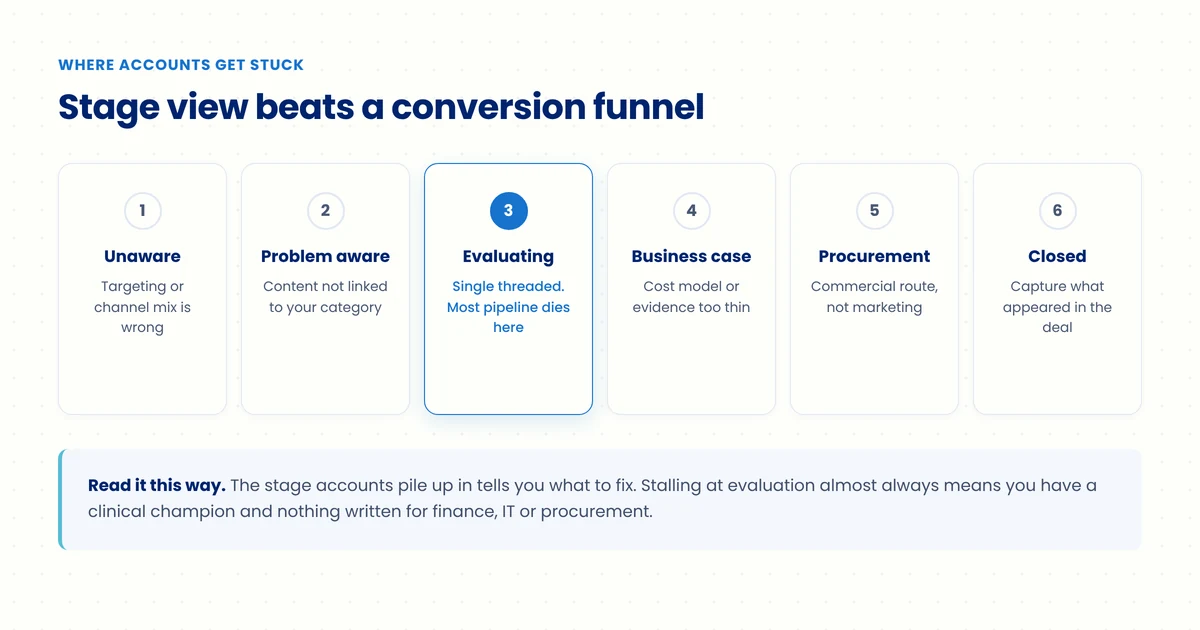
You stop asking which touch caused the deal and start asking whether accounts are moving. The stage view below is more useful than a conversion funnel, because it tells you where deals are getting stuck rather than how many fell out.
Where accounts get stuck, and what it tells you
Three numbers tell you most of what you need. How many target accounts have more than one engaged contact, how long accounts spend in each stage compared with last year, and which content appears in deals that closed. Everything else is reporting decoration.
Avoid judging this work on monthly lead counts. In a category where the cycle is a year, a monthly lead target will push your team toward whoever responds fastest, which in healthcare is rarely whoever can actually buy.
How much should you budget for B2B healthcare marketing?
There is no credible benchmark percentage for this, and anyone who quotes you one is guessing. Deal sizes, cycle lengths, market size and regulatory burden vary too much between a staffing agency and an implant manufacturer for a shared number to mean anything.
A more useful way to size it is to work from your market rather than from a percentage. Count your realistic target accounts. Estimate the revenue of winning one. Decide how many you need in the next two years. That tells you what a reasonable cost per account influenced looks like, and from there you can judge whether a given program is worth running.
Be careful with category level forecasts when you build the case internally. Healthcare market growth figures are often used to justify budget, but growth in a category only helps you if it is happening inside accounts whose contract structure allows them to buy from you. Growth you cannot access is not an opportunity.
Two things reliably waste money in this category. Spending on reach into accounts that cannot buy you because of contract structure, and spending on top of funnel volume before the material your buying committee needs actually exists. Fix the second before you scale the first.
What does a sensible first 90 days look like?
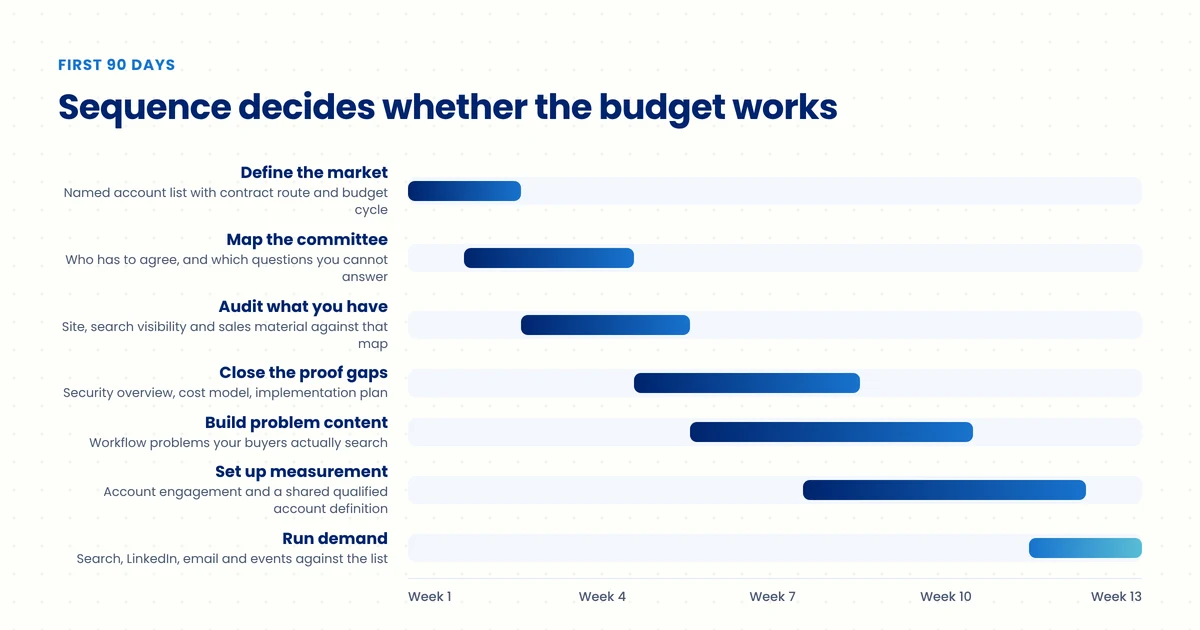
If you are starting or restarting this work, sequence matters more than effort. Doing these in the wrong order is how companies spend a year producing content that cannot convert.
First 90 days
Companies in earlier stages often want to skip to the last step, and healthcare startup marketing fails most often for exactly that reason. The demand generation is not the hard part. Knowing who can buy you and having the material that gets them through their own internal process is the hard part.
Where The Healthcare Marketing fits
The Healthcare Marketing is a digital marketing, website development and app development agency that works exclusively with healthcare and healthcare adjacent businesses. That focus is the relevant part here: the committee structure, the procurement constraints, the regulatory review step and the long cycle are the conditions we work in by default rather than things we have to learn on your account.
We offer a free marketing audit and review. For a B2B healthcare company that usually means looking at your search visibility against problem level demand rather than product keywords, the material your internal champions currently have to work with, whether your site survives a procurement or security review, and where accounts are stalling in your pipeline. If the answer is that your marketing is fine and your commercial route is the problem, we will tell you that too.
Talk to a specialist
Not sure whether your problem is marketing or market access?
Bring us the accounts you are trying to win and the deals that stalled. We will tell you which of the two is actually blocking you, and what we would do in the first 90 days.
Frequently asked questions
What does B2B healthcare marketing mean?
It means marketing products and services to healthcare organizations rather than to patients. The buyers are hospitals, health systems, clinics, practices, labs and payers, and the decision is usually made by a committee that includes clinical, financial, IT, legal and procurement reviewers.
How long is a typical B2B healthcare sales cycle?
It varies enormously by product, but anything involving capital spend, clinical adoption or data integration commonly runs nine to eighteen months and sometimes longer. The length is driven by sequential reviews and fixed committee and budget calendars rather than by buyer hesitation.
Why is my healthcare product getting no search traffic?
Usually because you are targeting the product category, which almost nobody searches, instead of the problem your product solves, which people search constantly. Shift your content to the workflow problems, cost questions and comparison decisions that sit one step before the purchase.
Does SEO work for companies selling to hospitals?
Yes, but not as a volume channel. It works as a credibility and research channel, because reviewers inside an account search for answers independently and quietly. You are optimizing to be found and cited during an internal evaluation, not to generate a high number of enquiries.
How do you market to doctors who will not take vendor calls?
You stop interrupting and start being present where they already look. Specialty society content, peer channels, conference and education formats, clinician communities and search for clinical problems all reach physicians who ignore outbound entirely.
What are the biggest B2B healthcare marketing challenges?
Long committee driven cycles, no direct access to clinical buyers, regulatory review slowing content production, very small total addressable markets, broken attribution over long cycles, and group purchasing contracts that decide whether a deal is even commercially possible.
Should we be running LinkedIn ads or Google Ads for healthcare B2B?
Usually both, for different jobs. LinkedIn reaches named roles inside named accounts, which search cannot do, while search captures the problem level research that happens during an evaluation. In regulated categories, check platform healthcare policy before you build the campaign.
How do we prove marketing ROI when deals take over a year?
Measure account progression instead of attribution. Track how many target accounts have multiple engaged contacts, how long accounts spend in each stage, and which content shows up in deals that closed. Last click reporting will misread almost every healthcare deal.
Do we need to be on a GPO contract before marketing to hospitals?
Not before you market, but you need to know your contract position before you spend heavily on an account. Marketing into a hospital where your category is locked to an incumbent agreement can create clinical demand that procurement then refuses to act on.
Is content marketing worth it for a small healthcare vendor?
Yes, if it is aimed correctly. With a small market you are not producing content for traffic, you are producing the specific documents and answers that let a handful of accounts move through their own internal approval process. Ten useful pages often outperform a hundred generic ones.
Where to start if you only do one thing
Map the buying committee for your three best accounts and write down, honestly, which of their questions you currently cannot answer with existing material. Almost every B2B healthcare marketing program has a clinical story and a hole where finance, IT or procurement should be. That hole is why deals stall after a good first meeting, and it is usually cheaper to fix than another quarter of demand generation.
Do that before you commission more content, and the content you commission afterwards will be aimed at something real.