
Most lists of healthcare marketing trends tell you what is new. Very few tell you what to do about it, what it costs, or which of it you can safely ignore. That gap is why practices end up buying whatever was pitched to them last, rather than whatever would actually move bookings.
This guide takes the opposite approach. Each trend gets a clear verdict: act now, watch, or ignore. Each one comes with what acting on it actually costs in time, money and effort, and how long before it shows anything. There is also a section on the trends that are not worth a small or mid-sized practice’s money next year, which is the part most trend articles leave out.
It is written for practice owners, practice managers and marketing leads planning 2027 with a budget that probably has not grown.
The short version
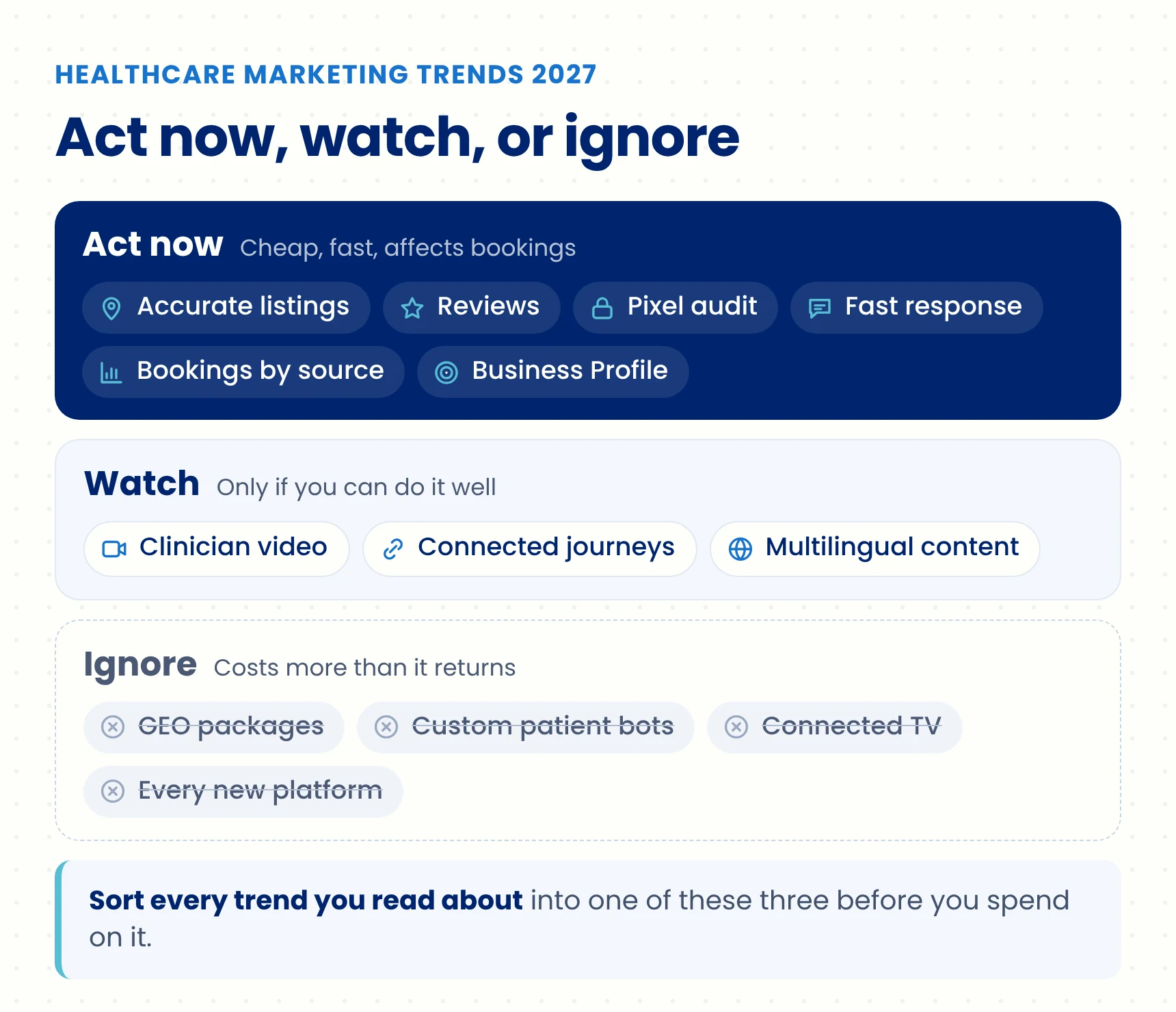
- 1Act now: patients are finding you through AI answers, maps and reviews, not only through search results. Make sure what they find is accurate.
- 2Act now: your Google Business Profile does more work than your homepage for most local searches. Treat it that way.
- 3Act now: tracking pixels on booking, symptom checker and portal pages are a privacy liability. Audit them.
- 4Act now: the practice that replies first usually gets the booking. Fix response speed before you buy more traffic.
- 5Act now: measure booked appointments by source, not clicks. Without that, every other decision is a guess.
- 6Watch: clinician-led video, connected patient journeys and multilingual content. Worth doing well or not at all.
- 7Ignore: paid AI search optimization packages, in-house patient chatbots, connected TV for a single location, and chasing every new platform.
How should you judge a healthcare marketing trend?
Ask three questions before you spend anything on it. Does it change where patients find you or how they choose you? What does acting on it actually cost, including staff time? What happens if you wait a year? If the honest answer to the last question is “nothing much,” it is not a priority, however often it appears in lists of healthcare digital marketing trends.
Apply the same three questions to any other roundup of healthcare marketing trends 2027 you read this winter, including this one. A trend that cannot answer them clearly is a sales pitch, not a priority.
Most marketing trends in healthcare fail the first question. They change how marketing is done without changing how patients behave, which makes them interesting to agencies and largely irrelevant to a practice’s bookings. The trends worth acting on are the ones that sit between a patient’s first search and their first appointment, because that is where practices quietly lose people.
It also helps to separate healthcare marketing trends from healthcare market trends. The second is about consolidation, payer mix and industry spending. Those matter to your business, but they are not a reason to change your marketing plan next quarter.
Which healthcare marketing trends should you act on in 2027?
These six affect almost every practice, regardless of specialty or size. None of them require a large budget. Most require attention more than money.
Are patients still finding practices through Google search?
Yes, but not only there, and the share coming through other routes is growing. In a KFF poll published in March 2026, 32 percent of US adults said they had used AI for health information or advice in the past year. In the same poll, 68 percent had used search engines and 80 percent had used doctors, so search is far from finished. It is just no longer the only front door.
What changes in practice is that patients increasingly see a summary before they see your website. An AI answer, a map listing, a review snippet or a short video may be the first thing they read about you. If your practice details, services or clinician information are inconsistent across those places, the summary will be wrong or vague, and the patient moves on without ever reaching your site.
Verdict: act now. What it costs: a few hours to audit how your practice appears across Google, Apple Maps, Bing, the main directories and your own site, then fixing every inconsistency in name, address, phone, hours, services and clinician names. Time to see results: weeks, not months. This is the cheapest fix in the whole guide.
Is your Google Business Profile more important than your website now?
For most local searches, it does more of the work. A patient searching for a dentist, physiotherapist or dermatologist near them often makes a decision from the map listing alone: photos, reviews, hours, whether you take their insurance, and whether they can book. Many never click through to the website at all.
Most practices set up their profile once and never touch it again. That means outdated hours, stock photos, unanswered questions, missing services and no posts. Each of those is a small reason for a patient to choose the listing next to yours.
Verdict: act now. What it costs: one to two hours to bring the profile up to date, then roughly an hour a month to keep it current with posts, new photos, answered questions and review replies. Time to see results: typically within one to three months for calls and direction requests.
Why are tracking pixels on healthcare websites a problem?
Because on some pages they can send patient information to advertising platforms, and most practices do not know which pages that is. Tracking code from ad and analytics platforms was often added years ago by a developer or agency and never reviewed. On a booking page, a symptom checker or a patient portal login, that code may capture details that count as protected health information.
The HHS guidance on online tracking technologies says tracking on authenticated pages such as patient portals generally has access to protected health information, and that unauthenticated pages can also involve it where patients enter identifying details, such as appointment scheduling or symptom checkers. It says a signed business associate agreement is required with any tracking vendor that qualifies as a business associate. Part of that guidance was vacated by a federal court in June 2024, specifically where it treated an IP address on certain public pages as triggering HIPAA, and HHS has said it is evaluating next steps. The parts about portals, scheduling and identifying information still stand, and several states have added their own health data privacy laws on top.
Verdict: act now. What it costs: a technical audit of every tracking script on your site, page by page, usually a day of a developer’s time for a typical practice site. Then removing or reconfiguring anything on booking, intake, symptom or portal pages. Time to see results: this is risk reduction rather than growth, so the result is the problem you avoided.
Does response time really affect how many patients book?
Yes, and it is one of the most under-managed parts of practice marketing. A patient who fills in a form or calls after hours is often contacting more than one practice. The one that responds first, clearly and with a way to book, usually wins. A practice that replies the next afternoon has often already lost them.
Online booking, text replies and secure patient messaging have moved from extras to expectations, particularly for younger patients and for specialties where people compare options. The fix is usually operational rather than technical. New healthcare marketing tools rarely solve it on their own; what solves it is deciding who answers enquiries, how fast, and what happens outside opening hours.
Verdict: act now. What it costs: if you already have online booking, mostly staff process and a clear response standard. If you do not, the cost of a booking or messaging tool plus setup, usually modest compared with a month of ad spend. Time to see results: immediate, because you are converting enquiries you were already getting.
This is also where a lot of wasted spend hides. Practices buy more traffic to fix a booking problem, which is one of the most common problems practices face with marketing, and the extra enquiries leak away at the same point the old ones did.
Why do reviews matter more now?
Because reviews are often the first impression, read before your website and sometimes before your name. Patients look at the number, the recency, the rating and, increasingly, whether the practice replies. A profile with forty reviews, the latest from two years ago, reads as a practice that may not be very active, whatever the reality.
The rules around reviews have also tightened. US federal rules now prohibit fake or purchased reviews, incentives conditioned on positive sentiment, and undisclosed reviews from staff or relatives, with financial penalties attached. The only sustainable approach is asking real patients consistently and replying to what they write, including the negative ones, without disclosing anything about their care.
Verdict: act now. What it costs: a simple, consistent request process after appointments, plus a few minutes a week replying. Time to see results: one to three months for recency and volume to shift noticeably.
How should practices measure marketing results now?
By booked appointments by source, not by clicks, impressions or traffic. Those numbers are easy to report and almost useless for decisions. A campaign with fewer clicks that produces more booked new patients is the better campaign, and only appointment-level tracking shows you that.
This trend matters more each year because the easy signals are getting weaker. Privacy changes, AI summaries that answer without a click, and phone calls that start on a map listing all make click-based reporting less complete. Call tracking, booking-source fields and a simple monthly reconciliation against your practice management system give you healthcare marketing metrics you can actually act on.
Verdict: act now. What it costs: call tracking set up correctly, a source field on every booking, and an hour a month to reconcile. Time to see results: the first month of clean data usually changes at least one spending decision.
| Trend | Verdict | What acting costs | Time to results |
|---|---|---|---|
| Accurate details everywhere patients look | Act now | A few hours of auditing and fixes | Weeks |
| Google Business Profile upkeep | Act now | One to two hours, then about an hour a month | One to three months |
| Tracking pixel audit | Act now | About a day of developer time | Risk avoided |
| Faster response and online booking | Act now | Mostly process, sometimes a tool | Immediate |
| Consistent review requests | Act now | A process and a few minutes a week | One to three months |
| Booked appointments by source | Act now | Call tracking and a booking source field | First month |
Which healthcare marketing trends should you watch but not rush?
These are real, but they only pay off when done well, and done badly they cost more than they return. Watch them, and act when you have the right conditions in place.
Is short video worth it for a medical or dental practice?
It can be, if a clinician is willing and able to appear in it regularly. Short, plain explanations from a real clinician about what to expect, how a procedure works or what a common symptom might mean build trust in a way that polished brand video does not. Patients want to see who they will be seeing.
The failure mode is predictable. A practice commissions a batch of videos, posts them for six weeks, and stops. Inconsistent video does very little. If nobody on the clinical team wants to do this, that is a perfectly good reason to skip it.
Verdict: watch, or act if you have a willing clinician. What it costs: an hour or two of clinician time a month, basic recording equipment, and editing. Time to see results: three to six months of consistent posting.
Do small practices need omnichannel marketing?
Not in the form usually sold. Omnichannel marketing in healthcare means a patient’s experience is connected across channels: the email they get after booking knows what they booked, the reminder arrives by their preferred method, and the follow up reflects their visit. It depends on a patient CRM or a practice management system that can hold that information and talk to your other tools.
For a multi-site group or a specialty with long treatment journeys, this can be worth building. For a single-location practice, the honest version is simpler: send reminders reliably, follow up after visits, and make it easy to rebook. That captures most of the value without the platform cost.
Verdict: watch, unless you run multiple sites or long treatment journeys. What it costs: a CRM or integrated platform, setup, and ongoing management. Time to see results: six months or more.
Why does culturally relevant healthcare marketing matter?
Because patients choose practices where they feel understood, and generic marketing often fails the communities a practice actually serves. Culturally relevant healthcare marketing means content, imagery and messages that reflect your real patient base, and in many areas it means offering information in the languages your patients speak.
This is not about adding a translated page as a box-ticking exercise. Machine-translated clinical content can be wrong in ways that matter. If a meaningful share of your patients prefer another language, a small set of well-translated, clinically reviewed pages and a front desk that can respond in that language often outperforms a much larger English-only budget.
Verdict: act now if your patient base needs it, watch otherwise. What it costs: professional translation and clinical review for a small set of key pages, and a staff process for responding. Time to see results: one to three months.
What about AI in healthcare marketing?
AI is changing how marketing work gets done more than how patients choose practices, and the line between helpful and risky matters a lot in healthcare. Our full guide to ai in healthcare marketing covers where it saves time, where it creates risk, and what a sensible policy looks like.
The short version for trend planning: use it for drafts and repetitive work, keep patient information out of general AI tools, and never let it publish clinical claims without review. Verdict: act, carefully.
Which healthcare marketing trends are not worth your money next year?
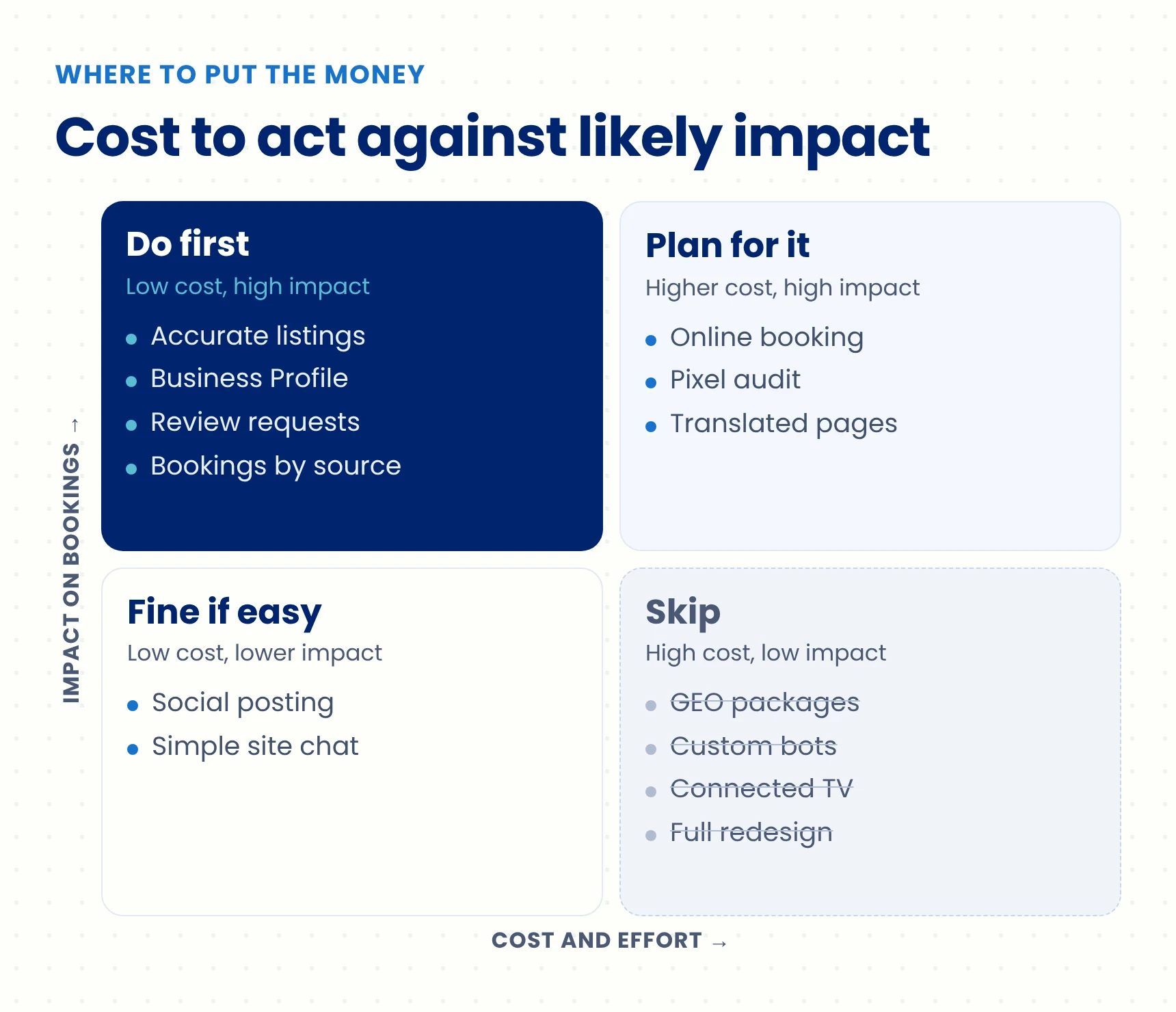
This is the part most trend articles skip, because these are things someone is trying to sell you. For a small or mid-sized practice, each of these is likely to cost more than it returns in 2027.
Should you pay for AI search optimization?
Not as a separate product. Packages sold as AI search optimization, sometimes called GEO or AEO, often promise placement in AI answers through special files, rewritten content or structured markup. Google’s own guidance on optimizing for generative AI features says that optimizing for AI search is still SEO, that you do not need new machine-readable files, AI text files or special markup to appear, and that no third-party tool has access to its ranking or AI systems.
What does work is unglamorous: accurate practice information, useful pages that answer real patient questions clearly, and a site that loads and works properly. If someone is charging you extra for something different, ask exactly what they will do that ordinary good SEO would not.
Verdict: ignore the packages. Put the money into content and accuracy instead.
Should you build your own AI chatbot for patients?
Not next year, for most practices. A chatbot that handles hours, directions and booking links is fine and often built into tools you already have. A custom bot that answers clinical questions brings privacy obligations, clinical risk, testing and ongoing monitoring that a small marketing budget cannot properly support.
Verdict: ignore the custom build. Use simple, non-clinical assistance inside existing tools if you want it.
Is connected TV advertising worth it for a practice?
Rarely, for a single-location practice. Streaming TV ads are increasingly easy to buy, but they are a broad awareness channel. For a practice drawing patients from a few miles away, most of that spend reaches people who will never visit.
Verdict: ignore unless you are a multi-site group with a regional brand and you already have measurement in place.
Should you use influencers to promote clinical services?
It is risky enough that most practices should not. Endorsements need clear disclosure, claims about outcomes are easy to get wrong, and an influencer saying something your clinicians would not say becomes your problem. For non-clinical services or wellness products there can be a case with tight controls, though that is closer to ecommerce marketing for health products than to practice marketing. For clinical treatments, the downside is larger than the upside.
Verdict: ignore for clinical services.
Do you need to be on every new social platform?
No. Being absent from a platform costs you very little. Being present and inactive costs you credibility, because an abandoned profile looks worse than no profile. Choose the one or two channels your patients actually use and do them consistently.
Verdict: ignore new platforms until your existing ones are working.
Should you rebuild your website because it looks dated?
Only if it is actually failing. A redesign is expensive, slow and often resets what was already working in search. If your site loads quickly, works on a phone, lets patients book easily and answers their questions, a refresh of content and photos usually does more than a rebuild.
Verdict: ignore the full rebuild unless the site is broken. Fix booking, speed and content first.
What about B2B healthcare marketing trends?
If you sell to healthcare organizations rather than to patients, the trends that matter are different. Buying committees, procurement and group purchasing contracts, and long sales cycles shape everything, and patient-facing tactics mostly do not apply.
Our hub on b2b healthcare marketing trends covers how those buyers research, what has shifted in how they buy, and where vendors lose deals they should have won.
How should these trends change your 2027 budget?
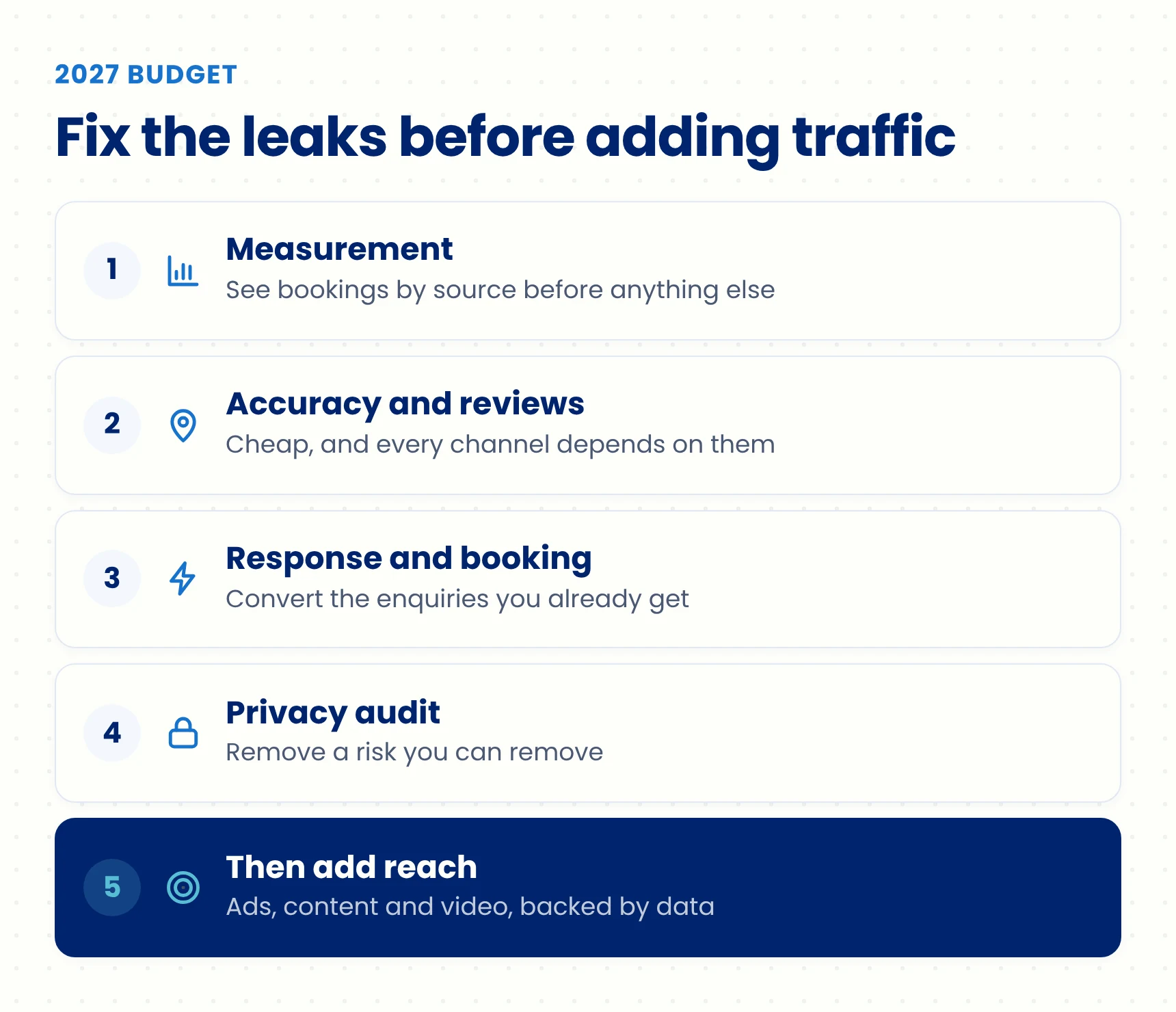
Mostly by changing the order you spend in rather than the total. The pattern that wastes money is buying more visibility before fixing what happens after a patient finds you. The pattern that works is fixing the leaks first, then adding reach.
A sensible order for most practices is: measurement first, because without it you cannot tell what works. Then accuracy and reviews, because they are cheap and affect every channel. Then response speed and booking, because they convert what you already get. Then the privacy audit, because it is a risk you can remove. Only then extra ad spend, content or video.
That sequence also makes healthcare marketing campaigns perform better, because every campaign lands on a profile, website and booking process that converts. It belongs inside your overall digital marketing strategy for healthcare, rather than being a separate list of reactions to whatever was new this year.
For a practice with a flat budget, this usually means moving some money from ads into fixing measurement and conversion for a quarter. That feels like spending less on growth. In practice it usually means each ad dollar after that quarter produces more booked appointments.
What does a 2027 marketing plan look like for a small practice?
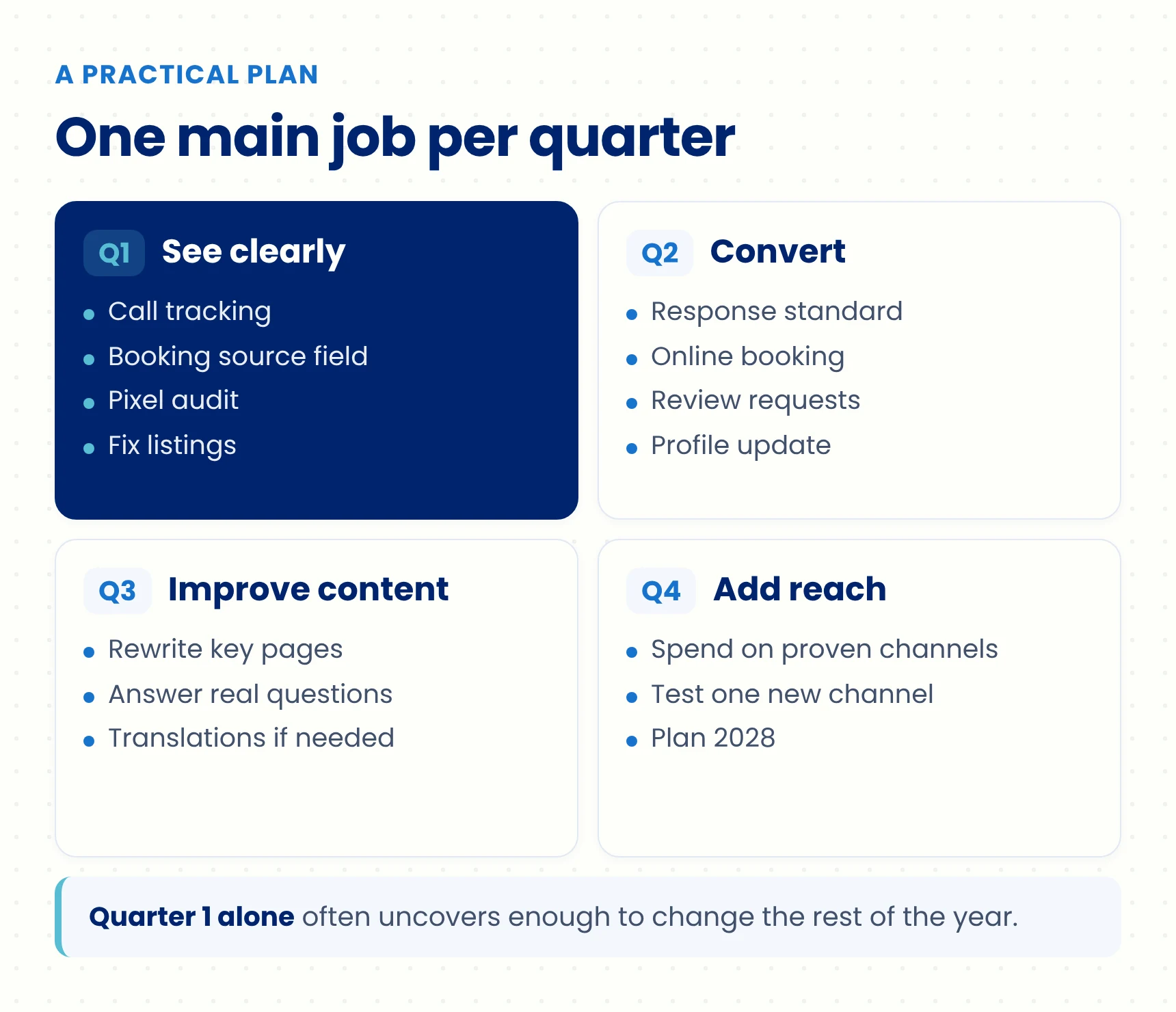
A quarter-by-quarter plan keeps this realistic for a team without a full-time marketer. Each quarter has one main job, so nothing competes for the same few hours.
A practical 2027 plan
Do thisSet up call tracking and booking source fields, audit tracking scripts on patient pages, and fix practice details everywhere they appear.
Do thisSet a response standard, add or fix online booking, start a consistent review request process, and update your Google Business Profile fully.
Do thisRewrite your most important service pages to answer real patient questions, and add translated pages if your patients need them.
Do thisPut spend behind the channels your booking data shows are working, and test one new channel at a time.
Newer practices and healthcare startup marketing teams can compress this into two quarters, because there is less legacy to fix. Established practices often find quarter one alone uncovers enough to change the rest of the year.
2027 readiness checklist
- You can see booked new patients by source each month.
- Your practice details match everywhere patients look.
- Your Google Business Profile has current hours, real photos and replies to reviews.
- You know which tracking scripts run on booking, intake and portal pages.
- Any tracking vendor touching patient information has the right agreement in place.
- Enquiries get a reply within a standard you have actually written down.
- Patients can book online without calling.
- Real patients are asked for reviews consistently, and none are incentivized for a positive rating.
- Your key service pages answer the questions patients ask on the phone.
- Nobody on the team is pasting patient information into general AI tools.
Should you handle this in-house or get help?
Most of the act-now items can be done in-house if someone owns them. The profile updates, review requests and response standards need consistency more than expertise. The technical items, tracking audits, call tracking setup and measurement, usually need someone who has done them before.
The trap is splitting the work so that nobody owns the result. A front desk that handles reviews, a developer who handles the site and an ad freelancer who reports clicks can each be doing their part while bookings stay flat, because nobody is looking at the whole path from search to appointment.
If you are weighing up outside help, our guide to hiring a healthcare marketing agency covers the questions to ask, the red flags, and what you should own regardless of who does the work.
Where The Healthcare Marketing fits
The Healthcare Marketing is a digital marketing, website development and app development agency that works exclusively with healthcare and healthcare adjacent businesses. The trends in this guide are the ones we see affecting bookings in practices right now, and the ignore list reflects things we regularly talk clients out of buying.
We offer a free marketing audit and review. For 2027 planning, that usually covers how accurately your practice appears across search, maps and reviews, which tracking scripts sit on your patient pages, whether you can see bookings by source, and which of the act-now items would make the biggest difference first.
If you would rather have the whole path handled, from search visibility and reviews through to booking and measurement, our healthcare digital marketing services are built around that full journey rather than single channels.
Frequently asked questions
What are the biggest healthcare marketing trends for 2027?
Patients finding practices through AI answers, maps and reviews as well as search, the Google Business Profile doing more work than the website, privacy risk from tracking code on patient pages, faster response expectations, stricter review rules, and measuring booked appointments rather than clicks.
Which healthcare digital marketing trends should a small practice ignore?
Paid AI search optimization packages, custom patient chatbots, connected TV advertising for a single location, influencer promotion of clinical services, and joining every new social platform. Each tends to cost more than it returns for a small or mid-sized practice.
Do patients really use AI to look for doctors and health information?
A growing share do. A KFF poll published in March 2026 found about a third of US adults had used AI for health information or advice in the past year, while most still used search engines and their doctors. AI is an additional route, not a replacement.
Is SEO still worth it for healthcare practices in 2027?
Yes. Google’s own guidance treats optimizing for AI search as ordinary SEO, and search engines are still among the most common places people look for health information. What has changed is that accuracy across all your listings matters as much as your website.
Are Facebook and Google tracking pixels allowed on medical websites?
It depends on the page and what the code can capture. Tracking on patient portals, booking pages or symptom checkers can involve protected health information and may need a business associate agreement or removal. Have someone audit each page rather than assuming either way.
How much should a practice spend on marketing in 2027?
There is no reliable universal percentage, because location, specialty and growth goals vary too much. A better starting point is fixing measurement and conversion first, then spending more only on channels your booking data shows are producing patients.
How do I know which marketing channel is bringing in patients?
Use call tracking numbers by channel, add a source field to every booking, and reconcile against your practice management system each month. Clicks and traffic reports cannot tell you which channel actually produced appointments.
Do online reviews still matter for choosing a doctor?
Yes, often more than the website. Patients look at the number of reviews, how recent they are and whether the practice replies. The only safe way to improve them is asking real patients consistently, since fake or incentivized reviews now carry penalties.
Is video marketing worth it for a dental or medical practice?
It is worth it if a clinician will appear consistently, because patients trust seeing who will treat them. A short burst of polished videos that then stops does very little, so only commit if you can sustain it.
Should my practice redesign its website in 2027?
Only if it is slow, hard to use on a phone, or makes booking difficult. Otherwise, updating content, photos and the booking path usually delivers more than a full rebuild, at a fraction of the cost and risk.
Where to start if you only do one thing
Set up a way to see booked new patients by source before you change anything else. Call tracking, a source field on bookings and a monthly check against your practice management system is enough to begin.
Every other decision in this guide gets easier once you can see what is actually producing patients. Without it, next year’s plan will be built on the same guesswork as this year’s.