A patient books online, gets a confirmation email from one system, a reminder text from another, a newsletter about a service they already use from a third, and a call from the front desk asking them to confirm the appointment they confirmed yesterday. Every channel is working. None of them are working together.
That gap is what omnichannel marketing in healthcare is meant to close. It is not about adding more channels. It is about making the ones you already have share what they know, so a patient gets one consistent experience and your team can see what actually led to a booking.
This guide explains what omnichannel means in practice, what has to be in place before it works, which rules apply to each channel, who genuinely needs it, and what a realistic version looks like for a smaller practice.
What is omnichannel marketing in healthcare?
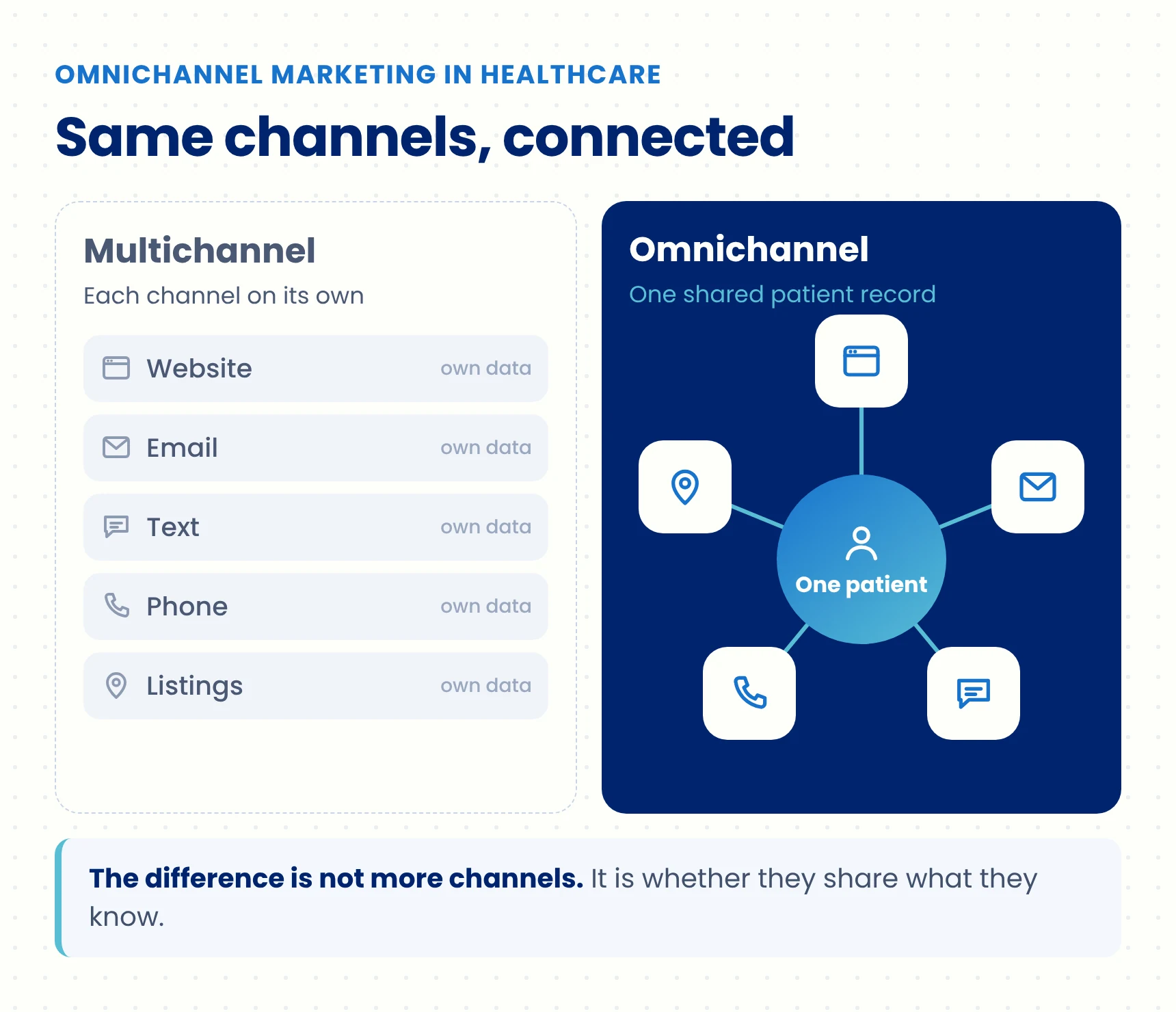
Omnichannel marketing in healthcare is an approach where every channel a patient uses, such as your website, search listings, email, text, phone, social media and in-person visits, shares the same information about that patient and works as one experience. Each message knows what the patient has already seen, booked or asked for.
In practice it looks like this. A patient books a consultation online and chooses text as their preferred contact method. The confirmation arrives by text, in the language they selected. The reminder references the right clinician and location. After the visit, the follow-up reflects what was actually discussed, and when they call to rebook, the person who answers can see all of it.
How is omnichannel different from multichannel marketing?
Multichannel marketing means being present on several channels, each run more or less on its own. Omnichannel marketing means those channels are connected, so they share data, follow the same rules and pick up where the last one left off.
Most healthcare organizations are multichannel already. They have a website, a Google Business Profile, email, text reminders and social accounts. The step to omnichannel is not adding another channel. It is connecting the ones that exist so the patient is treated as one person rather than five separate contacts.
What is the role of omnichannel marketing in healthcare?
Its role is continuity. Healthcare relationships run over months or years: a first enquiry, an initial visit, follow-ups, results, reminders, recalls, and often a long treatment plan. Every gap or contradiction in that sequence is a chance for the patient to miss an appointment, lose confidence or go elsewhere.
Done well, omnichannel marketing reduces those gaps. Patients get fewer duplicate and conflicting messages, the right reminders arrive through the method they prefer, and staff stop asking for information the patient already gave. It also makes measurement possible, because you can finally see which sequence of touchpoints led to a booked appointment.
What has to be in place for omnichannel marketing to work?
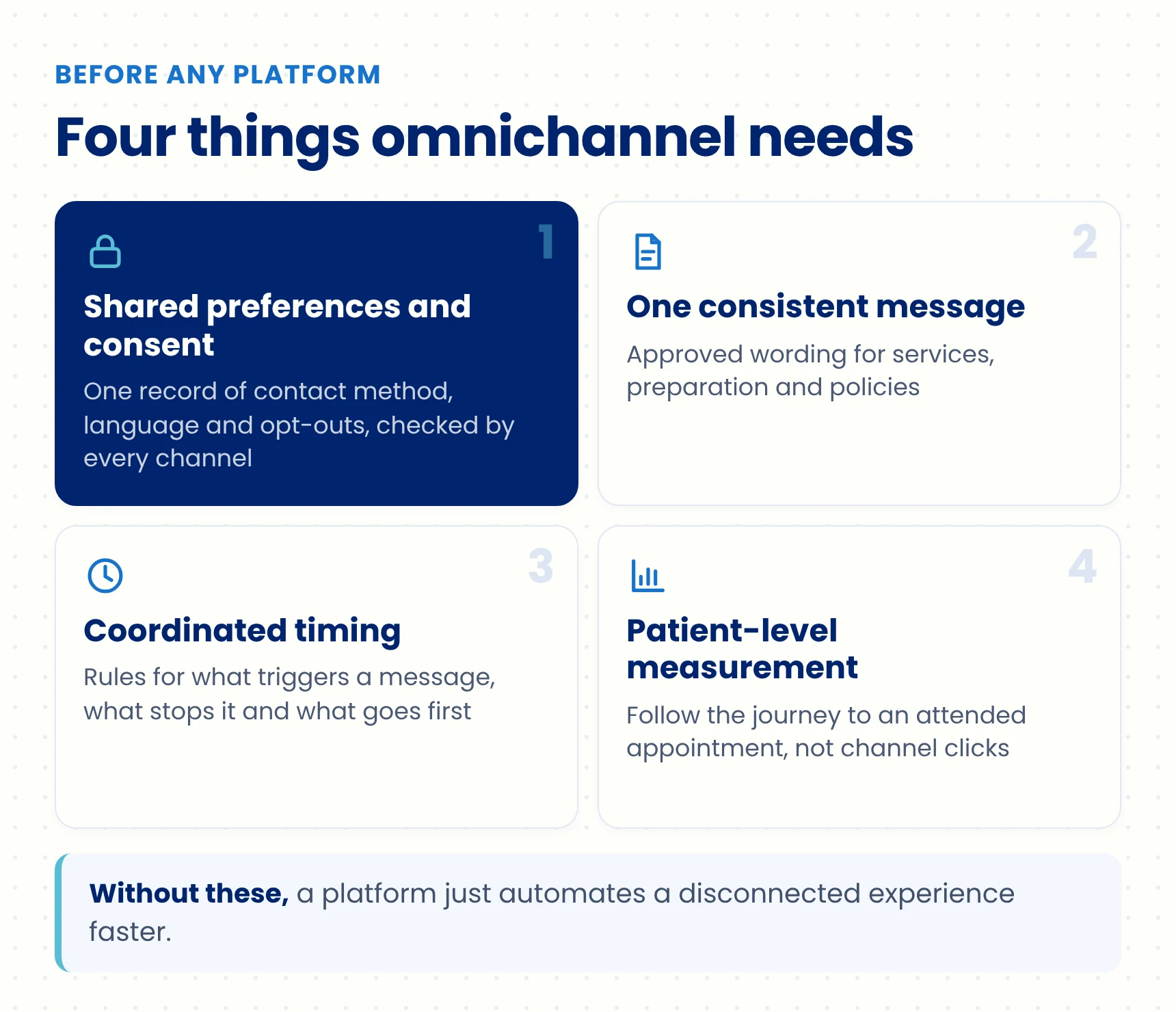
Four things. Without them, buying an omnichannel platform just automates the same disconnected experience faster.
A shared record of contact preferences and consent
Every channel needs to read from one place that holds how each patient wants to be contacted, what they have agreed to receive, and what they have opted out of. That includes their preferred language. Culturally relevant healthcare marketing starts here: if a patient prefers Spanish, every channel should know it, not just the one where they said so.
This record usually lives in your practice management system, a healthcare CRM, or both, as long as they are actually synchronized. The common failure is a patient opting out of marketing email in one system and still receiving it from another.
One consistent message
Your website, ads, emails, front desk script and printed materials should describe services, prices, preparation steps and policies the same way. When they disagree, patients notice, and the version they remember is usually the one that causes a problem at check-in.
The practical fix is a single source of approved wording for services, preparation instructions, cancellation policy and key claims, which every channel uses rather than rewrites.
Coordinated timing
Messages should arrive in a sensible order and respect what has already happened. A patient who booked yesterday should not get an ad encouraging them to book. A patient who cancelled should get a rebooking prompt, not a preparation reminder for an appointment that no longer exists.
This needs rules about what triggers each message, what stops it, and which channel goes first. Without those rules, every system sends what it was set up to send, whenever it was set up to send it.
Measurement that follows the patient, not the channel
Channel reports tell you how each channel performed in isolation. They cannot tell you that a patient found you through search, read two emails, ignored a text and then booked by phone. Omnichannel measurement connects those steps so you can see which journeys produce bookings and where people drop out.
That shift, from channel metrics to journey metrics, is what makes healthcare marketing metrics useful for decisions rather than just reporting.
Which healthcare marketing problems does omnichannel actually fix?
Mostly operational ones. These are the problems that show up in patient complaints, missed appointments and confused front desk staff, long before anyone calls it an omnichannel issue.
Why do patients get conflicting messages?
Because different teams and systems each own a channel. Marketing runs email, the practice management system sends reminders, a vendor runs text, and the front desk handles calls. Each is working from its own data and its own wording.
The fix: agree on one approved source of wording and one owner for patient-facing messages across channels. Then audit what a single patient actually receives in a typical month. Most practices are surprised by the result.
Why do reminders, marketing and clinical messages clash?
Because they are sent by systems that were bought separately and never connected. A patient might receive a promotional email the same morning as a sensitive results notification, from what looks to them like the same practice.
The fix: separate patient communications into clear types, such as appointment and care messages, practice updates and marketing, and set rules for how each type behaves. Care messages should never be delayed or crowded out by marketing.
Why is consent ignored in some channels?
Because it is recorded where the patient gave it and nowhere else. A patient unsubscribes from email and keeps getting marketing texts, or asks not to be called and is called anyway.
The fix: one record of preferences and consent that every sending system checks before it sends. If a system cannot check it, it should not be sending marketing.
Why can staff not see what a patient has been sent?
Because messages are logged in the system that sent them, not in the record staff use. The front desk calls to confirm an appointment the patient confirmed by text an hour earlier.
The fix: make outbound messages visible in the system staff actually use day to day, even if that is a simple activity log rather than a full integration.
Why can reports not show what produced a booking?
Because each channel reports on itself. Email reports opens, ads report clicks, and the booking system reports bookings, with nothing joining them together.
The fix: track the source of every booking, use call tracking, and connect marketing contacts to booked appointments, even if you start by reconciling them manually once a month.
What happens when tools are bought before the process exists?
You pay for capability you cannot use. Many organizations buy a CRM or marketing automation platform expecting it to create a connected experience, then discover their data is incomplete, their consent records are scattered and nobody owns the journeys.
The fix: map one patient journey and its rules first, then choose healthcare marketing tools that support it. The tool should follow the process, not define it.
What rules apply to each channel in healthcare marketing?
Each channel carries its own requirements, and an omnichannel approach has to respect all of them at once. The summary below covers the main US rules. It is general guidance, not legal advice, and the details depend on your organization and what each message contains.
Email with patients is allowed, with sensible safeguards. HHS guidance on emailing patients says covered providers may communicate with patients by email if they apply reasonable safeguards, that the Privacy Rule does not prohibit unencrypted email for treatment-related communications, and that providers should limit the amount or type of information sent. If a patient finds unencrypted email unacceptable, the provider should offer other options such as a more secure method, mail or phone.
For omnichannel planning, that means the channel choice should depend on what the message contains. A reminder of a date and time is different from a message discussing results. Keep sensitive detail out of email and text, and route it to a secure portal instead.
Marketing is treated differently from care. HIPAA distinguishes communications about treatment and care from marketing communications, and some marketing uses of patient information require the patient’s written authorization. Your consent record should reflect that distinction rather than treating every message the same.
Text messages
Marketing texts need clear prior consent. The FCC’s rules require prior express written consent for telemarketing calls and texts sent using an automatic dialing system or prerecorded voice, meaning a signed agreement, which can be electronic, that clearly authorizes the messages and includes the phone number.
A stricter version, often called the one-to-one consent rule, was vacated by a federal appeals court in 2025, and the FCC’s July 2025 order reinstated the earlier definition of prior express written consent. Appointment reminders and other healthcare messages can be treated differently from marketing under these rules, so confirm with counsel which category each of your text programs falls into.
Practically, record how and when each patient agreed to texts, what they agreed to, and honour opt-outs across every system that sends texts.
Website tracking and advertising
Tracking code on booking, intake, symptom checker and portal pages can send patient information to advertising platforms. Omnichannel measurement depends on tracking, so it has to be configured carefully. Audit what each page sends before connecting it to any marketing system, and keep identifying patient information out of ad platforms unless the right agreements and permissions are in place.
Who actually needs omnichannel marketing?
Not everyone, at least not in its full form. The organizations that benefit most are those where patients interact with them many times, across several locations or over a long period, or where the audience is clinicians rather than patients.
Which healthcare organizations benefit most?
Multi-site groups and health systems, where a patient may see different locations and departments. Specialties with long treatment journeys, such as fertility, orthodontics, physiotherapy programs, cosmetic and aesthetic treatments, and chronic condition management. Pharma and medtech teams engaging healthcare professionals across field and digital channels. And businesses selling health products direct to consumers, where ecommerce marketing for health products depends on connected email, site behaviour and reorder timing.
For these organizations, the cost of disconnected channels is high: missed recalls, abandoned treatment plans, duplicated effort and campaigns that cannot be measured.
What does a single-location practice actually need?
A simpler version, and usually not a full platform. Send reminders reliably through the method each patient prefers. Follow up after visits. Make rebooking easy. Keep your wording consistent across your website, listings and front desk. Respect opt-outs everywhere.
That captures most of the value at a fraction of the cost. It is the same conclusion as our review of marketing trends in healthcare, which rates full omnichannel as one to watch rather than act on for smaller practices next year.
How do you build omnichannel marketing step by step?
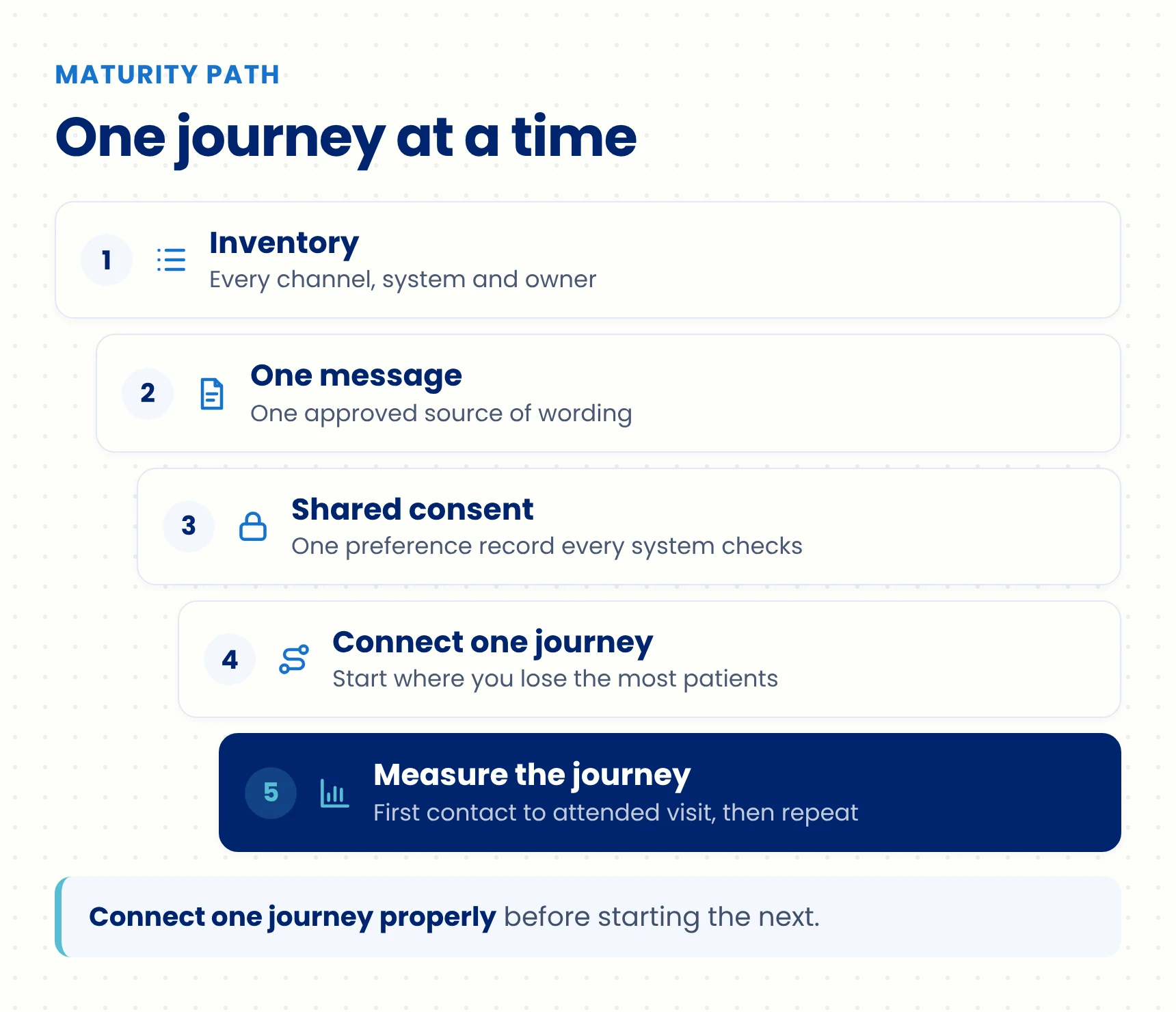
One patient journey at a time. Organizations that treat omnichannel as a single platform project usually spend a year on integration before any patient notices a difference. Organizations that connect one journey properly see results in weeks, and learn what the next one needs.
The first journey to connect is usually the one where you lose the most patients. For many practices that is the gap between enquiry and first appointment. For specialties with long treatment plans it is often the gap between consultation and starting treatment.
Omnichannel work should also sit inside your wider healthcare marketing strategies, not alongside them. The journeys you connect first should be the ones your strategy depends on most.
| Stage | What it looks like | Typical cost | Time |
|---|---|---|---|
| Scattered | Channels run separately, consent recorded in several places | Where most start | Not applicable |
| Coordinated | One message, one owner, consistent wording | Mostly internal time | Weeks |
| Connected | Shared preferences and consent, one journey coordinated | Integration work, sometimes a tool | One to three months |
| Measured | Journeys tracked from first contact to attended visit | Tracking setup and reporting | Ongoing |
How does omnichannel marketing work in pharma and medtech?
The audience is different, but the principle is the same. Pharma and medtech teams engage healthcare professionals through field representatives, email, webinars, medical information portals, conferences and paid media. Omnichannel means those touchpoints share what each clinician has already seen, asked or attended, so the next interaction builds on the last rather than repeating it.
The coordination problem is usually between field and digital teams. A clinician meets a representative, then receives a generic email that ignores the conversation, then sees an ad for information they already requested. Connecting field activity, digital engagement and medical information requests removes most of that friction.
What has changed recently in pharma omnichannel marketing?
Clinicians increasingly expect to research on their own schedule, through channels they choose, rather than waiting for a representative visit. That has pushed more of the conversation into digital channels and made follow-up after field visits more important than the visit alone. It has also raised the importance of the search side of pharmaceutical marketing, because many clinicians research independently before and after any contact with a company.
It has also made content reuse a priority. Teams increasingly build approved content in smaller, reusable pieces so the same reviewed material can appear consistently across email, web, field and paid channels, without each version going back through full review.
Clinician preferences now need the same treatment as patient preferences. Which channels a clinician has agreed to, how often they want to hear from you, and what they have already requested should sit in one record that field and digital teams both use, so a request made to a representative is not followed by an unrelated email the next day.
How do you keep risk information balanced across channels?
Every channel that carries promotional benefit information for a prescription product needs to carry risk information in a balanced way, including short formats. FDA’s draft guidance on character-limited platforms, issued in 2014 and still in draft, recommends that firms choosing to present benefit information on those platforms present both benefit and risk information within the communication.
For omnichannel planning, that means a message cannot be shortened for a new channel by dropping the risk information. If the risk content does not fit, the format is wrong for the claim. Build channel-specific versions through your medical, legal and regulatory review rather than adapting approved material after the fact.
How do you measure omnichannel marketing in healthcare?
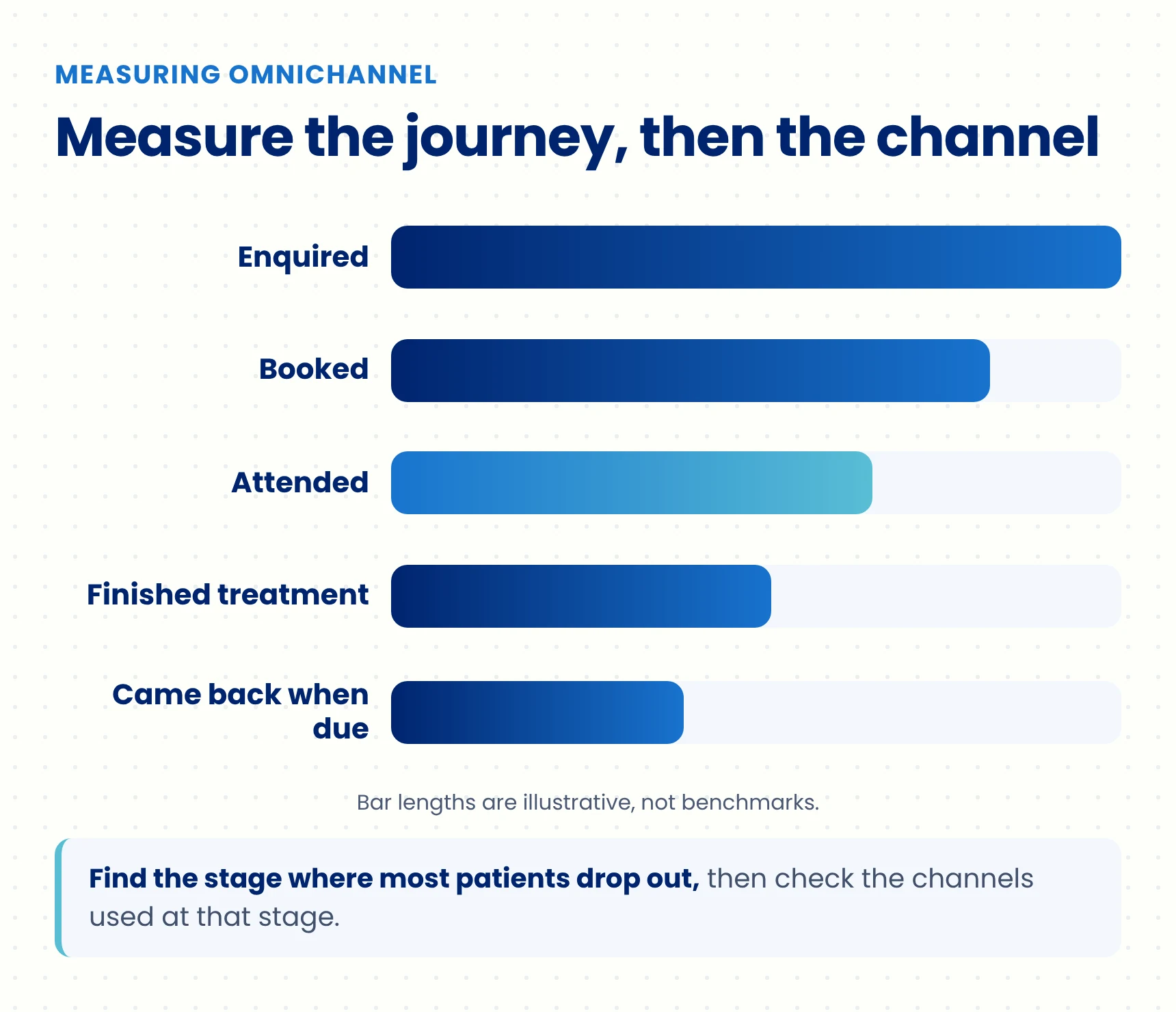
By journeys, not channels. The useful questions are how many people who enquired went on to book, how many who booked actually attended, how many who started a treatment plan finished it, and how many came back when they were due.
Practical journey metrics include enquiry to booking rate, show rate, time from enquiry to first appointment, rebooking and recall rate, treatment plan completion, and opt-out rate by channel. Map them as stages in a simple healthcare marketing funnel, and look for the stage where most patients drop out.
Channel metrics still have a place, but as diagnostics. If show rate falls, then you check whether reminders were delivered and opened. Start with the journey outcome, then work back to the channel.
Where does AI fit into omnichannel healthcare marketing?
AI can help draft message variations, summarize engagement and suggest timing, but it depends on the same foundations: clean preference and consent data, approved wording and clear rules. Without those, it scales the inconsistency rather than fixing it.
The bigger cautions are the same as anywhere in healthcare: keep patient information out of general AI tools and have a person review anything clinical. Our guide on how AI is changing healthcare marketing covers where it helps and where it creates risk.
Should you build omnichannel in-house or with an agency?
The planning should stay close to your team, because it depends on how your organization actually works: who answers enquiries, how bookings are handled, which systems you use and what your patients expect. No outside partner knows that better than your staff.
Outside help is useful for the parts that need specific skills, such as tracking and measurement setup, integrations between systems, content production and coordinated healthcare marketing campaigns across channels. The risk is buying a large platform or retainer before the basics are in place.
If you are considering an agency for this, the questions to ask a marketing agency matter more than usual. Ask how they would map your first journey, how they handle consent across channels, and how they would measure attended appointments rather than clicks.
Where The Healthcare Marketing fits
The Healthcare Marketing is a digital marketing, website development and app development agency that works exclusively with healthcare and healthcare adjacent businesses. In omnichannel work, that means we start from the patient journey and the rules on each channel, rather than from a platform.
We offer a free marketing audit and review. For omnichannel, that usually covers what a patient actually receives across your channels, where messages conflict or repeat, whether consent is respected everywhere, and whether you can see which journey led to an attended appointment.
When you are ready to act on it, our healthcare marketing services that connect your channels cover websites, search, paid media, email and measurement, built around the journeys that matter most to your organization.
Frequently asked questions
What is omnichannel marketing in healthcare?
It is an approach where all of a healthcare organization’s channels, such as website, email, text, phone, social and in-person visits, share information about each patient and work as one experience. Each message reflects what the patient has already seen, booked or asked for.
What is the difference between omnichannel and multichannel marketing in healthcare?
Multichannel means being present on several channels that run separately. Omnichannel means those channels are connected, share data and consent, and pick up where the last one left off, so the patient is treated as one person.
Does a small medical practice need omnichannel marketing?
Usually not in its full form. Reliable reminders by each patient’s preferred method, post-visit follow-up, easy rebooking, consistent wording and respected opt-outs deliver most of the value without a large platform.
Can a healthcare practice email patients without encryption?
HHS guidance says unencrypted email is not prohibited for treatment-related communications if reasonable safeguards are used and the information sent is limited. If a patient does not accept unencrypted email, other options should be offered.
Do healthcare practices need consent to send marketing texts?
Marketing texts sent with an automatic dialing system generally need prior express written consent under FCC rules. Appointment reminders and other healthcare messages can be treated differently, so confirm which category each program falls into.
What software do you need for omnichannel healthcare marketing?
Most organizations need a practice management system or CRM holding preferences and consent, a way to send coordinated email and text, and booking and call tracking. Choose tools after mapping your first journey, not before.
How do you measure omnichannel marketing results in healthcare?
Measure patient journeys rather than channels: enquiry to booking rate, show rate, time to first appointment, treatment completion and rebooking. Use channel metrics only to diagnose why a journey stage is underperforming.
Which patient journey should be connected first?
The one where you lose the most patients. For many practices that is between enquiry and first appointment, and for specialties with long treatment plans it is often between consultation and starting treatment.
How is omnichannel marketing used in pharma?
Pharma teams coordinate field representatives, email, webinars, medical information and paid media so each clinician’s next interaction builds on what they have already seen or asked. Risk information must stay balanced in every channel, including short formats.
How long does it take to set up omnichannel marketing?
The first connected journey usually takes one to three months once wording and consent records are in place. A full platform rollout across every journey can take a year or more, which is why starting with one journey works better.
Where to start if you only do one thing
Pick one recent new patient and write down every message they received from your organization, by any channel, from their first enquiry to their first appointment. Note who sent each one, what it said and whether it repeated or contradicted anything before it.
That single list usually shows exactly where your channels disagree and which journey to connect first. It takes an hour, costs nothing, and gives you a far better brief than any platform demo.