
Most marketing advice assumes you already have something to work with: a brand people recognize, reviews, case studies, a few years of data. A healthcare startup usually has none of those. What it has is a product, a small budget, a team doing three jobs each, and investors asking when growth will show up.
Healthcare startup marketing is the work of building demand from that starting point. Digital marketing for healthcare startups is different from marketing an established practice or health system, because the first job is not to grow awareness. It is to earn enough trust, from the right buyer, that someone takes a risk on a company with no track record.
This guide covers how to do that: which go-to-market model you are in, how to build credibility with nothing to show yet, what you can and cannot claim, which channels to start with, what it costs, and what to put in front of investors.
Which healthcare startup marketing model are you in?
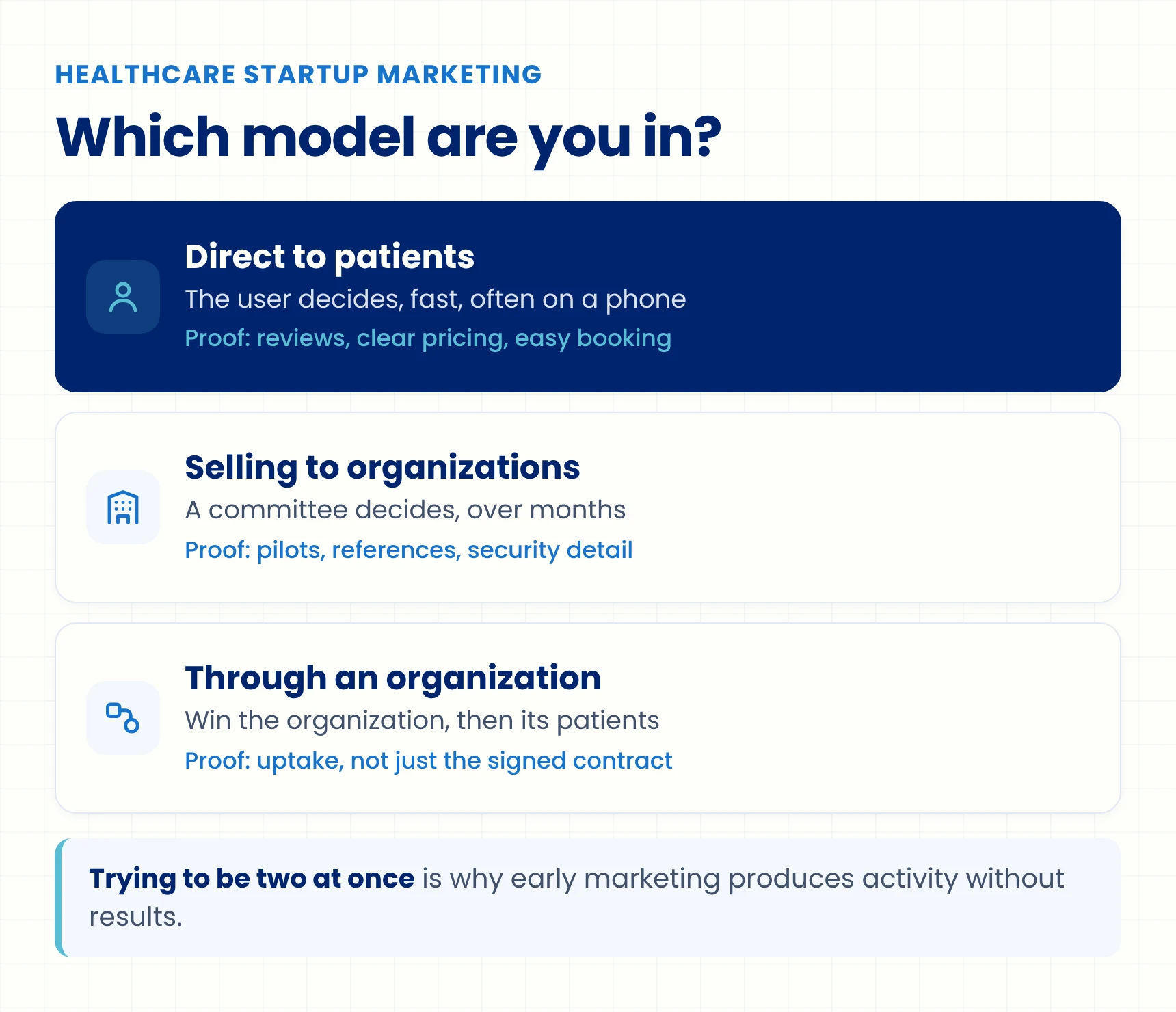
There are three, and the right marketing depends almost entirely on which one you are. The difference is who decides to buy, and what that person needs to see before they say yes.
Selling directly to patients or consumers
This covers telehealth services, consumer health apps, cash-pay clinics, new specialty practices and health products sold online. The person who decides is the person who uses it, and they usually decide quickly, often on a phone, often comparing you with two or three alternatives.
Your marketing has to be found at the moment of need, look trustworthy within seconds, and make the next step easy. The numbers that matter are cost to acquire one patient or customer, and how many come back or stay. If you sell physical products online, ecommerce marketing for health products adds its own layer: product pages, pricing comparison and repeat ordering.
Selling to healthcare organizations
This covers software, devices, services and staffing sold to clinics, hospitals, health systems, payers or employers. The buyer is a group of people, the decision takes months, and nobody wants to be the first customer of a company that might not exist next year.
Your early marketing is less about volume and more about getting the first few pilots and turning them into proof. Founder-led selling does most of the work at this stage, and marketing’s job is to support it with the right material.
Selling through an organization to its patients
This is the hybrid model: an app a clinic offers its patients, a program an employer provides to staff, a service a health plan offers members. You have to win the organization first, then get its patients or members to actually use what you provide.
Startups in this model often underestimate the second half. Signing the organization feels like the win, but if nobody uses the product, the contract does not renew. Plan marketing for both audiences from the start, including the material the organization needs to promote you to its own people.
If you cannot say clearly which of these you are, you are probably trying to be two of them at once. That is one of the most common reasons early healthcare startup marketing produces activity without results.
What should a healthcare startup do before spending on marketing?
Four things, and none of them cost much. Pick one buyer. Describe one problem in that buyer’s own words. Decide what proof you can show today. Decide which claims you can support with evidence. Spending before these are settled usually means paying to test four ideas at once and learning nothing from any of them.
Choosing one buyer is the hardest of the four, because it feels like closing doors. It is a temporary decision. Basic healthcare market segmentation, splitting your possible buyers by setting, size, specialty or patient group, usually shows one segment that has the problem worst and can say yes fastest. Start there and expand once it works.
You do not need expensive healthcare market research to do this well. Twenty conversations with people in your target segment, asking how they handle the problem today and what it costs them, will tell you more than a purchased report. Write down the phrases they use. Those phrases become your headlines, your ad copy and your search targets.
Once you have a clear buyer and some traction, the work shifts from finding a foothold to building something repeatable. That is where your healthcare marketing plan takes over from this early-stage playbook.
How do you build credibility with no reviews or case studies?
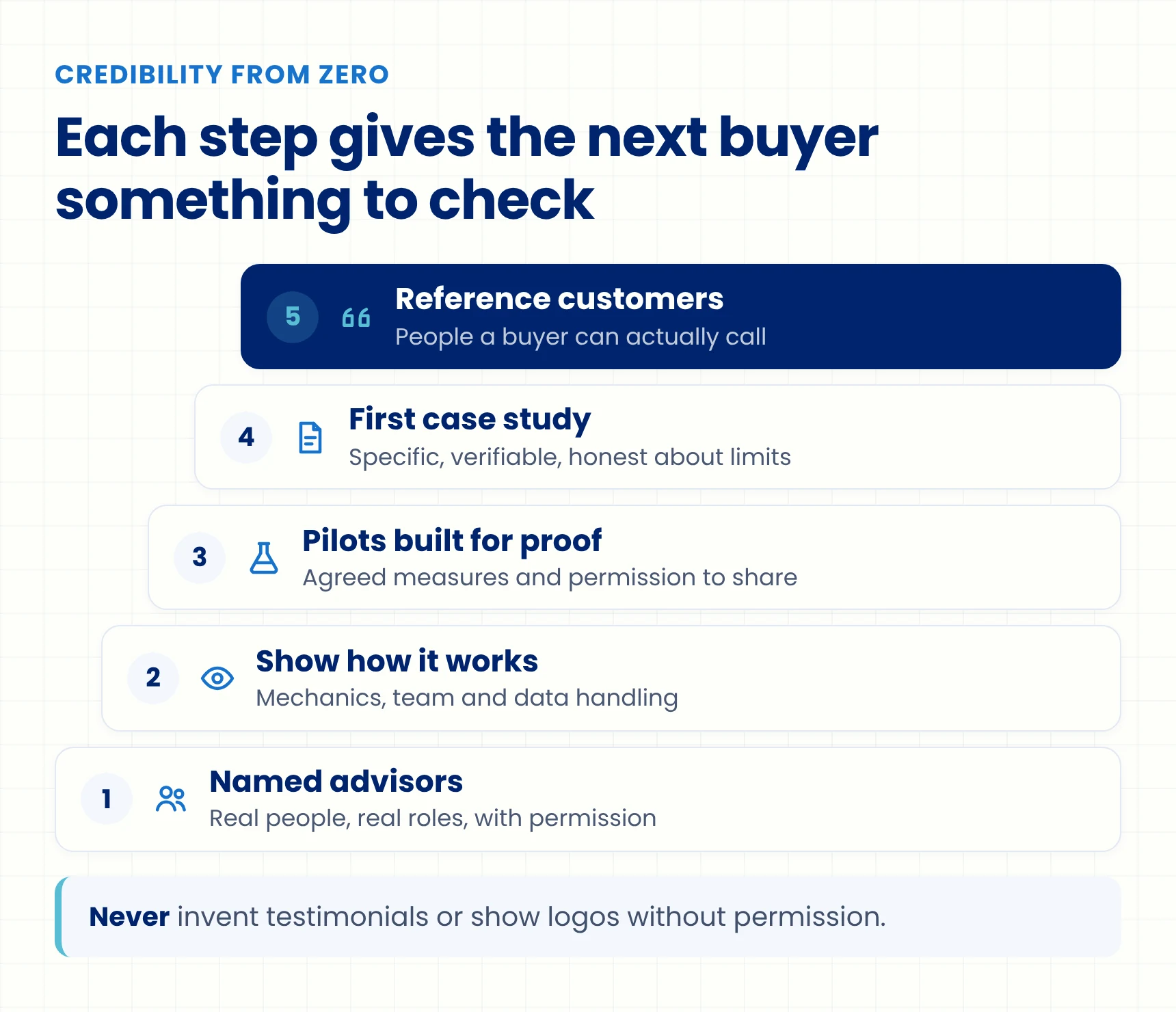
By borrowing it, showing your work, and creating proof on purpose. A startup cannot fake a track record, and should not try. What it can do is make it easy for a cautious buyer to see who is behind the product, how it works and what evidence exists so far.
Borrow credibility from real people
Clinical advisors, founders with relevant backgrounds, and early partners who are willing to be named all reduce the perceived risk of an unknown company. Name them, describe what they actually do, and make sure every name is used with permission. A credible advisor who genuinely reviews your clinical content is worth more than a long list of loose associations.
Show how the product works
Most startup websites describe outcomes and hide the mechanics. Cautious healthcare buyers want the opposite. Explain how the product works, who built it, how data is handled, what it does not do, and what happens after someone signs up. Transparency reads as confidence, and it answers the questions a buyer would otherwise not bother to ask.
Run pilots designed to produce proof
Treat your first customers or patients as the source of your first evidence, and plan for that before the pilot starts. Agree what you will measure, get permission to share results and use a name, and set an end date with a review. A pilot that ends with a usable case study and a reference is worth far more than a larger one that ends with nothing you can show.
What not to do
Do not invent testimonials, use logos of organizations that are not customers, or present a single enthusiastic user as typical. Beyond the ethical problem, these are exactly the things that get noticed in healthcare, and they destroy trust faster than having no proof at all.
What health claims can a startup make in its marketing?
Only claims you can support with solid evidence, and the bar is higher than most founders expect. A happy user, a strong internal metric or a promising early study is usually not enough to claim that a product improves health.
The US Federal Trade Commission’s health products compliance guidance says health claims need competent and reliable scientific evidence, and that substantiating a health benefit generally means randomized, controlled human clinical testing. It applies to health-related products broadly, including health equipment, diagnostic tests and health apps, not just supplements. It also says testimonials are not a substitute for scientific evidence, however genuine they are.
In practice, that means separating what you can say today from what you hope to say later. You can describe what the product does, how it works and what users report, labeled as user experience. You cannot imply outcomes your evidence does not support, and every claim about health benefits needs to be traceable to a specific source.
A useful habit is keeping a claims file: every health claim on your site, in your ads and in your sales material, with the evidence that supports it and the date it was last checked. When an investor, partner or regulator asks where a claim came from, you can answer in minutes instead of days.
If your product touches health monitoring or wellness, also check where it sits with the FDA. The agency’s general wellness guidance, reissued in January 2026, covers low-risk products that support a general state of health or a healthy lifestyle. It says a product is not a general wellness product if its labeling, advertising, user interface or functionality references specific diseases, clinical conditions or diagnostic thresholds, and it lists clinical action alerts and claims of clinical accuracy or medical-grade status among the other triggers.
That last point matters for marketing specifically. A wellness product can drift into device territory because of how it is advertised, not just how it is built. Words like “diagnose,” “detect,” “treat” or “medical-grade” in an ad deserve a careful look before they go live.
Name one person who approves every health claim before it publishes, and give them the authority to say no. For most startups that is a clinical advisor working with regulatory counsel. This is general guidance, not legal advice, and the details depend on your product.
Which privacy rules apply to a healthcare startup if HIPAA does not?
Often the FTC’s Health Breach Notification Rule, and sometimes state health privacy laws as well. Many founders assume that if they are not a hospital or a clinic, they have no health privacy obligations. For a large share of health apps, that assumption is wrong.
The FTC’s update to the Health Breach Notification Rule says it applies to health apps and similar technologies not covered by HIPAA. It defines a breach to include an unauthorized disclosure, not only a hack, and requires notifying affected people without unreasonable delay and no later than 60 days after discovering a breach.
For marketing, the risk is usually tracking. Advertising and analytics code that sends health-related information to ad platforms without proper authorization can count as an unauthorized disclosure. Audit what your site and app send to third parties before you scale paid campaigns, not after.
If you provide services to providers or health plans and handle their patients’ information, HIPAA may apply to you as a business associate, with its own agreements and obligations. Work out which regime applies to you early, with counsel, because it shapes which marketing tools you can use at all.
Which marketing channels should a healthcare startup use first?
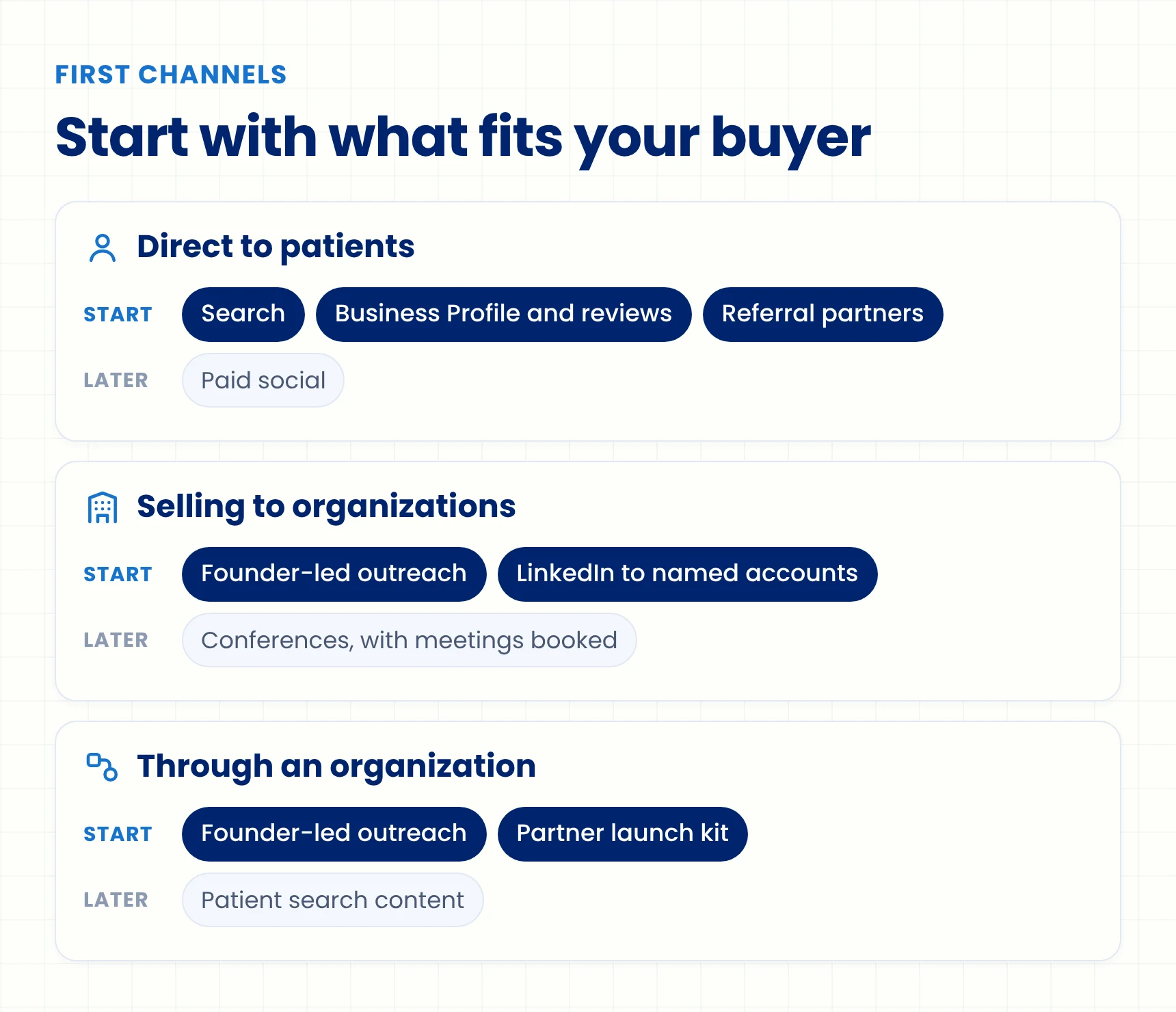
One or two, chosen to match your model, with a fixed test budget and a date to judge each one. That discipline is the core of digital marketing for healthcare startups at this stage. Spreading a small budget across five channels makes every channel look like it failed, because none of them got enough to work.
For startups selling directly to patients
Start where people are already looking. Search, both paid and organic, catches people at the moment they need a solution. If you have a physical location, your Google Business Profile and reviews matter as much as your website. Referral partners, such as clinicians or organizations that see your patients first, can be the cheapest source of all.
Paid social can work for consumer health products, but health advertising rules on the major platforms are strict and costs can climb fast. Treat it as a test, not a foundation. Patient lead generation from paid channels only pays off if your booking or sign-up process converts, so fix that before you scale spend.
For startups selling to organizations
Founder-led outreach to a short list of named accounts, supported by content that answers the questions each reviewer will ask. LinkedIn works for reaching specific roles inside specific organizations. Conferences work when you book meetings in advance rather than hoping for booth traffic.
The committee buying, procurement and long cycles that shape this model are covered in depth in our guide to b2b healthcare marketing. The startup-specific difference is that you are selling the company as much as the product, so stability, references and transparency matter even more.
For startups selling through an organization
Sell to the organization with the same approach as above, then build what the organization needs to promote you internally: launch emails, posters, staff briefing notes, short videos and simple onboarding. Make it easy for your champion to drive uptake, because their success is your renewal.
| Channel | Best for | Rough cost | Time to results |
|---|---|---|---|
| Paid search | Direct to patient, high intent | Ad spend plus setup | Weeks |
| Organic search and content | All models | Mostly time and writing | Four to nine months |
| Google Business Profile and reviews | Location-based services | Low, mostly time | One to three months |
| Referral partners | Direct to patient, B2B2C | Relationship time | One to three months |
| Founder-led outreach and LinkedIn | Selling to organizations | Founder time | One to three months for meetings |
| Paid social | Consumer health products | Ad spend, rises fast | Weeks, if it works at all |
How much should a healthcare startup spend on marketing?
There is no reliable universal figure, and percentage-of-revenue rules do not work when revenue is close to zero. A better way to set a healthcare marketing budget is to work backwards from what a customer is worth and how much runway you have.
Estimate what one customer or patient is worth to you over a realistic period. Decide the most you can afford to pay to acquire one. Then give each test channel a fixed budget and a fixed period, typically enough for a meaningful number of conversions rather than a handful of clicks, and agree in advance what result means continue, change or stop.
Your healthcare marketing mix at this stage should be narrow on purpose. One channel that works and can be scaled is worth more than five channels that each produce a little. Expand only when the first one is predictable.
It is also worth knowing what not to buy. Startups are a favourite target for packages that promise fast visibility, and many of them are poor value at this stage. The ignore list in our guide to healthcare marketing trends worth acting on covers the most common ones.
How do you keep messaging consistent when the product keeps changing?
Separate what changes from what does not. Your product features will change often in the early stage. The problem you solve, the buyer you serve and the reason they should trust you usually change much less. Build your messaging around those, and treat features as supporting detail.
Write a one-page message document: who it is for, the problem in their words, what you do about it, why you are credible, and what you will not claim. Review it monthly, not weekly. Every piece of marketing should trace back to it, which stops each new hire, agency or founder conversation from reinventing the pitch.
If the core message genuinely changes, because you have pivoted to a different buyer or problem, update the document first and everything else second. Changing ads and pages without changing the foundation produces a website that says three different things.
What marketing numbers should a startup show investors?
The numbers that show whether growth is repeatable: cost to acquire a customer or patient, conversion at each stage, how long it takes to pay back acquisition cost, and retention or repeat use. Traffic, followers and impressions are easy to grow and say very little about whether the business works.
Map your healthcare marketing funnel in simple stages, such as reached, engaged, enquired, converted and retained, and track the conversion rate between each. That shows exactly where you are losing people, which is a far more useful conversation with an investor than a chart of rising visits.
Be honest about what is early. A small number of well-documented customers with strong retention is a better story than large top-of-funnel numbers that do not convert. Investors who know healthcare expect slower, more credible growth, and they notice when metrics have been chosen to flatter.
Should a healthcare startup hire in-house, use an agency, or neither yet?
Neither, at the very start. Until you have one buyer, one message and some early proof, the founders are usually the best marketers the company has, because they know the problem and the customer better than anyone you could hire. Outsourcing marketing before you know what works often means paying someone to guess.
Once the message is proven, the choice depends on what you need. A first in-house marketing hire works well when you need someone close to the product and the customer every day. An agency works well when you need specific skills, such as search, paid media, website builds or design, faster than you could hire for them.
If you are weighing that up, our guide to hiring a healthcare marketing agency covers what to ask, what to own regardless of who does the work, and the red flags to avoid. Whichever route you take, keep ownership of your domain, ad accounts, analytics and content from day one.
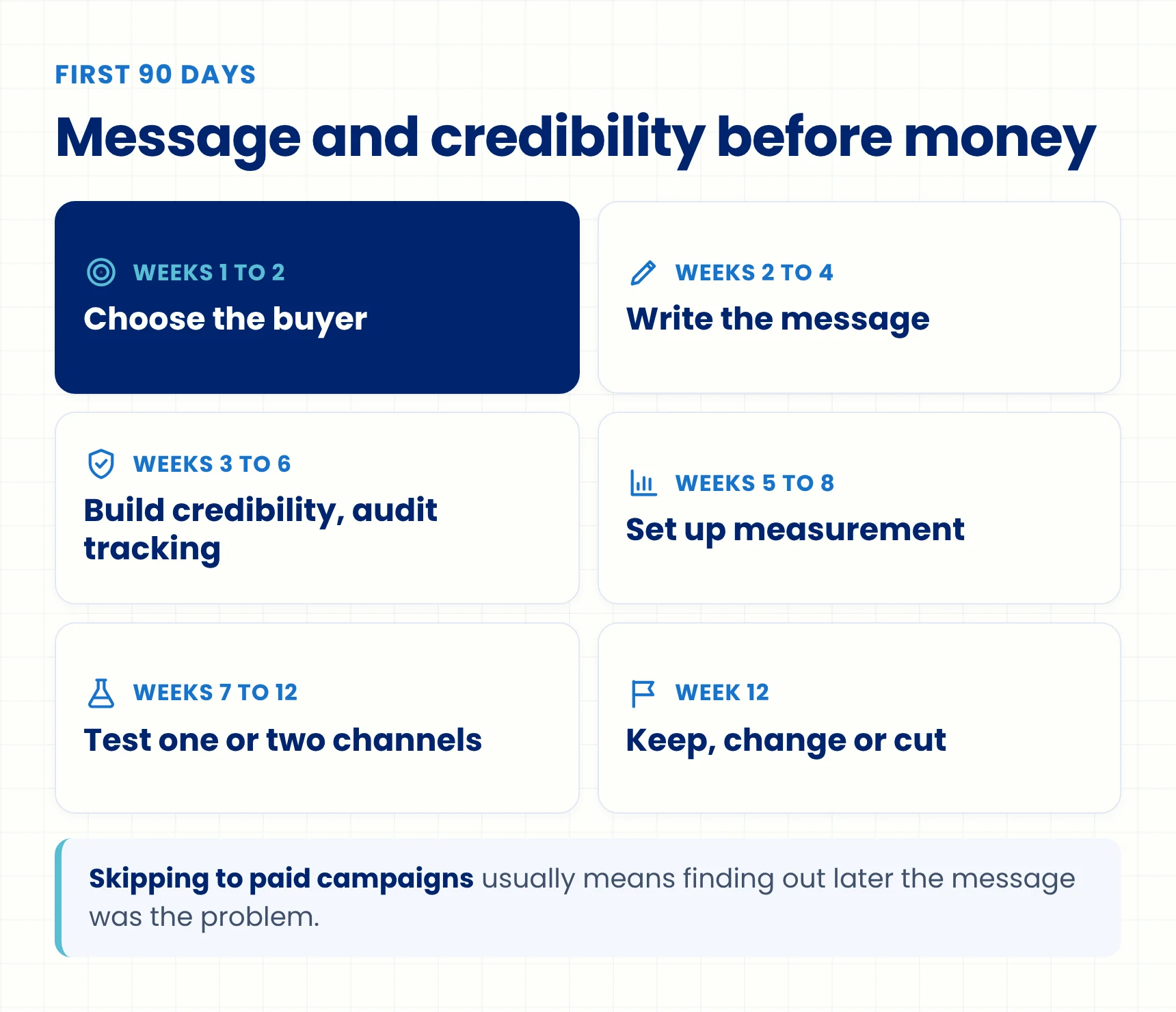
What does the first 90 days of healthcare startup marketing look like?
A focused sequence works better than doing everything at once. This is a realistic plan for a small team with limited budget.
The order matters more than the speed. Startups that skip straight to paid campaigns usually find, three months and a lot of money later, that the problem was the message or the credibility layer all along.
Where The Healthcare Marketing fits
The Healthcare Marketing is a digital marketing, website development and app development agency that works exclusively with healthcare and healthcare adjacent businesses. For startups, the relevant part is that the constraints in this guide, claims review, privacy rules, cautious buyers and long trust-building, are the normal working conditions in healthcare rather than surprises.
We offer a free marketing audit and review. For a startup, that usually means looking at whether your site builds enough trust for a cautious buyer, which claims need evidence or rewording, what your tracking sends to third parties, and which one or two channels make sense to test first.
When you are ready for help with execution, our digital marketing for healthcare companies covers search, paid media, websites and content, built around what each stage of growth needs.
Frequently asked questions
What is healthcare startup marketing?
It is how a new healthcare company builds demand when it has no brand, reviews or track record yet. The early focus is earning trust from one well-chosen buyer through credibility, proof and supportable claims, before spending heavily on reach.
How should a digital health startup get its first customers?
Pick one buyer and one segment, then go where they already are: search for patient-facing products, founder-led outreach for products sold to organizations. Treat the first customers as pilots designed to produce case studies and references.
How much should a healthcare startup spend on marketing?
There is no reliable universal percentage. Work backwards from what a customer is worth and how much you can afford to pay to acquire one, then give one or two channels a fixed test budget and a date to judge them.
Can a health app say it improves health outcomes?
Only with strong evidence. US guidance on health claims generally expects randomized, controlled human clinical testing to support health benefit claims, and user testimonials do not replace that evidence.
Does HIPAA apply to my health app?
Not always. HIPAA usually applies when you work for or on behalf of providers or health plans. Many consumer health apps fall under the FTC’s Health Breach Notification Rule instead, which has its own breach and notification duties.
Can a wellness app use words like detect or medical-grade in ads?
Be careful. FDA’s general wellness guidance says references to specific diseases, clinical conditions or diagnostic thresholds, and claims of clinical accuracy or medical-grade status, can take a product outside the wellness category.
How can a startup build trust with no reviews or case studies?
Name real advisors and founders with relevant experience, explain clearly how the product works and handles data, and design early pilots to produce results you are allowed to share. Never invent testimonials or use logos without permission.
Should a healthcare startup hire a marketing agency early?
Usually not before you have one clear buyer, one message and some early proof. Once those exist, an agency makes sense for specific skills you need faster than you could hire for, while you keep ownership of all accounts and data.
What marketing metrics do healthcare investors want to see?
Cost to acquire a customer or patient, conversion between funnel stages, payback period and retention. These show whether growth is repeatable, which matters far more than traffic or follower counts.
Which marketing channel works best for a healthcare startup?
It depends on the model. Search and referral partners usually suit patient-facing startups, while founder-led outreach and LinkedIn suit startups selling to organizations. Start with one or two and judge them on conversions, not clicks.
Where to start if you only do one thing
Write down, in one sentence, who your buyer is and what problem you solve for them, in the words they would use. Then check your homepage says exactly that.
Most early-stage healthcare marketing problems trace back to that sentence being missing, vague or different on every page. Fixing it costs nothing, and every channel you test afterwards will work better because of it.