
Your analytics shows traffic up forty percent. Your practice manager says the schedule looks much the same as last month. Both can be true at once, and that gap is why most marketing reports get skimmed and filed.
The problem is rarely that nobody is measuring. Most practices have analytics installed, a dashboard from somebody, and numbers arriving every month. The problem is that the numbers stop at the website, while the thing you actually care about happens inside your practice management system, often days later, usually after a phone call nobody logged.
This guide covers which healthcare marketing metrics are worth tracking at three different budget levels, how to connect them to booked and attended appointments, which numbers quietly mislead you, and how to measure any of it when patient data is protected and most tracking tools were never designed for healthcare.
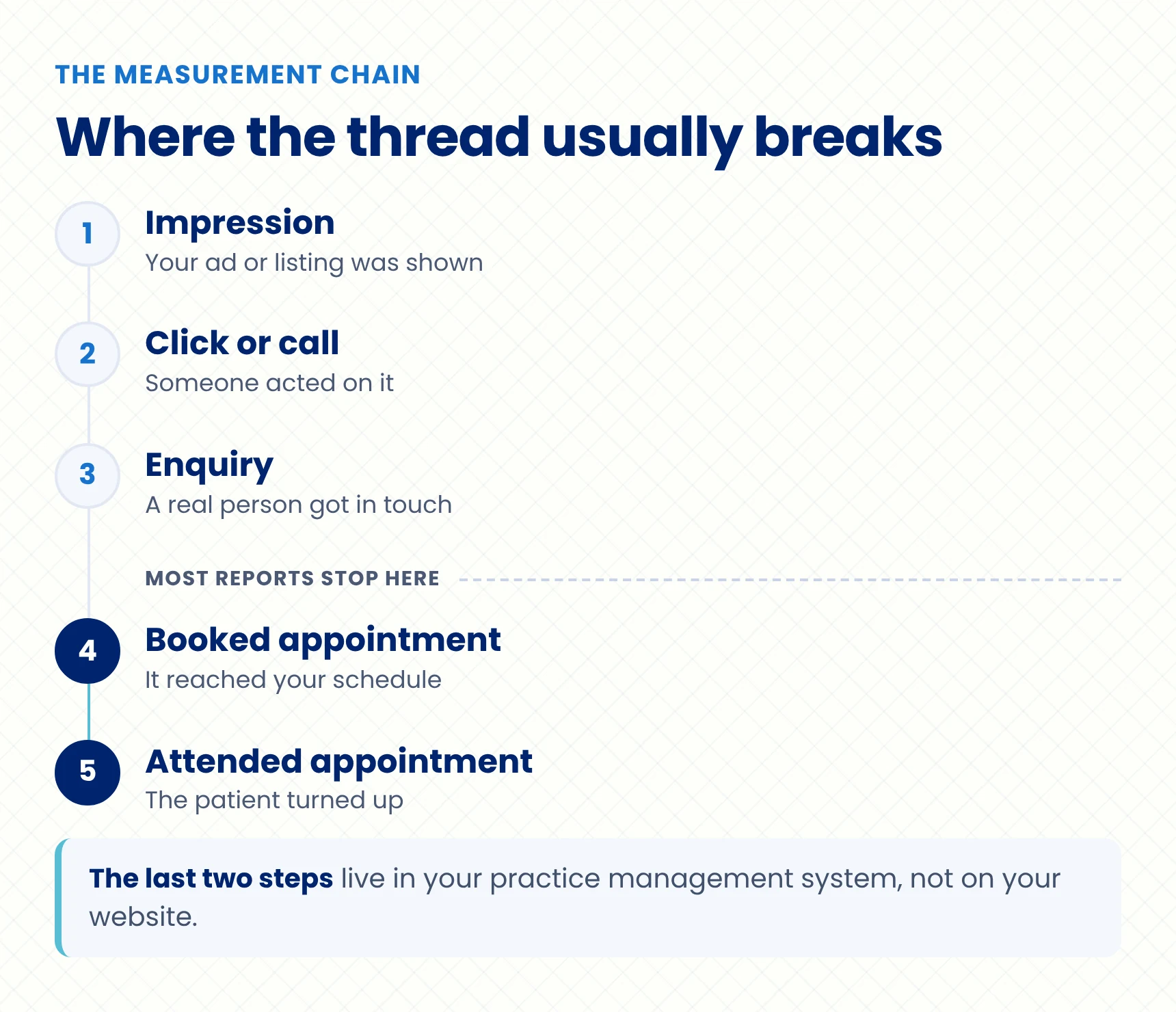
Why most healthcare marketing reports do not answer the question that matters
Because they measure the part that is easy to see. A website platform knows about sessions, clicks and form submissions. It does not know that the form submission turned into a consultation three weeks later, or that the patient actually turned up. Those facts live somewhere else, and nobody connects the two.
The report stops where the journey gets interesting
A typical monthly report ends at the enquiry. Someone filled in a form or clicked to call, and that counts as a win. But between the enquiry and a patient in a chair there are several places the whole thing can fall apart. The call rings out. The voicemail is never returned. The first available appointment is six weeks away. The patient books, then does not attend.
None of that shows up in a website report, and all of it decides whether the marketing was worth the money. A practice that doubles its enquiries and answers half as many calls has spent more to achieve nothing.
Easy numbers crowd out useful ones
When the easy numbers are the only ones available, they start to feel important. Impressions, rankings, followers and session counts all go in the report because they are there, not because anyone acts on them. Over time the report grows, the meeting gets longer, and the one question in the room stays unanswered.
A good report is usually shorter than a bad one. It carries fewer numbers, each of which someone could act on this week.
What your healthcare marketing analytics needs before any metric means anything
Four things have to be in place. Without them you are not measuring marketing, you are describing website activity.
- Website analytics, configured so you can see which channel brought each visit and what that visit did. This is the easiest piece and the one most practices already have.
- Call tracking, because in healthcare the phone is still where most bookings happen. If you cannot tell which calls came from which source, you are missing the majority of your results.
- Source capture at the point of enquiry, whether that is a form field, a booking widget or a question your front desk asks and records the same way every time.
- Your practice management system as the place where a booking becomes real. This is the system that knows whether the appointment happened. Any measurement that never touches it is guesswork.
Notice that only the first of those is a marketing tool. The useful healthcare marketing tools in this area are mostly plumbing: something to track calls, something to record where an enquiry came from, and a reliable way to match the two against your schedule. The software matters far less than whether somebody is responsible for keeping it accurate.
If you run several channels at once, they also need to agree with each other, otherwise your source data turns into noise. Our guide to omnichannel marketing in healthcare covers how to keep channels consistent rather than competing.
Tier one: the healthcare marketing metrics every practice should track
Five numbers. These are the key metrics for healthcare digital marketing at any size of practice, and they are worth tracking even if you spend nothing on advertising.
1. New patient enquiries by source
Every call, form, message and walk-in, grouped by where it came from. Not sessions, not clicks. A person who got in touch. This is the base of everything else, and it is the number most practices estimate rather than count.
2. Booked appointments by source
Of those enquiries, how many ended up in the schedule. The gap between enquiries and bookings is usually the most expensive problem in the practice, and it has nothing to do with marketing. It is answering the phone, offering a time soon enough, and following up.
3. Attended appointments by source
Bookings that actually happened. Some sources produce patients who book and never show. You will not find that out unless you look, and until you do, a cheap source can look better than an expensive one that fills chairs.
4. Enquiry to booking rate
Booked divided by enquiries, by source and overall. If this sits below about half, more marketing will not help you. Fixing the phone will. This single ratio has rescued more practice budgets than any campaign, because improving it costs almost nothing.
5. Missed and unanswered calls
Most phone systems report this, and most practices never look. Missed calls during opening hours are patients you already paid to reach. Any serious attempt at patient lead generation starts here rather than with a new campaign.
Tier two: what to add once you are spending on ads
Once real money is going out every month, you need to know what each result costs and which part of the spend is working. Add these.
- Cost per enquiry by campaign. Total spend divided by enquiries from that campaign. Useful for comparing healthcare marketing campaigns against each other, not for judging whether marketing works overall.
- Cost per booked appointment. The same sum, but using bookings. This is where campaigns start to separate.
- Cost per attended appointment. The number to run your healthcare marketing budget on. It is the only one that reflects what you actually received.
- Enquiry quality by campaign. Whether the enquiries are for the service you wanted, in the area you serve, and able to book. Volume with poor quality is worse than no volume, because it also eats your front desk’s time.
- Response time to enquiry. How long between someone getting in touch and someone replying. In most practices this predicts booking rate better than anything in the ad account.
Two of these are about the practice rather than the advertising. That is deliberate. Once you are buying attention, the cost of a slow response rises sharply, because you paid for every enquiry you then let go cold.
These numbers tell you how well the money is being spent. They cannot tell you whether you are spending it in the right places to begin with. That question belongs with your marketing strategy in the healthcare industry rather than with the reporting.
Tier three: what needs a healthcare CRM or patient level tracking
This tier is worth building for multi-site groups, specialty practices with high value treatments, and anyone whose patients take weeks to decide. For a single location practice with a short booking cycle, it usually is not worth the setup cost.
- Source to treatment value. Which sources bring patients who go on to have the treatments you want to grow.
- Time from first contact to booking. Long decision cycles need different follow-up, and you cannot design that without knowing the length.
- Recall and return rate by source. Whether patients from a given channel come back, which changes what you can afford to pay for them.
- Referral source alongside marketing source. So that word of mouth and professional referrals are not quietly credited to whichever ad the patient happened to click last.
- Enquiry to patient rate by provider or location. Useful in groups, where one site converting badly can hide inside a healthy average.
A healthcare CRM is what makes this tier practical, because it holds the enquiry, the follow-up and the outcome in one place. Without one, you are reconciling spreadsheets every month, and that job quietly stops being done around month four.
| Metric | What it tells you | Where the number comes from | How often |
|---|---|---|---|
| Enquiries by source | Whether marketing is reaching anyone | Call tracking, forms, front desk log | Weekly |
| Booked appointments by source | Whether enquiries turn into patients | Practice management or booking system | Weekly |
| Attended appointments by source | What you actually received | Practice management system | Monthly |
| Enquiry to booking rate | Whether the problem is marketing or the front desk | Both of the above | Monthly |
| Missed calls in opening hours | Demand you already paid for and lost | Phone system or call tracking | Weekly |
| Cost per attended appointment | Whether the spend is justified | Ad spend divided by attended | Monthly |
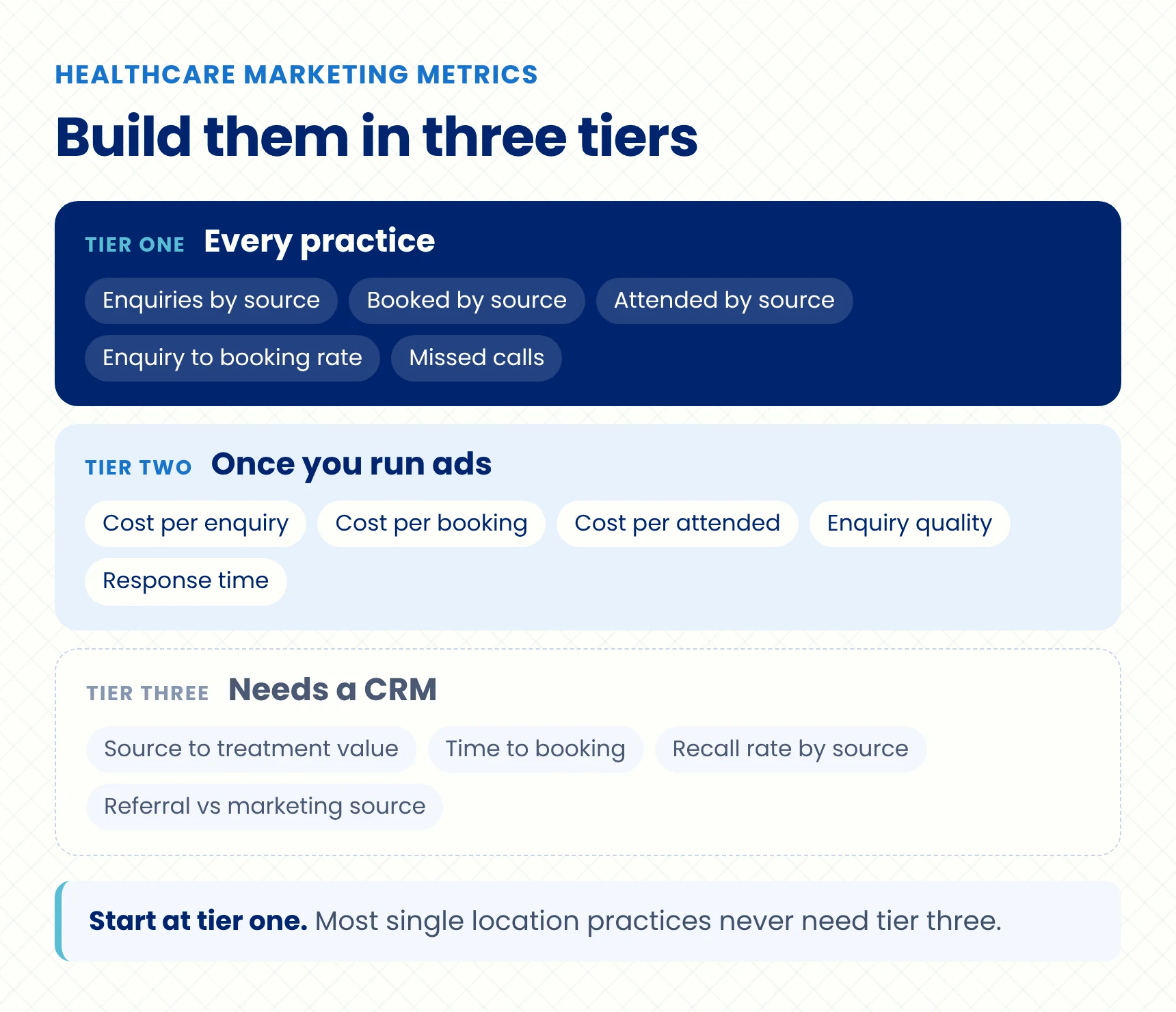
What metrics should healthcare providers track for marketing ROI?
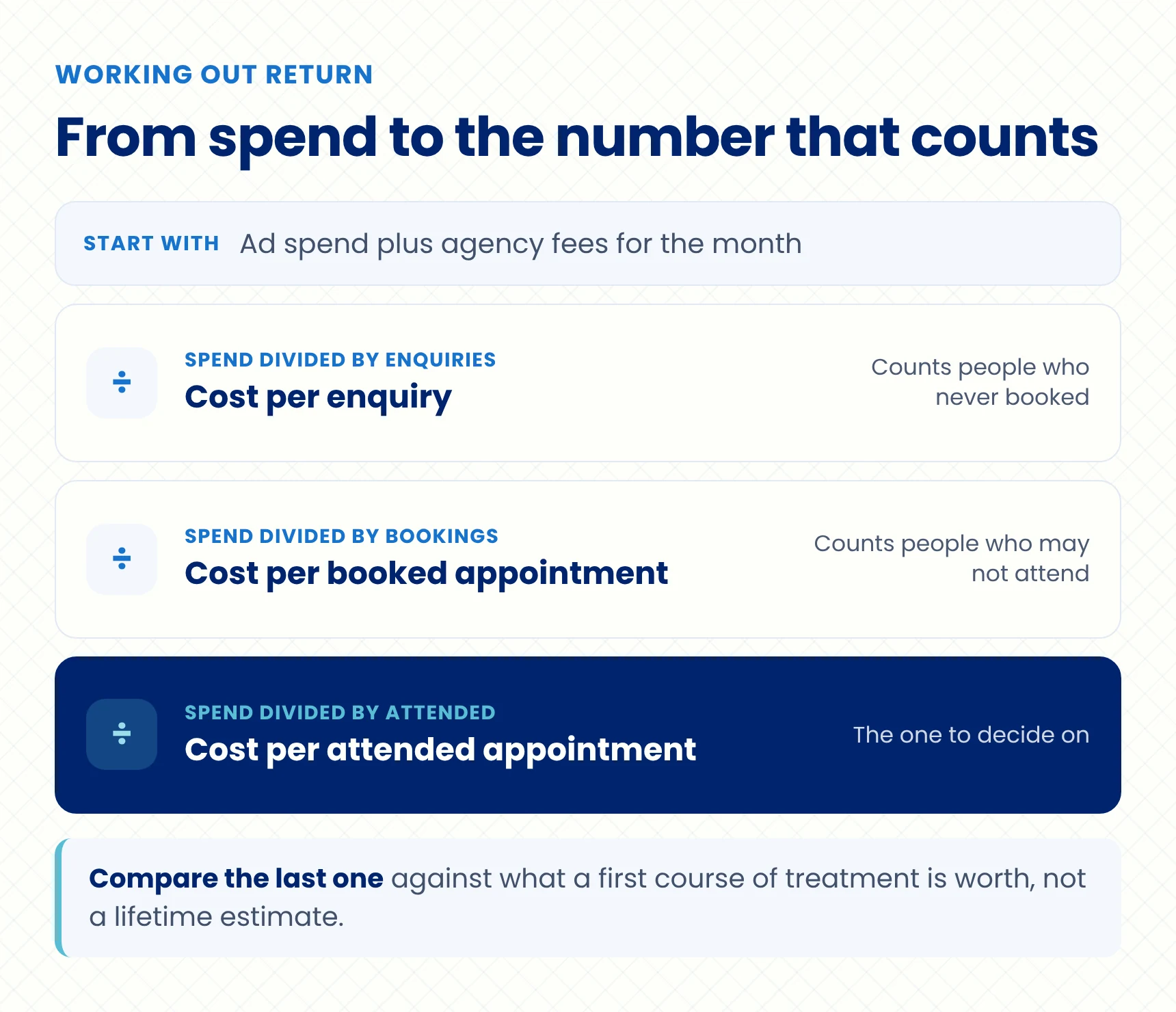
Cost per attended appointment, compared against what a patient is worth to you over a reasonable period. That is the whole answer. Everything else is either an input to that sum or a distraction from it.
The sum is simple. Take everything you spent on a channel in a month, including agency fees and ad spend. Divide it by the number of patients from that channel who attended. You now have a number you can hold against the value of a patient.
Patient value is the part people get wrong. Resist the urge to use a headline lifetime figure, because lifetime value assumes retention you have not proved yet. Start with the value of the first course of treatment, and add return visits only once you can see them in your own data.
Thinking of this as a healthcare marketing funnel helps, as long as you remember that the last two stages sit inside your practice, not inside your advertising. Which is why improvements there often beat anything you can do to the campaign itself.
One caution on attribution. When several things run at once, no model divides credit perfectly, and arguing about models wastes more time than it saves. If you want to know whether a specific effort caused a result, the cleaner approach is measuring a single campaign against a group that did not receive it.
Which healthcare marketing metrics mislead you
These numbers are not wrong. They are just routinely read as evidence of something they do not show.
Cost per lead
The most common one. It treats every enquiry as equal, so a channel producing price shoppers looks identical to one producing patients who book. Two campaigns can have the same cost per lead and a threefold difference in cost per attended appointment.
Impressions and reach
They measure how much you bought, not what happened. A rise in impressions with flat enquiries usually means you widened your targeting, which is a cost increase described as growth.
Rankings without clicks
Position one on a term nobody searches, or on a term where the answer appears directly in the results, produces no visits. Judge search by enquiries it generated, not by where you sit.
This is also changing quickly, as more answers appear inside search results and AI summaries, which means some visibility now produces no click at all. Our guide to generative AI in healthcare marketing covers what can and cannot be measured there today.
Bounce rate read on its own
A visitor who lands on your contact page, reads your phone number and calls you is recorded as a bounce. In healthcare, where the phone converts so much of the demand, a high bounce rate on contact pages is often a sign of success.
Total leads, counted loosely
The same patient calling twice and also filling in a form is three leads in most dashboards. Deduplicate before you believe any trend, especially when a number improves suddenly.
How healthcare marketing analytics works when patient data is protected
This is the part that makes healthcare different from every other industry, and the part most guides skip. The short answer is that you can measure a great deal, but not with the default setup, and the booking page is where the trouble starts.
What the rules say right now
In the United States, the relevant guidance is the Office for Civil Rights bulletin on online tracking technologies used by HIPAA covered entities, issued in December 2022 and revised in March 2024. It explains how the HIPAA rules apply to cookies, pixels and similar tools, and it states that it does not itself have the force of law.
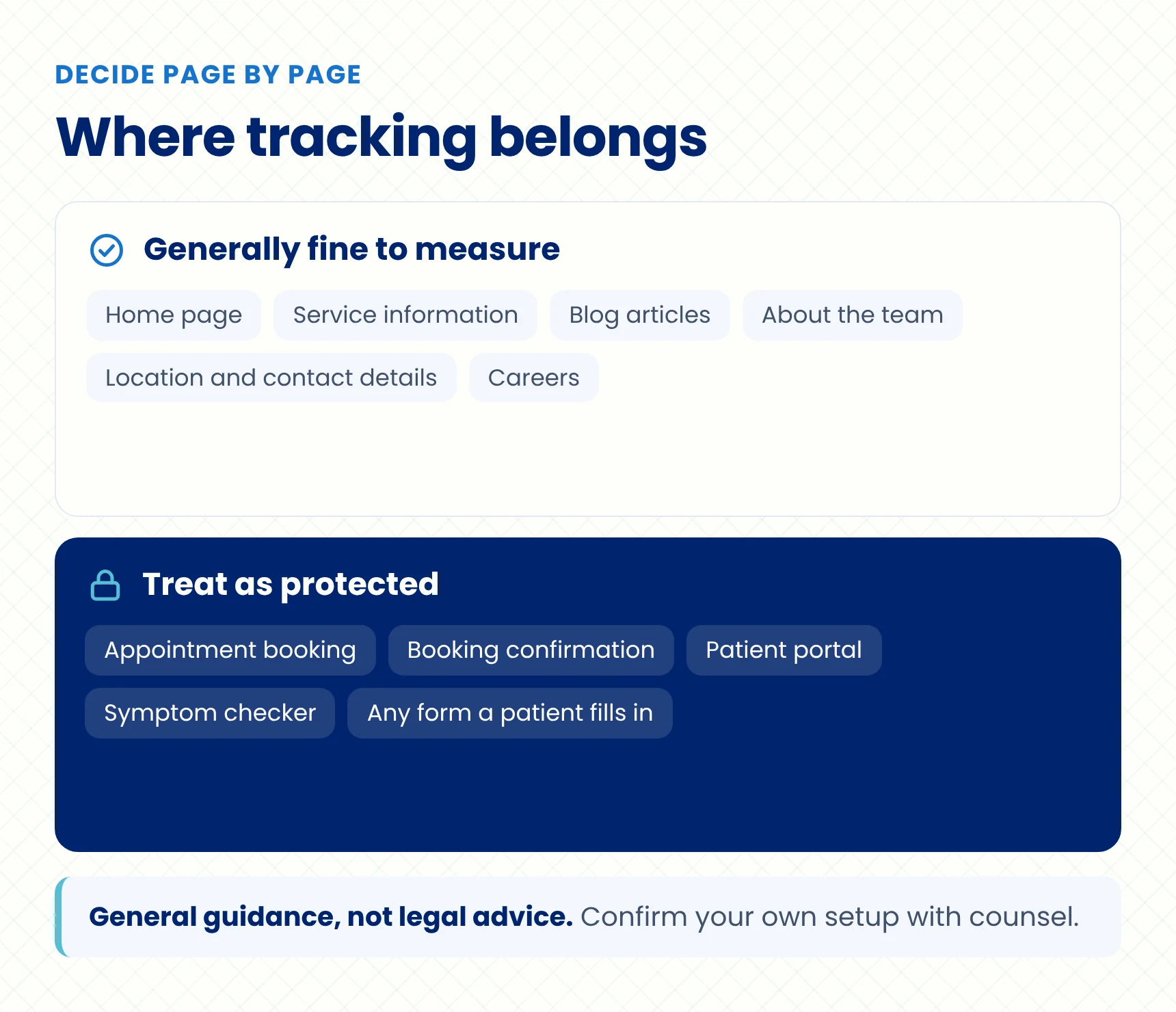
Its central distinction is between pages. On pages behind a login, such as a patient portal, tracking tools generally have access to protected health information, so they are regulated. On ordinary public pages, often they are not. The bulletin names important exceptions, including pages where someone schedules an appointment or uses a symptom checker.
Three other points in it catch practices out. A vendor handling protected information on your behalf is a business associate and needs an agreement with you. Mentioning the tracking in your privacy policy is not sufficient on its own. And a cookie banner is not a HIPAA authorization, however it is worded.
Part of that guidance no longer stands. In June 2024 a federal court in Texas vacated the portion that treated an IP address combined with a visit to a public page about a health condition as individually identifiable health information, finding that the department had exceeded its authority. The rest of the bulletin was left in place, and the court specifically noted that much of the remaining guidance was sound. The department has said it is considering its next steps.
In practice that narrowed the risk around informational pages. Someone reading your page about knee replacement is no longer automatically protected information under that theory. The exceptions the court left untouched, appointment scheduling among them, are the ones that matter most to marketing.
This is general guidance rather than legal advice, and tracking setups turn on specifics. Treat it as the starting point for a conversation with your own counsel, and fold the outcome into whatever you already do for healthcare marketing compliance.
The booking page is where practices get caught
Here is the collision. The single event every practice most wants to measure is the completed booking. It is also the event sitting on the page the guidance treats most carefully.
Google is direct about this. Its documentation on HIPAA and Google Analytics states that Google makes no representations that the service satisfies HIPAA requirements and does not offer business associate agreements for it. It says regulated customers may only use Analytics on pages that are not HIPAA covered, that pages behind a login are likely to be covered, and that unauthenticated pages tied to the delivery of care are more likely to be covered than ordinary ones.
Read together, that means the common setup, where a practice drops the same analytics and advertising tags across every page including the booking confirmation, is the thing to look at first. It is also usually fixable in an afternoon.
What to do instead
- Audit which tags fire on which pages. Most practices have never checked, and often find tags nobody remembers adding, left behind by a previous agency.
- Keep third party tags off booking, portal and symptom checker pages, and off any page where a patient types information about themselves.
- Count the booking in your own systems. Your practice management system already records it, and that record is better evidence than a browser event anyway.
- Measure the step before. Tracking that someone reached the booking page tells you nearly as much as tracking the completion, without carrying the same information.
- Use call tracking that will sign an agreement with you, and check that recordings and transcripts are handled accordingly.
- If you need to send results back to an ad platform, work out with your counsel what can be shared, and consider a platform that will sign an agreement and de-identify first.
None of this stops you from running measurable marketing. It changes where the measurement happens. The practices that handle this well tend to rely more on their own systems and less on the browser, which usually makes their numbers better as well as safer.
If your business is not covered by HIPAA
Plenty of health businesses are not covered entities. Med spas, aesthetic clinics, wellness providers, supplement sellers and most health apps often fall outside HIPAA, and many assume that means nothing applies. It does not work that way. The Federal Trade Commission’s Health Breach Notification Rule covers health apps and similar technologies that HIPAA does not reach, and when the commission finalised changes to that rule in April 2024, it confirmed that a breach of security includes an unauthorised acquisition of health information arising from a disclosure, not only from a hack. The amended rule took effect in July 2024.
In plain terms, sending health information to an advertising platform without proper consent can itself be the problem, even though nobody broke in.
How to build a baseline when no credible benchmark exists
You will see plenty of articles quoting an average conversion rate or an average cost per patient for healthcare. Look at where those numbers come from and you will nearly always find an agency or a software vendor, with no sample size, no definition of a lead, and no method published. They are marketing material. Comparing yourself to them tells you nothing.
Your own history is a far better benchmark, and you can build one in a quarter.
After two quarters you have something no benchmark can give you: a reliable picture of your own practice, your own market and your own front desk.
What a useful analytics report contains
One page. The healthcare marketing metrics from tier one, the cost figures if you are spending, a comparison against the previous period and the same period last year, and a short note on what changed and what happens next.
The last line matters more than it looks. Honest reporting of what cannot be measured is a good sign. Reports with no gaps are usually hiding them.
If someone else produces your reporting, the standard is simple. You should be able to read it in five minutes and know what to do next. When you are reviewing providers, our list of questions to ask a marketing agency includes the reporting questions worth asking before you sign anything.
Where The Healthcare Marketing fits
We work only with healthcare organisations, which means tracking that respects patient privacy is part of how we build things rather than something bolted on afterwards. For most clients the first month is spent connecting enquiries to the schedule, because until that works, nothing else can be judged.
That first month is also where the uncomfortable findings usually appear. Calls going unanswered at lunchtime, a booking form that has been broken on mobile for a quarter, two different teams counting enquiries differently. Fixing those tends to produce more patients than any change to the advertising.
Our healthcare digital marketing services include measurement setup, call tracking, reporting and the campaigns themselves. We also review existing setups for practices who already have an agency and simply want to know whether the numbers they receive are real.
Frequently asked questions
What healthcare marketing metrics should a small practice track first?
Enquiries, bookings and attendances by source, plus your enquiry to booking rate and missed calls. Five numbers answer almost every question a small practice has, and none of them need expensive software.
Is Google Analytics HIPAA compliant for a medical practice?
Google states that it makes no representations that Google Analytics meets HIPAA requirements and does not offer business associate agreements for it. Covered practices should keep it off portal, booking and symptom checker pages and confirm the specifics with their own counsel.
What is a good conversion rate for a healthcare website?
There is no trustworthy published figure, because nearly every quoted benchmark comes from an agency or vendor with no stated method. Measure your own rate for ninety days and improve on that instead.
How do I track which marketing brought in a patient?
Use call tracking for phone enquiries, capture the source on every form, and record it against the appointment in your practice management system. The record in your own system is what makes the answer reliable.
How long before healthcare marketing results show in the numbers?
Paid search can show enquiries within days. Search engine optimisation and content usually take three to six months before the trend is clear. Judge both on bookings rather than traffic.
What is the difference between a lead and a new patient in marketing reports?
A lead is anyone who got in touch. A new patient attended an appointment. The gap between the two is often fifty percent or more, which is why reports built on leads alone tend to look better than reality.
Can I use conversion tracking on my appointment booking page?
Treat that page carefully, because the official guidance names appointment scheduling as an area where information is protected. Many practices measure arrival at the booking page instead and count the completed booking inside their own system.
Do small practices need a CRM to measure marketing?
Usually not at first. A practice management system plus call tracking and a consistent source field will answer the main questions. A CRM earns its place when decision cycles are long or you run several locations.
What should a monthly healthcare marketing report include?
Enquiries, bookings and attendances by source, cost per attended appointment, comparisons against previous periods, and a short note on what changed. If it takes longer than five minutes to understand, it is too long.
How much should I spend on marketing measurement and tracking?
Call tracking and a properly configured analytics setup usually cost a small fraction of a monthly ad budget. The expensive part is staff time keeping records consistent, and that is still cheaper than guessing.
Where to start if you only do one thing
Pick last month. Count how many people got in touch, how many booked, and how many attended. Do it by hand if your systems will not tell you, and group them by where they came from, even roughly.
Most practices find something uncomfortable in that first count, and it is almost never the campaign. It is the calls that were missed, or the enquiries that waited two days for a reply. That is good news, because those cost nothing to fix.
Once you have that one month on paper, every other decision gets easier, and the rest of the healthcare marketing metrics in this guide have something solid to attach themselves to.