Most lists of the best healthcare marketing campaigns are built from award entries and agency case studies. They show striking creative and quote impressive results, but the results are rarely independently checked, and the budgets behind them are usually far beyond anything a practice or regional hospital will ever spend.
This guide takes a stricter approach. Every campaign below has results you can verify from the organization that ran it or from a peer-reviewed study. Two of them are campaigns that went badly wrong, because those teach as much as the successes. After the examples, you will find campaign templates sized for a practice, a planning sequence, and a way to measure healthcare marketing campaigns by bookings rather than clicks.
One honest caveat before starting. The campaigns with the best published evidence are mostly public health programs and large health systems. Very few practices publish their results. So the useful question is not how to copy these campaigns, but what they prove that a much smaller organization can use.
What makes a healthcare marketing campaign successful?
A successful healthcare marketing campaign changes a specific behaviour in a specific group of people, and can show that it did. That usually means one clear audience, one action you want them to take, a message they believe, a channel that reaches them near the moment they would act, and measurement planned before launch.
Notice what is missing from that list: reach, awareness and creative awards. Those can matter, but they are not the result. For a practice, the result is booked and attended appointments. For a public health program, it is people changing what they do. A campaign that is widely seen and changes nothing is not successful, however good it looks.
Why are most “best campaign” lists not much use?
Because the evidence behind them is weak. Award entries are written by the agencies that made the work, results are often self-reported, and the comparison that would show whether the campaign caused anything is usually missing. They also skew towards very large budgets and national brands.
That does not make big campaigns irrelevant. It means you need to know what they proved, separate it from what they spent, and translate the principle to your own scale. That is what each breakdown below tries to do.
Which healthcare marketing campaign examples have published results?
The four below all have results published by the organization that ran them or by peer-reviewed researchers. Two are national public health campaigns. Two are health system messaging programs, and one of those did not work, which is exactly why it is included.
CDC Tips From Former Smokers
The US Centers for Disease Control and Prevention launched Tips From Former Smokers in 2012. Instead of statistics or warnings, it featured real people living with serious long-term health effects from smoking, and family members caring for them, telling their own stories.
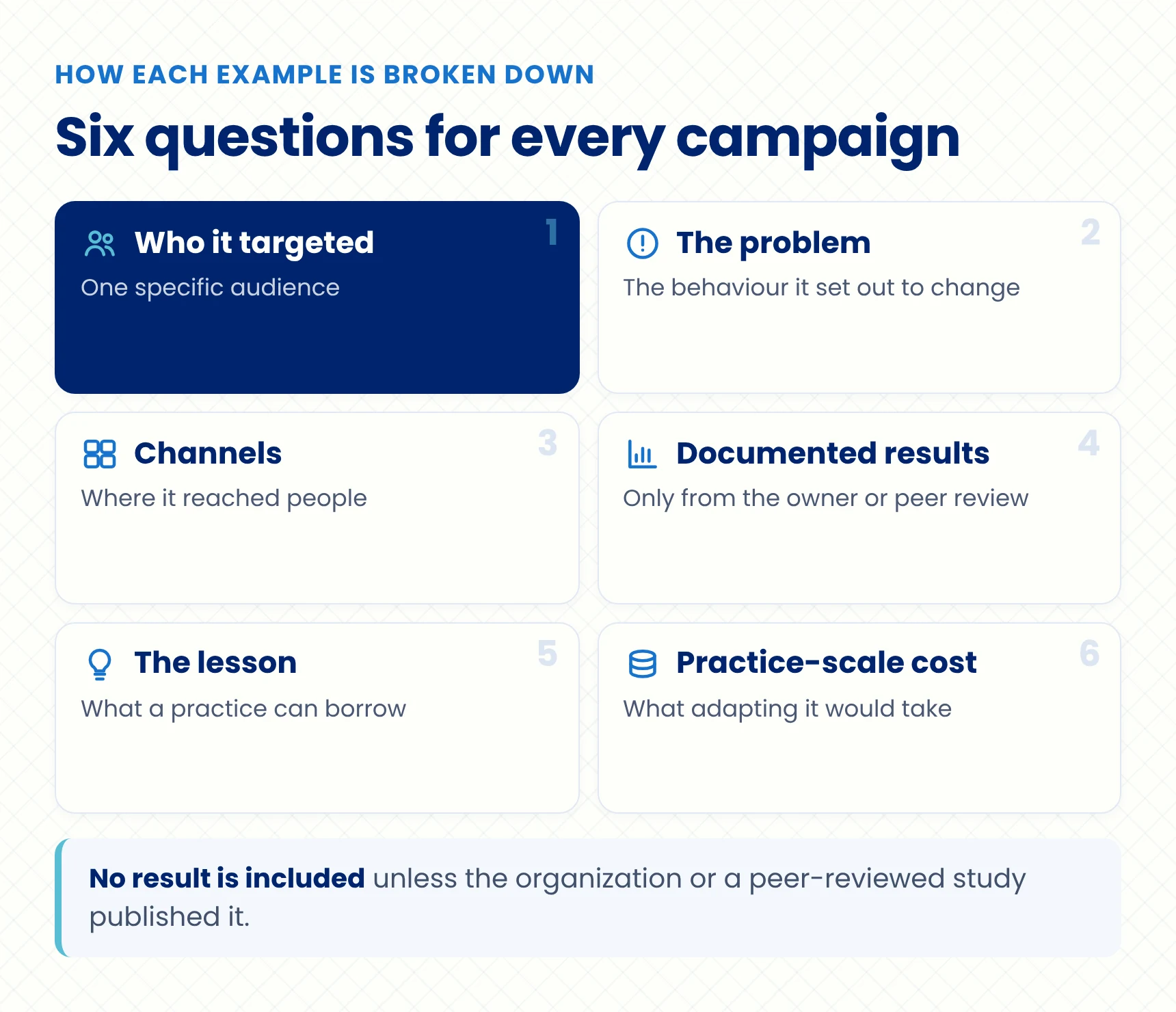
- Who it targeted: adults who smoke, nationally.
- The problem: people who smoke underestimate personal, day-to-day consequences.
- Channels: paid media nationally, a campaign website, social media and promotion of the 1-800-QUIT-NOW quitline.
- What is documented: CDC’s published impact results estimate that from 2012 to 2018, more than 16.4 million people who smoke attempted to quit and about one million quit for good because of the campaign, with the campaign also generating over two million additional quitline calls between 2012 and 2023.
- The lesson for a practice: real patients describing a real experience, with permission, are more persuasive than claims. Pair the story with one easy next step.
- Practice-scale cost: a short series of consented patient stories, filmed simply, plus a clear booking action. Mostly staff time and modest production.
FDA The Real Cost
The US Food and Drug Administration launched The Real Cost in 2014 as its first tobacco prevention campaign, aimed at teenagers at risk of starting to smoke. FDA says the ads are built from research with teens about which messages they find believable and motivating.
- Who it targeted: young people aged 12 to 17 at risk of smoking.
- The problem: a hard-to-reach audience that ignores conventional health messages.
- Channels: streaming video and audio, social platforms used by teens, gaming-focused advertising and influencers.
- What is documented: FDA’s campaign page states the campaign prevented up to 587,000 young people aged 11 to 19 from starting to smoke between February 2014 and November 2016.
- The lesson for a practice: test messages with the actual audience before you spend. What you find persuasive may not be what they do.
- Practice-scale cost: ask ten real patients from the target group to react to two or three draft messages. It costs a few hours and prevents spending on the wrong one.
Penn Medicine and Geisinger flu shot text messages
In a large study run with Penn Medicine and Geisinger, researchers tested 19 different text messages sent to primary care patients before upcoming appointments, to see which ones increased flu vaccination. The work was published in a peer-reviewed journal in 2021.
- Who it targeted: about 47,000 primary care patients with a scheduled appointment.
- The problem: patients attending appointments without getting a recommended flu shot.
- Channels: text messages only.
- What is documented: the study reported that texts sent before a primary care visit boosted vaccination rates by an average of 5 percent. According to the University of Pennsylvania’s summary, the best-performing set was two texts, sent 72 and 24 hours before the visit, saying a flu shot had been reserved for the patient, which boosted vaccination rates by 11 percent.
- The lesson for a practice: the moment matters more than the channel. A specific, personal message tied to something the patient has already booked works.
- Practice-scale cost: almost nothing if your booking system already sends texts. It is a change of wording and timing.
UCLA Health portal and text reminders
UCLA Health ran a randomized trial across 79 primary care practices in the 2022 to 2023 flu season, comparing monthly patient portal reminders, monthly text reminders and no reminders. It is included because it shows what happens when the channel is right but the moment is not.
- Who it targeted: about 262,000 primary care patients across the health system.
- The problem: raising flu vaccination across a whole patient population.
- Channels: patient portal messages or text messages, monthly.
- What is documented: the published trial found all three groups had vaccination rates of about 47 percent, and the authors concluded that at the population level neither portal nor text reminders were effective.
- The lesson for a practice: sending more generic reminders to everyone is not a campaign. Without a specific moment, a specific ask or a specific audience, the channel alone does very little.
- Practice-scale cost: the cost here is the wasted effort. Check whether your own broadcast reminders are changing anything before adding more.
What do these four campaigns have in common?
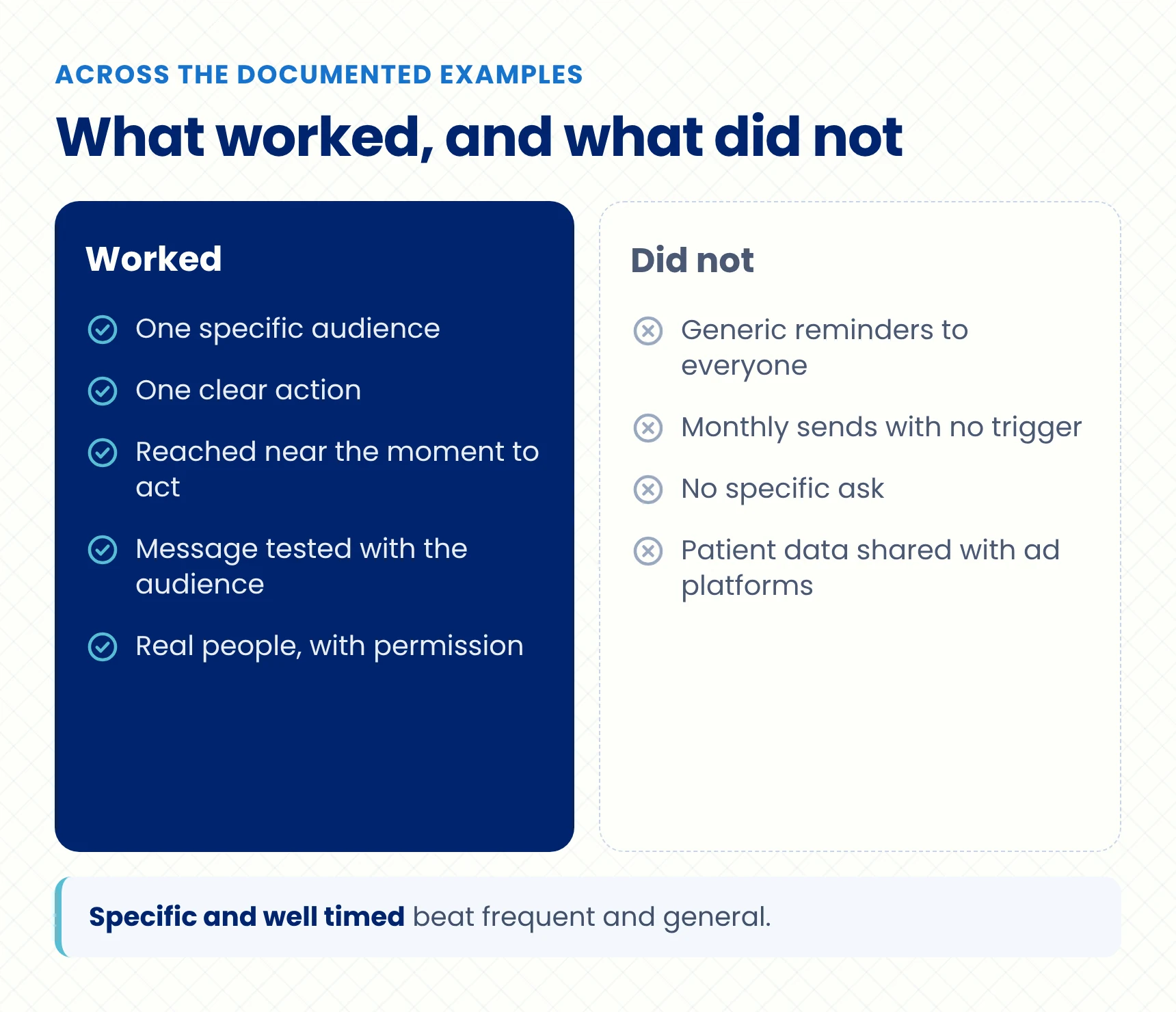
The ones that worked were specific. Tips used real people and one clear action. The Real Cost was built on testing with its audience. The Penn texts reached patients at the exact moment they could act, with a personal message. The UCLA reminders were well run but general, and the population did not respond.
For a practice, that is encouraging. None of the lessons depend on a national budget. They depend on choosing one audience, one action and the right moment, and those are decisions, not expenses.
Which healthcare marketing campaigns went wrong, and why?
The most expensive campaign mistakes in recent years were not bad creative. They were privacy failures, where health companies shared sensitive information with advertising platforms to target their ads. Both cases below ended in action by the US Federal Trade Commission.
GoodRx
In February 2023, the FTC announced its first enforcement action under the Health Breach Notification Rule, against GoodRx. The FTC said GoodRx shared users’ prescription medication and health condition information with Facebook, Google and other companies despite promising it would never share personal health information with advertisers, and used some of that data to target its own users with health-related ads.
GoodRx agreed to a 1.5 million dollar civil penalty and a permanent ban on sharing user health information with third parties for advertising. The FTC also said the company displayed a seal suggesting HIPAA compliance that it was not entitled to use.
The case matters beyond apps. It showed that the FTC treats sharing health information with ad platforms, without proper consent, as a breach in its own right, even when nobody was hacked. Many health companies that assume HIPAA does not apply to them are covered by these rules instead.
BetterHelp
In July 2023, the FTC gave final approval to an order against BetterHelp, the online counselling service. The FTC said BetterHelp disclosed people’s email addresses, IP addresses and health questionnaire information to Facebook, Snapchat, Criteo and Pinterest for advertising, after promising to keep that data private.
BetterHelp agreed to pay 7.8 million dollars, used for partial refunds to consumers, and was banned from sharing health data for advertising and from using personal information for retargeting.
What do these cases mean for your own campaigns?
Do not upload patient lists to ad platforms to build audiences, and do not let tracking code send health information from booking, intake, symptom or portal pages to advertising platforms. That applies whether you are covered by HIPAA or, like many health apps, by the FTC’s rules instead.
Build audiences from context instead: the service people are searching for, the area they live in, the content they read. It is less precise, but it is the version that does not end in an enforcement action. Healthcare marketing compliance deserves its own review before any targeted campaign goes live.
What healthcare marketing campaigns can a practice actually run?
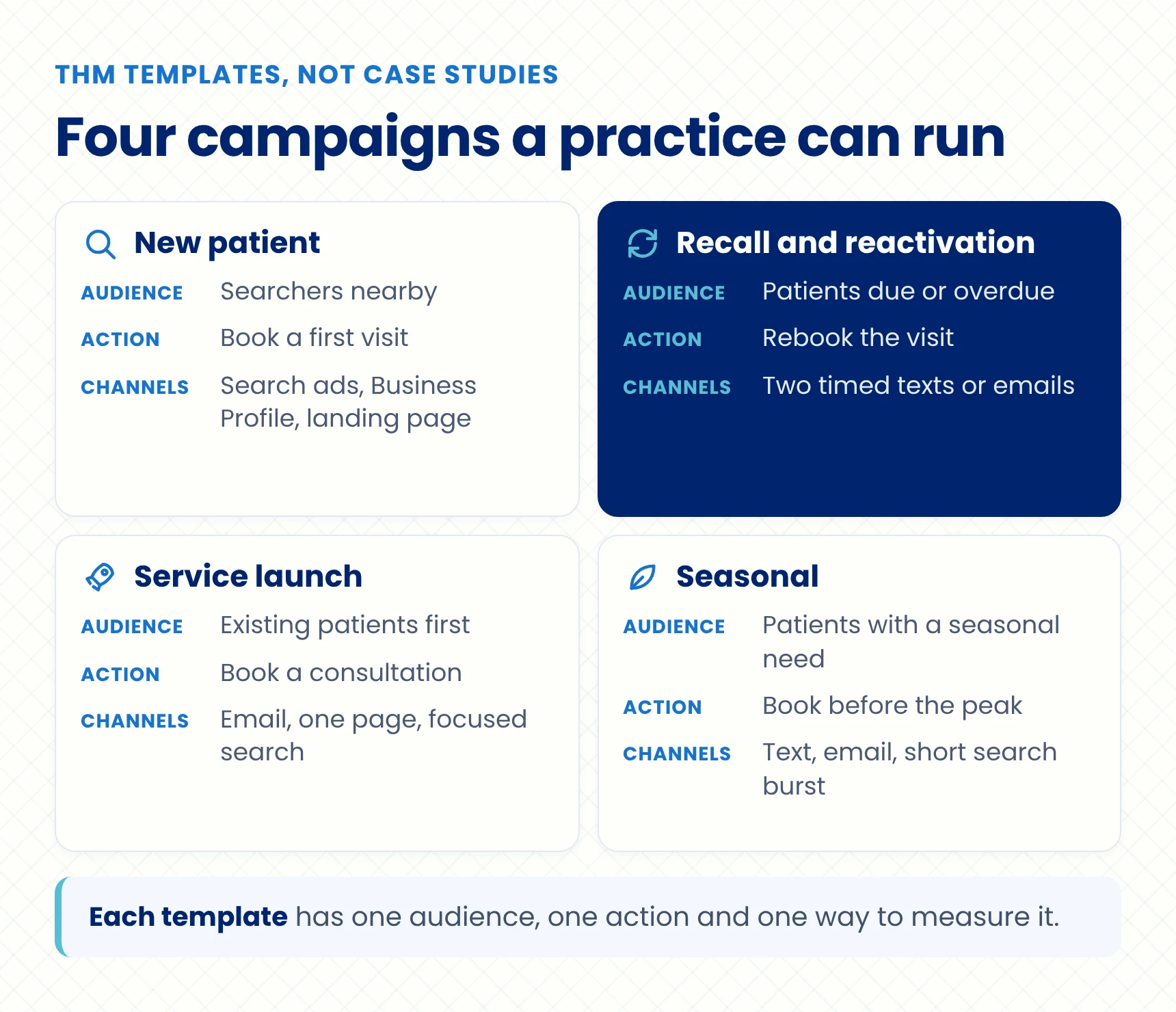
The four templates below are THM templates, not case studies. They apply the principles from the documented examples at a scale a practice can manage. Budget ranges are rough guides from practice experience and vary with your market, specialty and competition.
Each assumes the foundations are already in place: an accurate listing, a website that answers patients’ questions and a booking process that works. If those still need attention, our article on healthcare marketing ideas covers them first, because a campaign only amplifies what is already there.
New patient campaign
Audience: people in your area searching for the service you are best placed to provide. Action: book a first appointment online or by phone. Channels: paid search, your Google Business Profile and a landing page that answers the questions people ask before booking.
Make the offer specific, such as same-week appointments or a named service, rather than a general welcome. Then make sure enquiries are answered quickly, because patient lead generation only pays off if someone books when they call.
Recall and reactivation campaign
Audience: existing patients who are due or overdue for a visit, check-up or follow-up. Action: book the visit they are due. Channels: text and email, timed to when each patient is actually due.
This is the closest practice equivalent to the Penn text study. Send two short, personal messages close to the due date, tell the patient what is waiting for them, and make rebooking a single step. A healthcare CRM or your practice management system needs to know who is due and how each patient prefers to be contacted.
Service launch campaign
Audience: existing patients who would benefit, plus new patients searching for the service. Action: book a consultation for the new service. Channels: email to existing patients, a dedicated page, and focused search ads.
Start with existing patients, who already trust you, before spending on new ones. For the search side, paid healthcare campaigns work best when they point to a page about that one service, not your homepage.
Seasonal campaign
Audience: patients affected by a predictable seasonal need, such as flu vaccination, back-to-school checks, allergy season or end-of-year benefit deadlines. Action: book before the season peaks. Channels: text and email to existing patients, social posts, and a short search campaign.
Plan seasonal campaigns at least six weeks ahead, because the window is short and late campaigns compete with everyone else. Use the same specific, timed messaging that worked in the documented examples.
| Template | Main channels | Rough monthly budget | Measure |
|---|---|---|---|
| New patient | Search ads, Business Profile, landing page | Low four figures in ad spend for most local markets | Booked new patients by source |
| Recall and reactivation | Text and email | Mostly staff time and messaging costs | Overdue patients rebooked |
| Service launch | Email, dedicated page, search ads | Low to mid four figures for the launch period | Consultations booked for the service |
| Seasonal | Text, email, social, short search burst | Low, concentrated in a few weeks | Seasonal bookings versus last year |
How do you plan a healthcare marketing campaign?
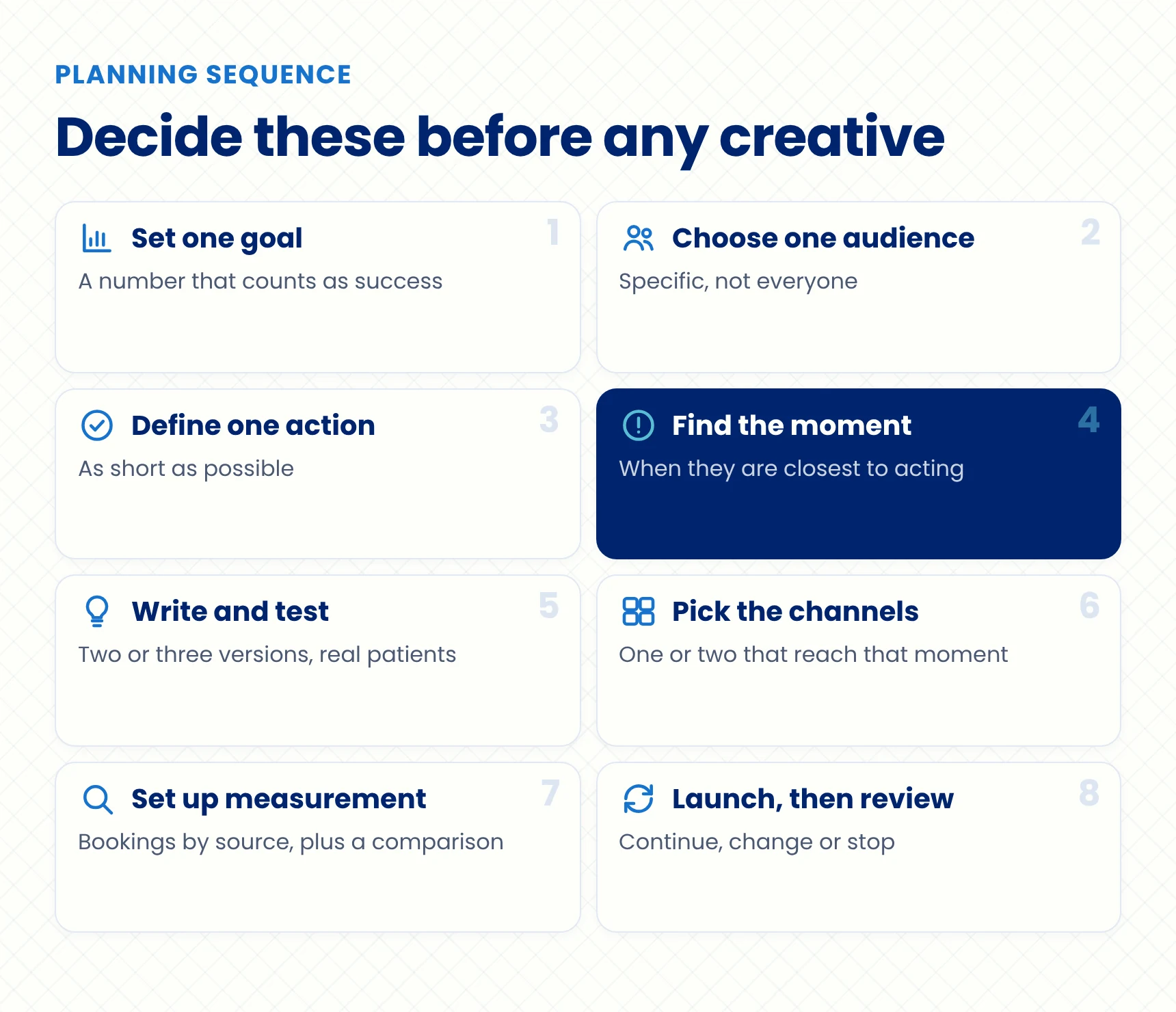
Work through the decisions in order, and do not start on creative until the first four are settled. Most failed campaigns skipped straight to the ad.
If your audience includes communities with different languages or cultural expectations, plan for that at step two rather than translating at the end. Culturally relevant healthcare marketing works best when the message is written for the audience from the start, and reviewed clinically if it is translated.
When a campaign uses more than one channel, the messages need to agree and arrive in a sensible order. Our guide to coordinating your marketing channels covers how to stop email, text and ads from contradicting each other.
Campaigns work best when they serve a wider plan rather than replacing one. Each campaign should push forward something your marketing strategies in healthcare already prioritize, not chase a new idea every quarter.
How do you measure a healthcare marketing campaign?
Count booked and attended appointments by source, and compare them with what would have happened without the campaign. Clicks, opens and impressions tell you whether people saw it. Bookings tell you whether it worked.
The trials in this guide could prove their results because they compared people who received the messages with people who did not. A practice can do a simple version: hold back a random portion of the patients on a recall list, send the campaign to the rest, and compare rebooking rates after a month. For new patient campaigns, compare bookings by source against the same period last year.
Pick a small set of healthcare marketing metrics per campaign and decide them before launch: bookings, attended appointments, cost per booked patient, and for recall campaigns, the share of overdue patients who rebooked. Everything else is supporting detail.
What about creative trends in healthcare campaigns?
Trends in format change every year: short video, clinician-led content, interactive tools. The principles in the documented examples have held for more than a decade. Pick a format because it reaches your audience at the right moment, not because it is new.
For the formats and channels worth acting on next year, and the ones to skip, see our review of current healthcare marketing trends.
Where The Healthcare Marketing fits
The Healthcare Marketing is a digital marketing, website development and app development agency that works exclusively with healthcare and healthcare adjacent businesses. For campaigns, that means we start from the audience, the action and the measurement, and treat privacy rules on targeting as a starting constraint rather than an afterthought.
We offer a free marketing audit and review. For a campaign, that usually covers whether the audience and action are specific enough, whether your tracking can show real bookings, and whether anything in your targeting or tracking puts patient information at risk.
When you want help running one, our healthcare campaign management covers planning, search, paid media, email, landing pages and measurement.
Frequently asked questions
What are some successful healthcare marketing campaign examples?
Well-documented examples include the CDC’s Tips From Former Smokers and the FDA’s The Real Cost, both with published results. In health systems, a Penn Medicine and Geisinger study showed that well-timed text messages raised flu shot rates.
What makes a healthcare marketing campaign successful?
One clear audience, one action, a believable message and a channel that reaches people near the moment they would act. Success is measured by changed behaviour, such as booked and attended appointments, not by reach or awards.
How much does a healthcare marketing campaign cost for a small practice?
It varies widely. Recall campaigns using text and email can cost little beyond staff time, while new patient search campaigns in a competitive local market often need a few thousand dollars a month in ad spend.
Do text message reminders really increase appointments or vaccinations?
They can, when they are timed well. A large Penn Medicine and Geisinger study found texts before scheduled visits increased flu vaccination, while a UCLA Health trial of monthly reminders to all patients found no effect.
Can a practice use patient lists to target ads on Facebook or Google?
It is very risky and in many cases not allowed. The FTC took action against GoodRx and BetterHelp for sharing health information with ad platforms, so build audiences from location, search intent and content instead.
What is the best healthcare email marketing campaign for a practice?
Usually a recall or reactivation campaign sent close to when each patient is due, with a personal message and a one-step way to rebook. It works because it is specific and well timed, not because it is email.
How do you measure whether a healthcare campaign worked?
Track booked and attended appointments by source and compare them with a group that did not receive the campaign, or with the same period last year. Clicks and opens only show that people saw it.
Should a healthcare campaign use real patient stories?
Real stories can be very persuasive, as the CDC’s Tips campaign shows, but only with clear written permission. Avoid implying typical results from one patient’s experience, and keep identifying health details out unless the patient has agreed.
How far ahead should a seasonal healthcare campaign be planned?
At least six weeks before the season peaks. That gives time to settle the audience and message, set up tracking and reach patients before competitors fill the same window.
Are award-winning healthcare ads good examples to copy?
Treat them with caution. Award results are usually reported by the agency that made the work, the budgets are large, and the evidence that the campaign caused the result is often missing.
Where to start if you only do one thing
Take your existing recall or reminder messages and rewrite one of them using the pattern from the Penn study: two short messages, close to the moment the patient is due, saying something specific is waiting for them, with a single step to book.
Then hold back a small group of patients who get your current message instead, and compare rebooking after a month. It costs almost nothing, and it gives you your own evidence about what works for your patients.