Somebody on your team is already using AI. They are drafting social posts with it, rewriting service pages with it, or pasting a patient’s message into a chatbot to work out how to reply. Most practices find this out by accident.
The question is not whether to allow it. That decision has usually already been made for you. The question is where the line sits: which marketing work AI can genuinely speed up, and which work it quietly makes riskier, slower or less effective than doing it properly.
This guide answers both halves honestly, including the parts most agencies skip.
The short version
- 1Never put patient information into a general AI tool. If a vendor handles patient data for you, you almost certainly need a signed agreement first.
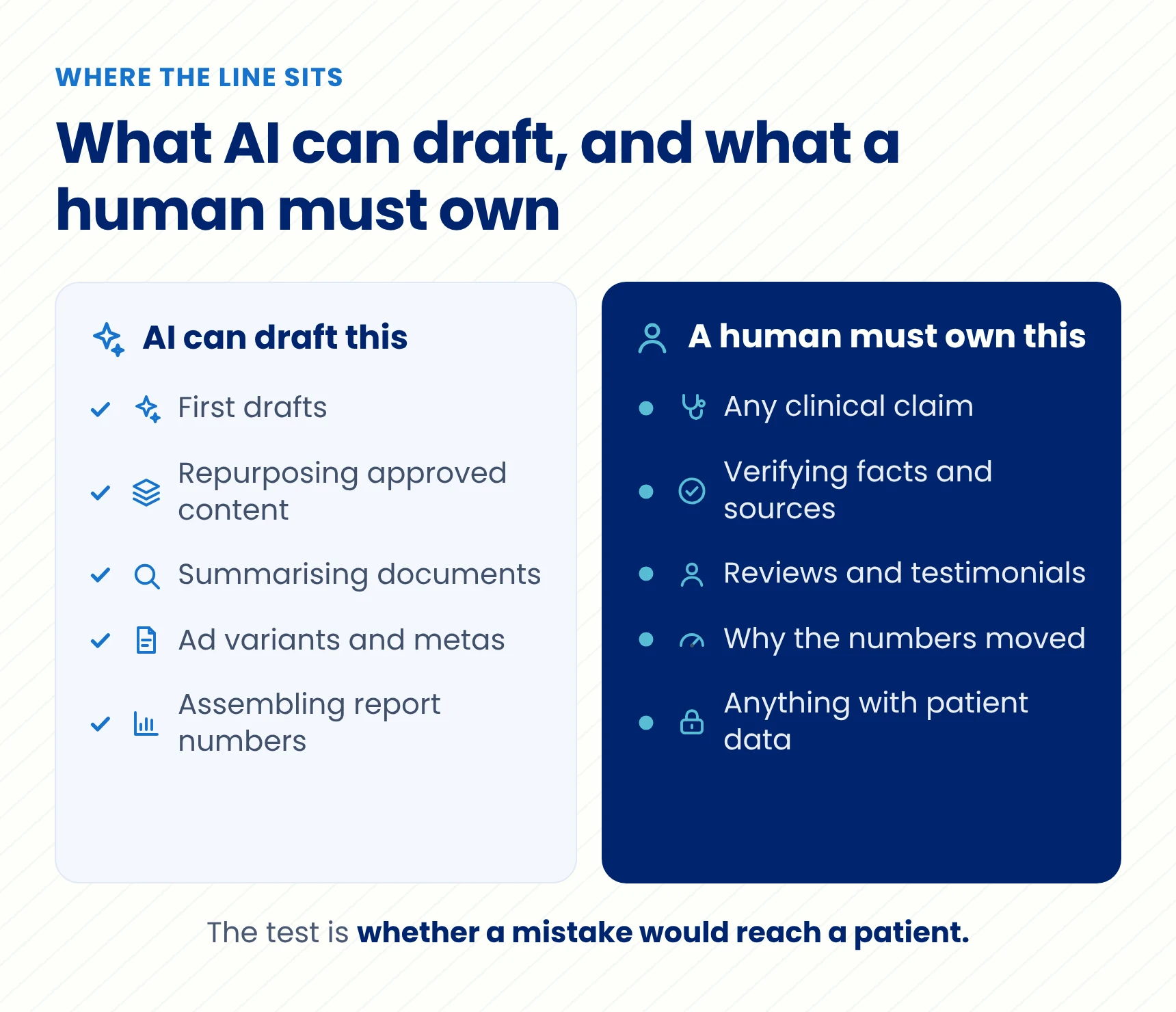
- 2AI is good at drafts, structure, summaries and variations. It is bad at facts, clinical claims and judgement.
- 3Anything clinical needs a qualified human reviewer before it publishes. Every time, not occasionally.
- 4AI cannot write your reviews or testimonials. That is a rule with financial penalties attached, not a best practice.
- 5Google does not penalise AI content for being AI. It penalises content with nothing in it, which is what unreviewed AI content usually is.
- 6AI-generated reporting commentary is confident and often wrong. Check the numbers it describes before anyone acts on them.
- 7If your agency uses AI, you are entitled to know where and how. Ask.
What does AI in healthcare marketing actually mean right now?
AI in healthcare marketing means using generative AI tools to do parts of your marketing work faster: drafting copy, summarising research, generating ad variations, assembling reports, transcribing calls, and answering routine questions. It does not mean handing your marketing to software and walking away, and in healthcare it cannot mean that, because too much of the output carries clinical or legal weight.
The practical version for most practices is narrower than the marketing of these tools suggests. AI shortens the distance between a blank page and a usable draft. It does not shorten the distance between a usable draft and something safe to publish, and in healthcare that second gap is the expensive one.
What are healthcare teams actually using AI for?
In the practices and healthcare businesses that use it well, AI is doing unglamorous work: turning a recorded consultation workflow into a written process document, drafting twelve versions of an ad headline so a human can pick two, summarising a long guideline document into something a front desk team can read, and writing the first pass of a service page that somebody then rewrites properly.
Where it goes wrong is almost always the same pattern. Somebody uses it to produce finished patient-facing content, nobody with clinical knowledge reads it closely, and it publishes with a claim in it that the practice cannot support. The tool did not fail. The review step was missing.
How big is the AI in healthcare market, and does that number matter to you?
Published forecasts put the AI in healthcare market in the tens of billions of dollars now, growing to several hundred billion within a decade. One forecast from Nova One Advisor, published in November 2025, estimated roughly 37 billion US dollars in 2025 rising to around 702 billion by 2034. Other firms publish different figures, sometimes very different, because each one counts a different set of products.
Here is the part that matters for your planning. Almost none of that spending is marketing. The AI in healthcare market growth you read about is dominated by clinical applications: imaging and diagnostics, drug discovery, clinical decision support, documentation and coding. Generative AI in healthcare and conversational AI in healthcare are both counted mostly as clinical or operational tools, not promotional ones.
So treat the headline number as context, not as a budget signal. The size of the AI opportunity in healthcare says almost nothing about whether an AI writing tool will improve your service pages. That depends on your content, your review process and your market, not on an industry forecast.
Where does AI genuinely help a healthcare marketing team?
These are the uses that hold up. Every one of them has AI producing something a human then takes responsibility for.
First drafts and structure
Getting from nothing to a rough draft is where AI saves the most real time. Give it the brief, the audience, the key points you want covered and the constraints, and it will produce a structured starting point in seconds. Expect to rewrite most of it. That is still faster than starting cold.
This works best when you already know what the page should say. It works badly as a substitute for deciding that. If you are using AI because you do not know what to write, you will get content that reads fine and says nothing, which is the most common failure in healthcare content marketing right now.
Turning one asset into several
A single recorded talk, webinar or long guide can become a set of social posts, an email, a short FAQ and a summary for the newsletter. AI is genuinely good at this because the source material already exists and the facts are already settled. The risk is low because you are reshaping approved content rather than generating new claims.
Summarising research and long documents
Guideline updates, payer policy documents, competitor sites, survey reports: AI will compress these quickly and accurately enough to tell you whether something deserves your full attention. Treat the summary as a triage tool. If you are going to act on a detail, open the source and read that part yourself.
Ad variations and meta descriptions
Generating twenty headline variants or a batch of meta descriptions is exactly the kind of repetitive, low-risk, high-volume work AI suits. A human still picks, edits and checks character limits and claims. For regulated categories, every variant still needs the same review as any other ad copy.
Assembling reports, not interpreting them
AI can pull numbers into a consistent format, describe what changed and save your team an hour of copy-paste. What it should not do unsupervised is explain why the numbers moved. More on that below, because this is where it fails most convincingly.
Transcription and internal documentation
Meeting notes, call transcription for internal training, process documentation, standard operating procedures for front desk staff. Low risk, immediate value, no patient-facing output. If you only adopt AI in one place, start here.
| Task | AI can do | A human must still do |
|---|---|---|
| Blog and page drafts | Outline, first draft, rewrite for tone | Verify every factual and clinical claim, rewrite for substance |
| Social and email | Variants, repurposing approved content | Approve claims, check it sounds like your practice |
| Ad copy | Generate variants in bulk | Compliance review, platform policy check, final selection |
| Reporting | Assemble and format the numbers | Explain why they moved, decide what to do |
| Patient-facing answers | Draft suggested wording internally | Review and send. Never auto-send clinical content |
| Reviews and testimonials | Nothing | All of it. These must be real |
Not sure whether AI has already crept into your marketing?
We will review your site, content and search visibility, and tell you where output looks machine-generated and unreviewed, where claims need checking, and what to fix first. No charge, no obligation.
Where does AI create real risk in healthcare marketing?
This is the half of the topic most articles skip, and it is the half that decides whether AI in healthcare marketing is worth doing at all. None of these risks are hypothetical, and most of them stay invisible until something goes wrong.
What happens when patient information goes into a public AI tool?
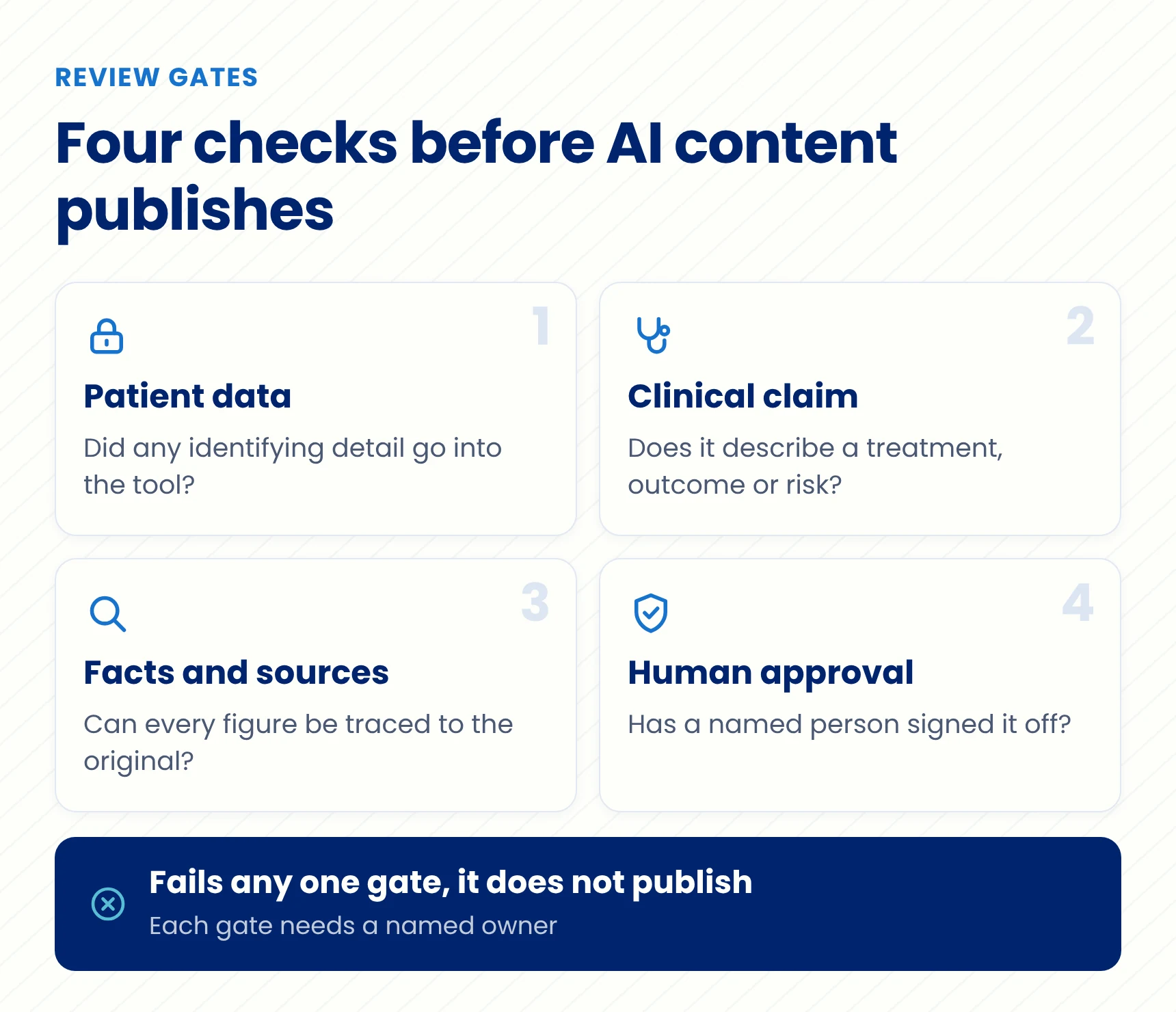
You lose control of it, and you may have created a compliance problem that did not exist five minutes earlier. A consumer AI chatbot is not built to hold protected health information, and pasting a patient’s name, condition, message or record into one is a disclosure.
Under HIPAA, a vendor that creates, receives, maintains or transmits protected health information on behalf of a covered entity is generally a business associate, and the covered entity needs satisfactory assurances in writing, usually a business associate agreement, before that information is disclosed. The HHS guidance on business associates lists cloud providers that store or process electronic PHI, and chatbot vendors on patient portals, among its examples.
The practical rule for a marketing team is simple. Patient information does not go into any AI tool unless your organization has a signed agreement with that vendor and someone has confirmed the configuration. Not the free tier, not a personal account, not “just to check the wording.” If you need AI help with a patient message, remove everything identifying first, or use a tool your organization has formally approved.
This is also why secure patient messaging and patient communications tooling sit outside the marketing stack. Those systems are chosen for their data handling, not their copywriting.
Why are AI-written clinical claims a liability?
Because AI produces text by predicting what usually comes next, not by checking whether something is true. It will write that a treatment is safe, effective, painless or suitable for a patient group with complete confidence and no basis. In most industries that produces an embarrassing sentence. In healthcare it produces a claim your practice cannot defend.
The failure is hard to catch precisely because it reads well. Unsupported clinical claims in AI output do not look like errors. They look like competent marketing copy, which is why they slip through reviews done by people without clinical training.
What to do: anything describing a treatment, an outcome, a risk, a recovery time or a comparison between options goes to a qualified clinical reviewer before it publishes. Build it into the workflow as a required step with a named owner, not as a final glance. If nobody on the approval chain can evaluate a clinical claim, the claim should not be in the copy.
Can you use AI to write reviews or testimonials?
No, and this one carries financial penalties. The US Federal Trade Commission’s rule on consumer reviews and testimonials, which took effect on 21 October 2024, prohibits writing, creating or selling fake or false consumer reviews and testimonials. It also prohibits offering compensation conditioned on a review expressing a particular sentiment, and requires clear and conspicuous disclosure when a review comes from an insider such as an employee or a relative.
The rule does not ban AI in marketing generally. What it bans is a review or testimonial that is fake, and a review generated by software on behalf of a patient who did not write it is fake regardless of how it was produced. Enforcement is active: in December 2025 the FTC sent warning letters to ten companies about possible violations, noting civil penalties of up to 53,088 dollars per violation.
So the honest uses are narrow. You can use AI to draft a request asking real patients for a review. You cannot use it to write the review, to polish a patient’s words into something they did not say, or to fill a thin review profile. If a page on your site has testimonials nobody can trace to a real person, deal with that before you worry about anything else in this article.
Why is AI-generated reporting commentary risky?
Because it is fluent, plausible and frequently wrong, and it is wrong in a way that survives a quick read. Ask a tool to explain a drop in enquiries and it will produce a tidy paragraph about seasonality, competition and algorithm updates. It will do that whether or not those things happened, because it is generating a reasonable-sounding explanation rather than analysing your data.
The specific danger is that somebody acts on it. A practice cuts a channel that was working, or doubles down on one that was not, because a generated paragraph sounded authoritative. The numbers in the report were real. The story attached to them was invented.
What to do: let AI assemble and format, and have a human write the interpretation. If a report you receive contains confident explanations of causation and nobody can tell you which numbers support each sentence, treat the commentary as decoration. This applies to whatever healthcare marketing metrics you track, and it is worth asking your agency directly whether their monthly commentary is written or generated.
What about AI chatbots that talk to patients?
This is the highest-risk use in the whole category, and the one most often sold as a quick win. A website chatbot that answers general questions about opening hours, parking, insurance acceptance and how to book is usually fine. A chatbot that moves into symptoms, treatment suitability, medication or anything resembling advice is a different product with different obligations, and it should not be deployed by a marketing team on its own.
Two things to settle before any chatbot goes live. First, what happens to what patients type into it, where that data goes and whether the vendor relationship is covered by an agreement. Second, where the hard stop is: the specific point where the bot must stop answering and hand over to a person, and whether it actually does that reliably rather than improvising.
Test it adversarially before launch. Ask it the questions a worried patient would ask at eleven at night, not the questions in the demo script.
What if your agency is using AI without telling you?
Many are, and that is not automatically a problem. AI-assisted work can be perfectly good work. The problem is the gap between what you are paying for and what you are receiving, and the fact that unreviewed AI output in a regulated category transfers risk to you rather than to the agency.
Ask four direct questions. Where in the process is AI used. Who reviews the output and what are their qualifications. Does any patient or client data ever go into an AI tool, and under what agreement. Is the monthly reporting commentary written by a person. A good agency answers all four without defensiveness. If you are in the middle of hiring a healthcare marketing agency, add these to your evaluation questions, because the answers tell you a lot about how the work is actually done.
Does AI content actually rank, and what about AI in search marketing for healthcare?
AI content can rank. Unreviewed AI content usually does not. The distinction matters because most practices that try AI content and conclude it does not work were publishing the raw output.
What does Google actually say about AI-generated content?
Google does not prohibit it, and has not for some time. The position is about quality rather than about how the words were produced, which is the opposite of what most practices assume when they avoid AI entirely or use it carelessly.
Its guidance on generative AI content describes these tools as useful for researching a topic and adding structure, and says the problem is using them to produce many pages without adding value for users, which can fall under its scaled content abuse policy. It also says to manually fact-check and review AI-generated content before publishing, including titles, meta descriptions, structured data and image alt text.
Read that as a quality test rather than a technology test. Nobody is checking whether a machine touched your draft. They are checking whether the published page is accurate, useful and worth ranking above the twenty pages that already answer the question.
Why does most AI healthcare content rank for nothing?
Because it contains no information that was not already on the first page of results. A generated article about a procedure will produce a competent summary of what everyone else has already written. There is no reason for a search engine to rank a restatement above the sources it was drawn from.
What makes healthcare content rank is the specific material a machine cannot generate: your clinician’s actual approach, what you tell patients in the room, the questions you get asked that nobody writes about, your real recovery timelines, your pricing structure, what happens at the first appointment. AI can help you write that faster. It cannot supply it. That is why the strongest practice content usually starts with a recorded conversation with a clinician rather than a prompt.
What changes now that patients use AI assistants to search?
People increasingly ask an assistant rather than scanning ten results, and the assistant summarises and cites a handful of sources. Being cited means answering a specific question clearly, early in a page, in plain language, on a site that looks credible.
In practice that means your pages should answer one real question per section, with the answer in the first two or three sentences rather than after a scene-setting paragraph. It also means your practice details, clinician credentials and locations need to be accurate and consistent everywhere, because that is what gets checked when something decides whether to recommend you.
Of the healthcare marketing trends worth attention right now, this is the one that changes how you write rather than where you spend. It is a shift in content structure, not a new channel, and it should sit inside your healthcare marketing strategy rather than being run as a separate project.
How do you measure whether AI is actually helping?
Most teams never check. They adopt a tool, feel faster, and never test whether the output performs. AI in healthcare marketing effectiveness is measurable, but not with the metrics vendors suggest, and not with the ones most dashboards put in front of you.
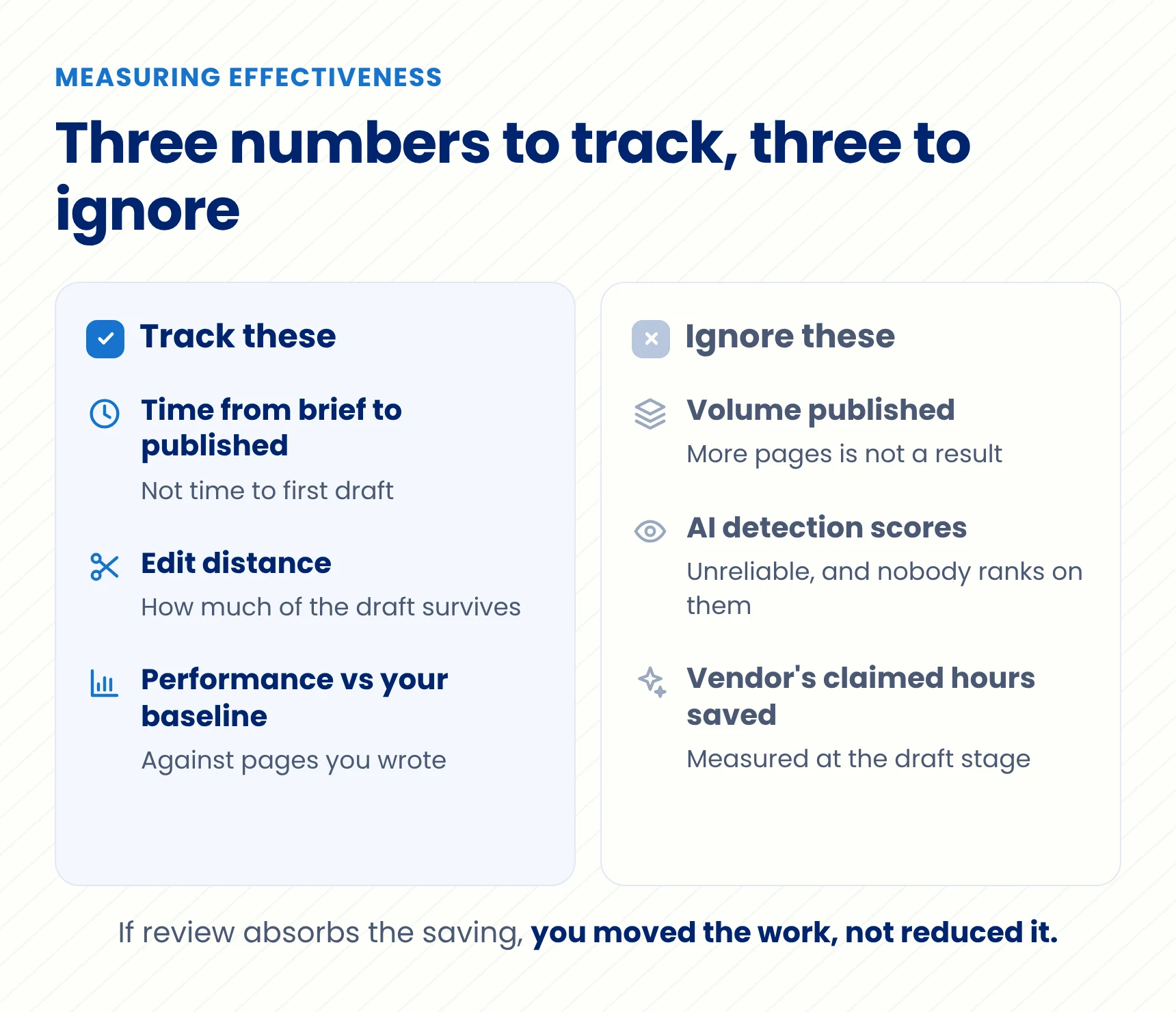
Three numbers worth tracking
Time from brief to published, measured properly. Not time to first draft, which AI obviously improves, but time until the thing is live and approved. If review and rework absorb everything AI saved, you have moved the work rather than reduced it.
Edit distance. How much of the AI draft survives to publication. If almost none of it does, the tool is producing a prompt for your writer rather than a draft, which is still useful but is a different and smaller benefit than claimed.
Performance against your own baseline. Compare AI-assisted pages with pages your team wrote conventionally, on the same kind of topic, over the same period. Rankings, enquiries and time on page. If the AI-assisted pages underperform, the issue is usually that they are thinner, not that AI touched them.
What not to measure
Volume published. More pages is not a result, and in healthcare it is often a liability, because every extra page is another place an unsupported claim can live. A practice with twelve excellent pages beats one with ninety generated ones, and the ninety take more work to police.
Also ignore any tool that scores your content for AI detection. Those scores are unreliable in both directions, nobody is ranking pages on them, and chasing a low score usually means making writing worse.
What rules should you put in place before anyone uses AI?
A short written policy prevents almost every problem in this article. It does not need to be long, and it needs to exist before someone makes a decision on your behalf at nine in the evening.
Minimum AI policy for a healthcare marketing team
- Name the specific tools people may use, and say that others are not approved.
- State plainly that no patient information goes into any tool without a signed agreement and a confirmed configuration.
- Require a named clinical reviewer for anything describing treatments, outcomes or risks.
- Require factual verification of statistics, citations and claims against the original source.
- Prohibit AI-written reviews, testimonials and patient stories outright.
- Require a human to write interpretation and recommendations in any report.
- Decide whether a chatbot may discuss anything clinical, and define its hard stop.
- Set an escalation path for anyone unsure whether a use is allowed.
- Apply the same rules to agencies and freelancers, in writing.
- Review the policy twice a year, because both the tools and the healthcare marketing rules around them are still moving.
What does a sensible AI setup look like in practice?
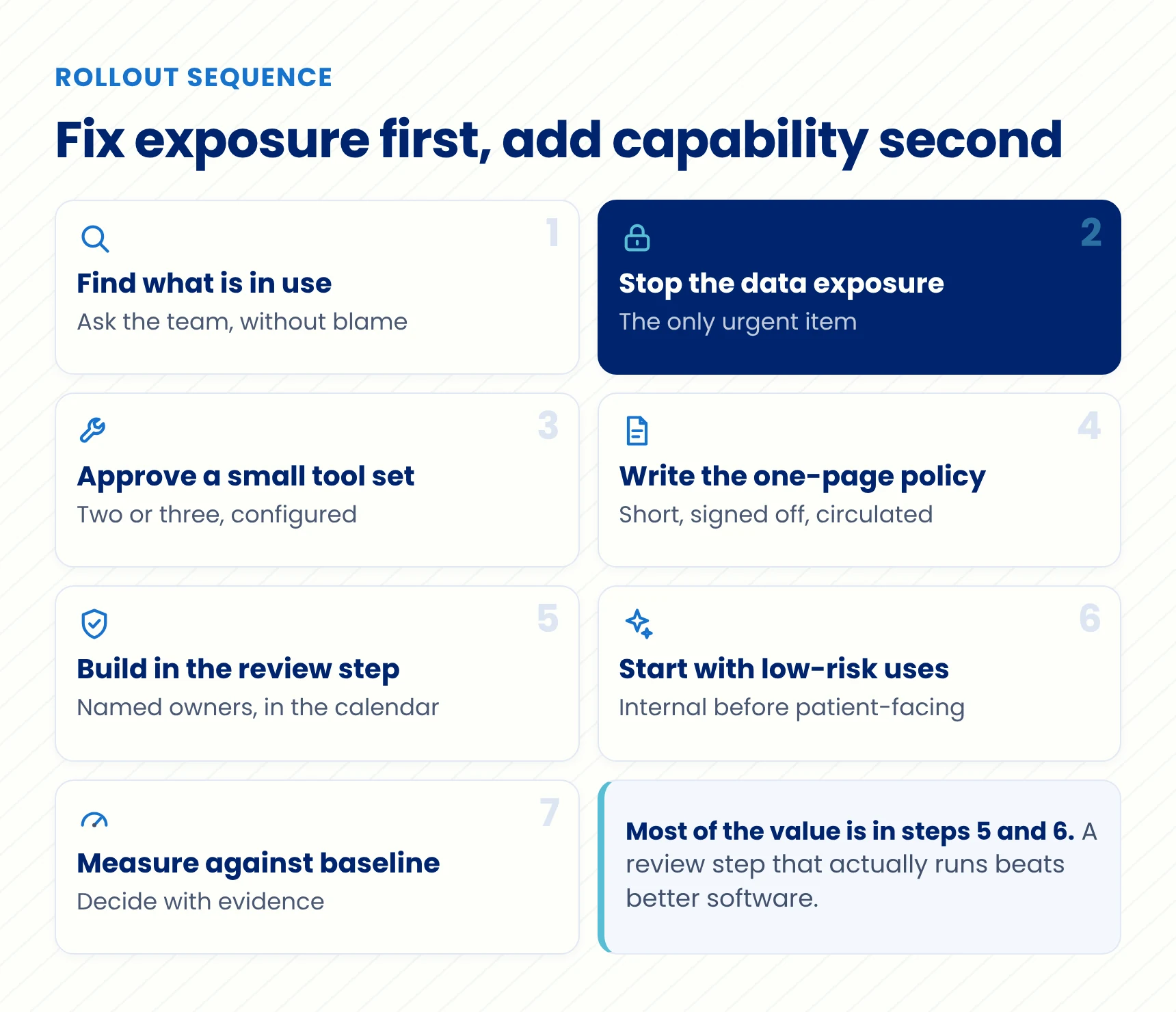
If you are starting from nothing, this order works. It fixes exposure before it adds capability, which is the opposite of how most teams approach it.
A workable sequence
Most of the value shows up in steps 5 and 6 rather than in the tool choice. Teams that get this right are not using better software than the teams that do not. They have a review step that actually runs, and they started somewhere that could not hurt them.
The same sequencing logic applies across most of the operational tooling practices adopt, whether that is a patient CRM, omnichannel marketing in healthcare or anything else. Fix the process, then add the tool. The reverse rarely works, and it is one of the more expensive problems practices face with marketing. If you want the wider picture, our write-up on the problems practices face with marketing covers the ones that are not about AI at all.
Where The Healthcare Marketing fits
The Healthcare Marketing is a digital marketing, website development and app development agency that works exclusively with healthcare and healthcare adjacent businesses. On this topic the relevant part is that the review step is not optional in how we work: clinical and factual claims get checked before anything publishes, patient data does not go into general AI tools, and reporting commentary is written by the person who looked at the numbers.
We use AI where it saves time without moving risk onto a client: drafting, repurposing, summarising research, generating ad variants and assembling reports. We do not use it to produce finished patient-facing clinical content, and we do not write reviews or testimonials.
We offer a free marketing audit and review. For a practice worried about this specifically, that usually means looking at where your published content reads as unreviewed, which claims would not survive scrutiny, whether your review profile is legitimate, and what a one-page AI policy should say for your setup.
Want someone to check what has already been published?
Send us your site and we will tell you which pages look machine-written and unreviewed, which claims need a clinician to sign them off, and what to fix in what order.
Frequently asked questions
Is it safe to use ChatGPT for healthcare marketing?
It is safe for work that contains no patient information and no unverified clinical claims, such as drafting, summarising and generating variants. It is not safe for anything involving patient data unless your organization has a formal agreement with the vendor and has configured it properly.
Can I put patient information into an AI tool if I remove the name?
Removing a name is usually not enough, because combinations of details can still identify someone. The safer default is to keep patient information out of general AI tools entirely and use only tools your organization has formally approved for that purpose.
Will Google penalise my site for using AI to write content?
Not for using AI itself. Google’s guidance treats generative tools as acceptable and focuses on whether the published page is accurate and adds value, with the concern being pages produced at scale without value. Unreviewed AI content tends to fail that test on quality, not on origin.
Can AI write patient reviews or testimonials for my practice?
No. US rules on consumer reviews prohibit fake or false reviews and testimonials, and a review written by software for a patient who did not write it is fake. You can use AI to draft the message asking real patients for a review.
Should my practice use an AI chatbot on the website?
A chatbot handling hours, location, parking, insurance and booking is usually low risk and genuinely useful. One that discusses symptoms, treatment suitability or medication needs clinical input, a clear handover point and a proper look at where the conversation data goes.
How do I know if my marketing agency is using AI?
Ask them directly where AI is used, who reviews the output, whether any client or patient data enters an AI tool, and whether reporting commentary is written by a person. An agency doing this responsibly will answer all four without hesitating.
Does AI-generated content rank as well as human-written content?
Reviewed and substantially rewritten AI content can perform as well as anything else. Raw AI output usually does not, because it restates what is already ranking and adds nothing a search engine has a reason to prefer.
What AI tools are worth using for healthcare marketing?
The category matters more than the brand: a general writing assistant, a transcription tool and your existing analytics platform’s built-in features cover most of the real value. Choose based on the data agreement the vendor will sign, not on the feature list.
Who should review AI-written healthcare content before it publishes?
Anything clinical needs a named qualified clinical reviewer. Everything else needs someone who verifies facts, statistics and citations against original sources. Both should be steps in the workflow with owners, not an informal final read.
How much time does AI actually save a marketing team?
Less than it appears, because the saving shows up at the drafting stage and the review stage grows. Measure time from brief to published rather than time to first draft, and you will see the real figure for your own team.
Where to start if you only do one thing
Send one message to everyone who touches your marketing saying that no patient information goes into any AI tool that your organization has not approved, and that it takes effect today. That single instruction removes the only risk on this list that can turn into a reportable incident, and it costs nothing.
Then spend an hour finding out what your team is already using. The policy, the review step and the tool choices all get easier once you know what you are actually working with, and most practices are surprised by the answer.
Everything else in AI in healthcare marketing is a judgement call you can make slowly. Those two are not.