
Most healthcare marketing challenges are not really marketing problems. They are approval problems, privacy problems, policy problems and measurement problems that happen to land on whoever runs marketing. That is why a tactic that works for a restaurant or a law firm stalls in a clinic, and why practices often spend more each year while booking roughly the same number of new patients.
The main healthcare marketing challenges are clinical review delays, patient privacy rules that limit tracking and messaging, advertising restrictions on Google and Meta, long patient research cycles that are hard to trace, local sameness, websites that get visits but few appointment requests, thin time and budget, and picking the wrong agency. Each one has a practical fix.
This guide works through all eight. For each one you get what it looks like day to day, why it happens, and what to do about it with the staff and budget you already have.
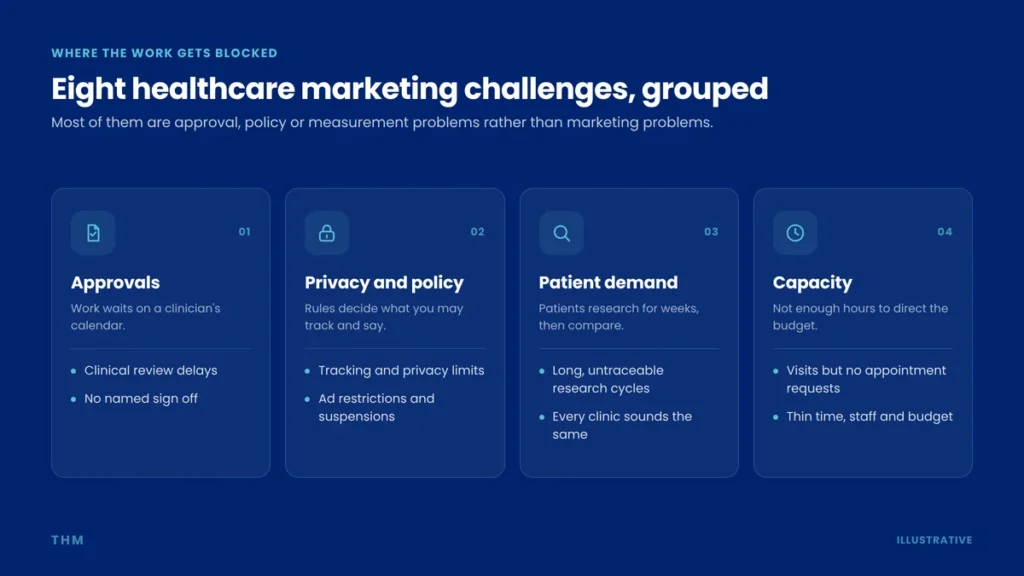 Illustrative diagram. The eight challenges grouped by where they actually block the work.
Why healthcare marketing challenges are harder to solve than in other industries
Healthcare marketing is harder because three things apply at once that rarely apply elsewhere: every public claim touches clinical accuracy, the data you would normally use for targeting and tracking is regulated, and the person who must approve the work is usually booked with patients all day. Volume of effort does not solve any of them.
There is also a credibility problem inside the building. The case for healthcare marketing still has to be made to partners who view it as a cost rather than as the thing that fills next month’s diary, and that argument is much easier to win with a clear link between spend and booked appointments than with a slide of impressions.
On top of that sit the healthcare marketing guidelines your practice has to work inside, which differ by country and by specialty: privacy law, advertising standards, professional body rules on testimonials and before and after images, and platform policies that are stricter than the law in places. None of that stops you marketing. It just means the sequence matters more than in other industries, and that guessing is expensive.
The sections below take the eight challenges in the order they usually bite. If you only have time for one, the self check near the end tells you which one is costing you patients right now.
Challenge 1: Content gets stuck waiting for clinical review
Clinical review delays are the most common healthcare marketing challenge and the least talked about. A page or ad is written, sent to a clinician for accuracy sign off, and then sits for three weeks because that clinician has a full list. The work is not blocked by skill or budget. It is blocked by one person’s calendar.
The usual symptoms are easy to recognise. Draft content piles up in a shared folder. Seasonal campaigns go live after the season. Nobody is quite sure who has final say, so three people comment and none of them approve. Writers avoid clinical topics altogether and produce vague content that ranks for nothing.
The fix is process, not pressure. Clinicians are not slow because they do not care. They are slow because reviewing marketing copy is an unscheduled, unbounded task with no clear standard for what they are checking.
How to clear the review bottleneck
- Name one clinical reviewer per service line and one named backup. Shared responsibility means no responsibility.
- Book a recurring 45 minute review slot every fortnight and batch everything into it. Ad hoc requests always lose to patients.
- Tell the reviewer what to check: factual accuracy, claims, and anything a patient could misread. Not tone, not commas, not layout.
- Build a pre-approved claims bank. Once a sentence about a procedure, a recovery time or a qualification is signed off, reuse it without re-review.
- Set a default: no response within five working days on a low risk item means it publishes, with the reviewer copied. Keep high risk clinical claims out of this rule.
- Keep a one page record of what was approved, by whom and when. This protects the clinician as much as the marketer.
Practices that put a claims bank and a fixed review slot in place usually cut their publishing cycle from weeks to days, because most content reuses language that has already been approved once.
Challenge 2: Privacy rules limit what you can track and say
Patient privacy is the challenge that quietly breaks healthcare marketing measurement. Standard marketing practice, which is to track everything, retarget visitors and email your database, collides with rules written to stop exactly that. The result is either reckless tracking that creates real exposure, or blind caution that leaves you unable to prove anything works.
Under the HIPAA Privacy Rule in the United States, a communication that encourages someone to buy or use a product or service is marketing, and using protected health information for it generally needs the patient’s written authorisation. The rule carves out several things that are not marketing: communications about your own health related services, anything made for the patient’s treatment such as a prescription refill reminder, and care coordination. Selling a patient list to a third party needs authorisation from every person on it. The HHS guidance on marketing under the Privacy Rule sets out the definitions and the exceptions.
Website tracking is the messier half. Analytics tags and advertising pixels on a patient portal or an appointment page can hand information to a third party you have no agreement with. In 2024 a federal court vacated part of the federal guidance on online tracking technologies, specifically the position that an IP address collected on a public, unauthenticated page is identifiable health information. The rest of the position, covering logged in areas such as patient portals, was not struck down. Treat this as unsettled, and have your compliance advisor decide what you run and where.
HIPAA-compliant messaging follows the same logic. The question is never whether a channel is allowed. It is what information travels through it, who else can see it, and whether the patient asked for it.
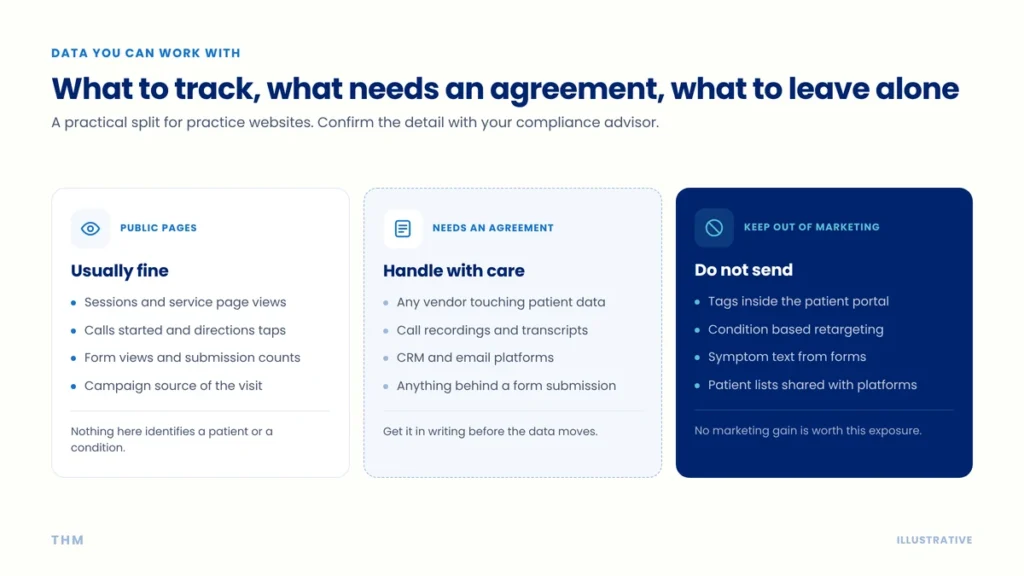 Illustrative diagram. A practical split between data you can work with freely and data that needs an agreement or the patient’s permission.
What you can usually do without creating exposure
- Measure what happens before the patient identifies themselves: sessions, service page views, calls started, form views, directions taps.
- Keep condition specific retargeting off. Retarget on a general service page or not at all.
- Separate marketing tags from logged in areas and from anything behind a form submission.
- Use a signed agreement with any vendor that touches patient data, and know which vendors will not sign one.
- Ask patients to opt in for anything promotional, and keep treatment reminders in a separate system from campaigns.
- Write forms so they collect the minimum: name, contact, service and preferred time. Not a symptom description.
Two practical notes. Rules differ outside the United States, and the United Kingdom, Canada and Australia each have their own privacy regime and advertising standards, so a United States checklist is a starting point rather than an answer. And none of this is legal advice. Agree the specifics with your own compliance advisor before you change your tracking setup.
Challenge 3: Advertising platforms restrict healthcare more than most sectors
Healthcare advertisers face restrictions that other industries never see: whole categories need certification before a single ad runs, some services cannot be advertised at all in certain countries, and the targeting options that make paid social efficient elsewhere have largely been withdrawn for health. Disapprovals and suspensions follow, usually with no warning.
On Google, certification is required for categories including prescription drug services and telemedicine, pharmaceutical manufacturers, addiction services, health insurance in the United States, and certain restricted drug terms. Clinical trial recruitment is not allowed in most locations. Some categories, such as HIV home tests and some fertility and testing services, are restricted or banned by country. The full detail is in Google’s healthcare and medicines advertising policy, and it changes, so check it before you build a campaign rather than after an account is suspended.
Meta tightened its side from January 2022, when it removed detailed targeting options covering sensitive categories including health causes. You can no longer reliably reach people by health interest or condition, which removes the shortcut many agencies still quote in pitches. What remains is location, age, broad interests and your own first party audiences, which you have to be careful about building in the first place.
The practical consequence is that healthcare paid media has to win on offer, landing page and geography rather than on clever targeting. That is a harder discipline, but it is also more durable, because it does not depend on a targeting option that may disappear at the next policy update.
How to keep campaigns running
- Check the policy for every service you plan to advertise before writing ads, and check it again each quarter.
- Complete any certification your categories require, in your own account, before you launch.
- Write ads about the service and the practice, not about the patient’s assumed condition. Implying you know something about someone’s health is the fastest route to a disapproval.
- Keep a second, clean campaign structure ready so a disapproval on one does not stop all your lead flow.
- Do not run the same ad copy across countries. A claim that is fine in the United States may breach advertising standards in the United Kingdom or Australia.
- Keep the ad account in the practice’s name with your own billing, so a suspension is yours to appeal and your history is not lost.
Free audit
Not sure which of these is actually blocking you?
We review your website, your search visibility and your current marketing, then tell you which of these challenges is costing you patients and what to fix first. No obligation and no sales pitch.
Challenge 4: Patients take weeks to decide, and your reports cannot see it
Patients rarely book the first time they find you. They search a symptom, read, compare two or three practices, check reviews, ask someone they trust, then call weeks later. Marketing reports built around last click attribution credit whichever touch happened last, usually a branded search, and make everything that created the demand look worthless.
This is why a practice can cut the content or the paid campaign that looked unproductive and then watch calls fall two months later. The spend that filled the top of the research cycle was removed, and the branded searches that the report was crediting had nowhere to come from.
The behaviour is well documented. In the second half of 2022, the National Center for Health Statistics found that 58.5% of United States adults had looked up health or medical information online, 46.1% had looked up test results online and 41.5% had communicated with a doctor or a doctor’s office online, in the past twelve months. Patients are doing research you never see, on devices and in sessions your analytics will not join up. Figures are from the NCHS data brief on health information technology use among adults.
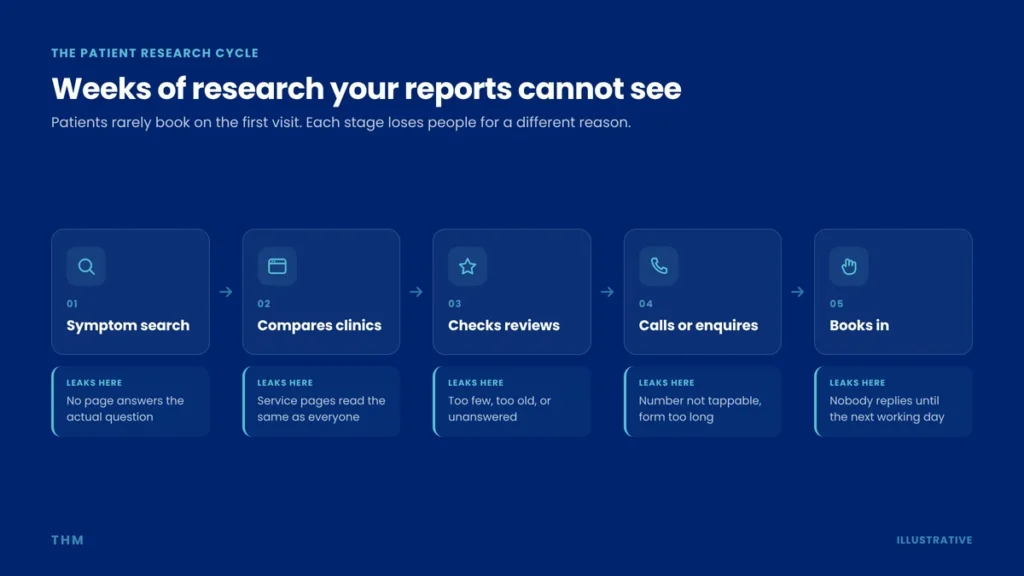 Illustrative diagram. The stages between a first search and a booked appointment, and what tends to leak at each one.
Add the healthcare specific wrinkle: a large share of bookings still arrive by phone, and phone calls are invisible unless you deliberately make them visible. A practice with no call tracking is usually measuring its least important channel most accurately.
What to measure instead
Tracking marketing performance in a practice works better when you stop trying to attribute every patient perfectly and start watching a small number of honest numbers in the same place every month.
- New patient appointments booked, by month, from the practice management system. This is the only number that matters and almost nobody reports it.
- Calls that lasted longer than 60 seconds, with the source they came from. Short calls are usually wrong numbers or existing patients.
- Form submissions by service and by page, not just a single site total.
- One question at the front desk and on every form: how did you hear about us? Imperfect, but it catches what analytics cannot.
- Service page views as a leading indicator. These move four to eight weeks before bookings do.
- Cost per new patient enquiry per channel, calculated quarterly rather than monthly, so normal variation does not drive decisions.
Look at anything slower than a month in quarters. Healthcare demand moves in longer cycles than most reporting rhythms, and monthly panic is the most expensive habit in practice marketing.
Challenge 5: Every clinic in your area says the same things
Look at ten practice websites in any city and you will find the same four promises: experienced team, patient centred care, state of the art equipment, convenient appointments. When every option looks identical, patients fall back on whatever they can actually compare, which is distance, reviews and how quickly someone answers the phone.
That is a positioning problem, not a design problem. Rewriting the homepage in a nicer font does not change it. What changes it is naming something true about your practice that the practice down the road cannot copy: a specific procedure your team does far more often than average, genuine same week availability, a language your staff speaks, parking, late clinics, a clinician with a specific sub-specialty, a care pathway you can describe step by step.
Reviews carry more weight here than any other single factor, and this is where practices get into trouble. The temptation to buy reviews, incentivise only the happy ones or quietly suppress the bad ones is strong. In the United States the Federal Trade Commission’s rule on consumer reviews and testimonials, in force since October 2024, prohibits fake reviews, reviews bought on condition of being positive, undisclosed reviews written by insiders, and the suppression of genuine negative reviews through threats or intimidation. Civil penalties apply per violation. The safe approach is also the effective one: ask every patient, make it easy, and reply to all of them.
Reaching diverse patient groups is part of the same problem and is usually ignored. The same national survey found online health information use varied widely by group, from 63.4% of White adults and 60.1% of Asian adults down to 49.0% of Black adults and 46.2% of Hispanic adults. If a meaningful part of your catchment is less likely to start online, a web only strategy quietly excludes them, and translated pages, phone access, community partnerships and print still matter.
What actually differentiates a practice
- Availability you can state in writing. Same week, evening, weekend, or a named wait time.
- Volume or focus in a specific procedure, described factually without superlatives.
- Who the patient will actually see, with a photograph and a real biography.
- What the first visit involves, step by step, including cost and duration.
- Practical access: parking, transport, step free entry, languages spoken.
- Reviews that are recent, numerous and answered, including the critical ones.
Challenge 6: The website gets visits but very few appointment requests
A practice website that attracts traffic and converts almost none of it is usually losing people in the last thirty seconds, not the first. The pages rank, the ads deliver clicks, and then the booking path asks for too much, loads too slowly on a phone, or offers a form when the patient wanted to call. Lead generation for practices fails far more often at this step than at the traffic step.
The pattern is consistent across the sites we audit. The phone number is an image or plain text rather than a tappable link. The booking form has eleven fields including insurance details and a free text symptom box. The contact page is three clicks from the service page. Nobody has tried to book an appointment on a phone on a slow connection. Appointment requests sent at 6pm on Friday sit unread until Monday afternoon.
Fixing this is cheap and fast compared with earning more traffic, which is why it should always come first.
- Put a tappable phone link in the header on every page, and at the end of every service page.
- Cut the form to name, phone, service and preferred time. Collect everything else at the appointment.
- Give each service page its own clear next step, rather than sending everyone to a general contact page.
- Test the whole booking path on a mid range phone, not on a desktop browser resized.
- Set a response standard for enquiries and measure it. An hour beats a day, and a day beats whatever is happening now.
- Show prices or ranges for anything where patients expect them. Silence sends people to whoever does publish.
One more thing worth checking: whether the people answering the phone know which campaigns are running. A patient who calls quoting an offer the front desk has never heard of usually does not book.
Challenge 7: There is not enough time, staff or budget
Most practices run marketing with no dedicated marketing person. It sits with a practice manager who already has a full job, or with a clinician doing it in the evening, or with an agency that was hired and then left unsupervised. The limit is rarely the budget on its own. It is the hours available to direct the budget.
The honest answer is that a small practice cannot do everything, and should stop trying. Three channels done properly beat seven done occasionally, and the first two should almost always be the Google Business Profile and the booking path, because they cost nothing and convert the patients who are already looking for you. The rest follows from your healthcare marketing strategy rather than from whatever arrived in the inbox this week.
Marketing a private clinic with no insurance referral pipeline changes this calculation, because every patient has to be earned directly and the cost of acquiring one is a real line in the budget rather than an abstraction. Those practices usually need to know what healthcare marketing costs per new patient before they can plan anything, and that number varies enormously by specialty and market.
What to drop when capacity is the limit
- Posting on every social platform. Pick the one where your patients actually are, or none.
- Monthly blog posts written to fill a calendar. Six genuinely useful service pages beat thirty thin articles.
- Rebuilding the website before the booking path and the Google Business Profile are right.
- Reporting on anything you will not act on. If a number has never changed a decision, stop collecting it.
- Any channel nobody in the building can explain the purpose of.
Challenge 8: Choosing and then managing an agency
Most practices that are unhappy with marketing have had at least one agency relationship end badly, and the usual cause is not incompetence. It is a mismatch: a generalist agency that has never dealt with clinical review, advertising certification or patient privacy, selling a package built for e-commerce.
The questions that prevent this are specific and worth asking before any contract. Who will actually do the work. What proof can you see from practices like yours. Will the practice own the website, domain, ad accounts and analytics. How will results be reported, and does the report mention patients or only rankings. Our guide on hiring a healthcare marketing agency covers the full list, including the red flags and the contract terms worth refusing.
Managing the relationship afterwards matters just as much. Agencies drift when nobody reviews the work, and a monthly call where the practice asks one question about new patient numbers changes the behaviour of most agencies within a quarter.
If you sell to hospitals, practices or distributors rather than to patients, the situation is different again: B2B healthcare marketing strategies run on long buying committees and procurement cycles, so the channels and the sales support needed have little in common with a clinic filling its diary.
Which challenge is costing you patients right now?
- Content you wrote more than a month ago is still waiting for someone to approve it.
- You cannot say how many new patients came from marketing last month without guessing.
- Your ad account has been disapproved or suspended in the last year.
- Nobody is tracking phone calls, or calls are tracked but not by source.
- Your service pages read like every competitor’s within fifteen miles.
- You have fewer than twenty recent reviews, or you do not reply to them.
- Your booking form asks for more than five pieces of information.
- Enquiries that arrive outside clinic hours are answered the next working day or later.
- Analytics or advertising tags are running on pages behind a patient login.
- Nobody in the practice can say what the agency delivered last month.
Three or more ticks is normal. The order you tackle them in is what decides how quickly anything changes, and most practices start at the wrong end by commissioning a new website while the booking path and the Google Business Profile stay broken.
What to fix first, and in what order
Fix the things that convert patients who have already found you before you spend anything on finding more. That order is not a preference, it is arithmetic: improving the booking path lifts every channel at once, while adding traffic to a leaking site multiplies the leak.
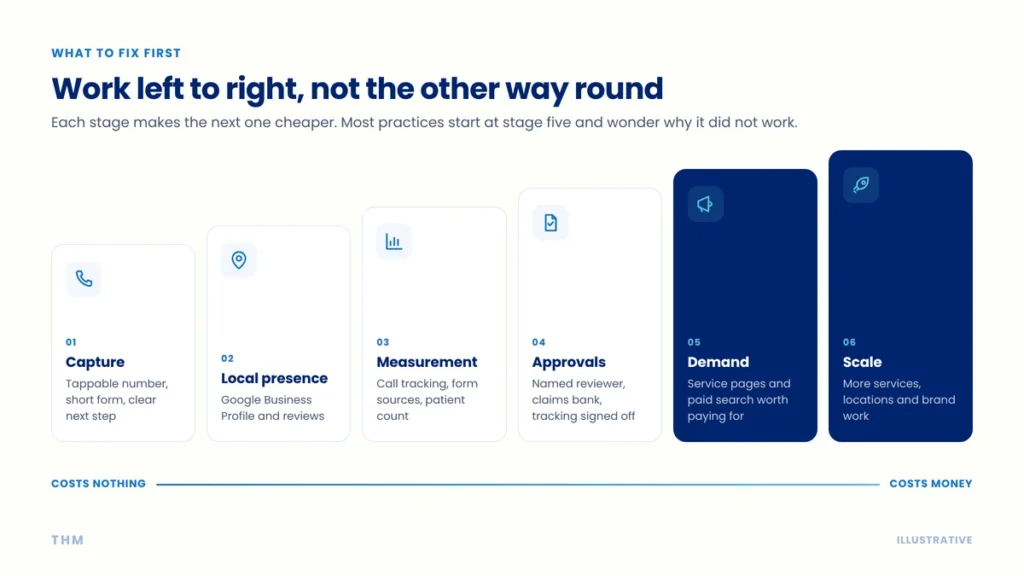 Illustrative diagram. Work left to right. Each stage makes the next one cheaper.
| Stage | What you sort out | Why it comes first |
|---|---|---|
| 1. Capture | Tappable phone number, short form, clear next step on every service page, response time standard | Costs almost nothing and lifts results from every other channel immediately |
| 2. Local presence | Google Business Profile complete and accurate, review requests running, replies to all reviews | This is where most ready-to-book patients already are |
| 3. Measurement | Call tracking by source, form source tags, a how did you hear about us question, new patient count by month | Without it, every later decision is a guess |
| 4. Approvals and compliance | Named clinical reviewer, fixed review slot, claims bank, tracking reviewed with your compliance advisor | Removes the bottleneck that will otherwise stall everything after this |
| 5. Demand | Service pages that answer real questions, paid search on your highest value services, content for the research stage | Now worth paying for, because the first four stages hold what it delivers |
| 6. Scale | More services, more locations, wider content, brand work | Only once there is a channel that reliably produces patients |
Most practices can complete stages one to three in a few weeks without any new budget. Stage four needs a conversation with a clinician and a compliance advisor rather than money. Stage five is the first point at which spending more is sensible.
How we work on this at THM
The Healthcare Marketing works only with healthcare businesses: practices, clinics, hospitals, specialists and healthcare organisations. That focus is the reason clinical review, advertising certification and patient privacy are part of how we plan work rather than problems we discover halfway through a project. Our digital marketing services for healthcare cover search, paid media, websites and apps for this sector specifically.
We start every relationship with a free audit and review. We look at your website, your search visibility, your Google Business Profile, your booking path and whatever marketing is running now, then tell you which of the challenges in this guide is actually costing you patients and what order to fix them in. You get that assessment whether or not you work with us afterwards.
What we will not do is guarantee rankings or promise a number of new patients. Nobody can, and an agency that does is telling you something about how it sells rather than how it works.
Talk to a person
Want a second opinion on your marketing?
Tell us what is not working and we will tell you what we would do about it. If the answer is that you do not need an agency yet, we will say that too.
Frequently asked questions about healthcare marketing challenges
What are the biggest healthcare marketing challenges for a small practice?
For a small practice the biggest ones are capacity and measurement. There is usually nobody whose job marketing is, and no reliable count of how many new patients each channel produced. Everything else gets easier once those two are handled.
Why is it so hard to get new patients from Google Ads as a clinic?
Healthcare advertising is restricted, so some services need certification before ads run and others cannot be advertised in certain countries. On top of that, health interest targeting has largely been withdrawn, so campaigns have to win on the offer and the landing page instead.
Can I use Google Analytics on my medical practice website?
Generally yes on public pages, but not without thought on pages behind a patient login or after a form submission, where the data can become identifiable. Keep marketing tags away from those areas and have your compliance advisor confirm your setup.
How do I stop marketing content getting stuck in clinical review?
Name one clinical reviewer with a backup, book a recurring slot to review everything in a batch, and tell them to check only factual accuracy and claims. Then build a bank of approved sentences so the same language never needs signing off twice.
Why does my practice website get traffic but no appointment bookings?
Almost always the booking path rather than the traffic. The usual culprits are a phone number that is not tappable, a long form, no clear next step on service pages, and enquiries that go unanswered for a day or more.
Can I ask patients for reviews without breaking the rules?
Asking every patient is fine. Paying for reviews, rewarding only positive ones, writing them yourself or suppressing genuine negative ones is not, and in the United States that is now covered by a specific Federal Trade Commission rule with financial penalties.
How long does healthcare marketing take to show results?
Conversion fixes and the Google Business Profile can move enquiries within weeks. Paid search produces calls as soon as it is approved. Organic search and content usually take several months, because patients research for weeks before they book.
Why did my healthcare ad account get suspended?
The common causes are advertising a category that needs certification without having it, ad copy that implies you know something about the user’s health condition, or landing page content that breaches the platform’s healthcare policy. Fix the cause before appealing.
How much should a medical practice spend on marketing?
There is no single benchmark worth quoting, because it depends on your specialty, your market and the lifetime value of a patient. Work out what one new patient is worth to you first, then decide what you can afford to pay to get one.
Do I need a healthcare specialist agency or will a general agency do?
A general agency can handle a brochure website. The difficulty comes with advertising certification, clinical sign off and patient privacy, where a generalist tends to learn at your expense. Ask any agency to explain how they handle all three.
None of these challenges are unique to your practice, and none of them are solved by working harder on the same things. They are solved by fixing the order: make it easy to book, be findable where patients already look, measure what actually happens, clear the approval bottleneck, and only then spend money on demand. Pick the one from the self check that stings most and start there.