
If you are working out how to choose a healthcare marketing agency, there is a fair chance a previous one let you down. The reports looked polished and the patients never came. The ad account turned out to be in the agency’s name, not yours. Or nobody could explain what the tracking on your appointment page was collecting.
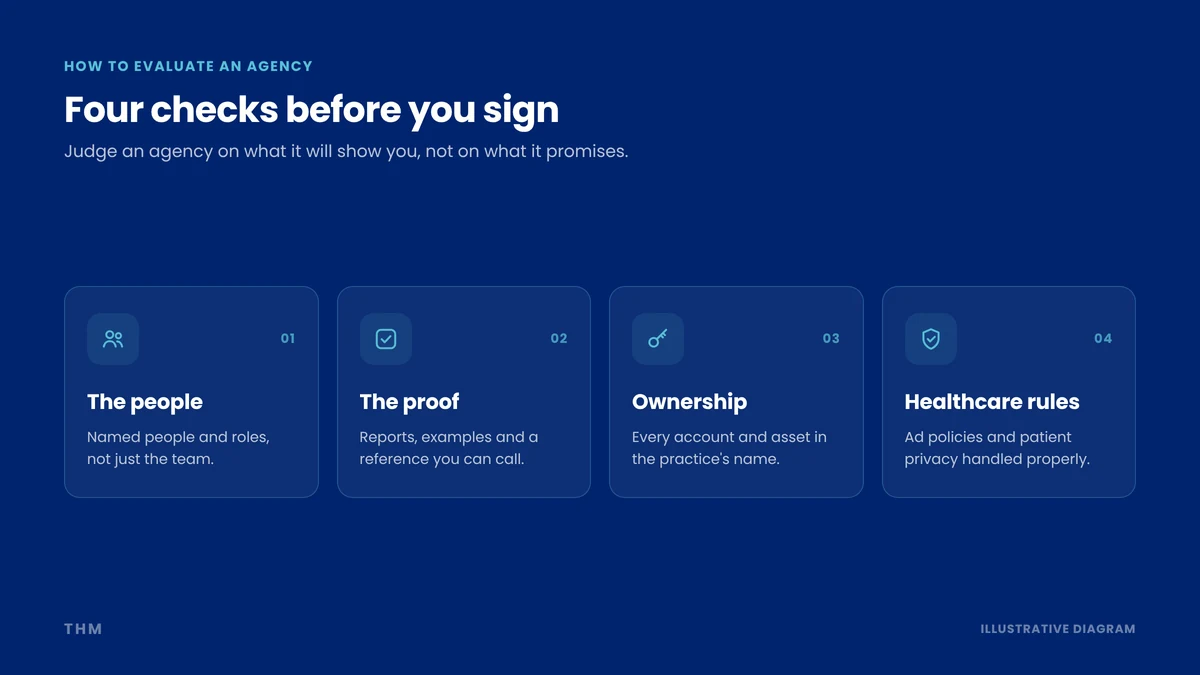
The short answer is to judge an agency on what it will show you before you sign, not on what it promises. Ask who will do the work, what you will own, how results will be reported, and how they handle healthcare advertising and privacy rules. A good agency answers all four plainly and is happy to put the answers in writing.
Why choosing an agency is harder than it looks
Most agencies sound the same on a sales call, and the differences only show up months later, in the reports and in the appointment book. That gap between the pitch and the work is the main reason practices end up switching agencies every year or two.
Healthcare adds its own layer on top. The usual marketing challenges in healthcare, such as strict advertising policies, patient privacy, referral-driven growth and busy clinical teams, are exactly the things a generalist agency tends to underestimate. The same patterns come up again and again:
- A monthly retainer with no clear list of what was delivered.
- Reports full of impressions, clicks and rankings, with nothing about new patients.
- A senior person on the sales call, then a junior account manager you never met.
- Ad accounts, analytics or even the domain registered in the agency’s name.
- Tracking added to appointment pages without anyone asking what it collects.
- A twelve month contract with no way out if the work is poor.
- A promise of first page rankings or a set number of new patients.
None of these are hard to spot in advance. They just need the right questions, asked before the contract rather than after it.
Do you need an agency at all?
Not always. An agency makes sense when the work needs skills or hours your practice does not have. If the basics are not in place yet, a good agency will tell you to fix them first, and much of that you can do yourself.
Our guide on how to market a medical practice covers the free fixes most practices can make in an afternoon: the Google Business Profile, reviews, the booking path and the phone. Work through those first and you will know far more about what you actually need help with.
Which kind of help fits your practice
Healthcare startup marketing is a slightly different case. A new clinic or health technology company usually needs a brand, a website and launch campaigns at the same time, which tends to favor an agency over a single freelancer, at least for the first year.
Generalist agency, healthcare specialist or freelancer
The biggest decision is not which agency, but which kind. Each has a place, and the right one depends on what you need and how much managing you can take on.
| Option | Usually good at | Watch out for |
|---|---|---|
| General marketing agency | Broad creative and channel skills, often a larger team | Learning healthcare ad policies and privacy on your account |
| Healthcare specialist agency | Ad restrictions, how patients search, privacy issues | A generalist using the label, so ask for healthcare-only proof |
| Freelancer | One skill done well, lower cost, direct contact | A single point of failure, and you own the strategy |
Specialist is a claim anyone can put on a website. The proof is in the work they can show you and the questions they ask on the first call. A real healthcare agency will ask about your services, your capacity and your referral sources before it talks about tactics.
Get clear on these before the first call
Before you choose a healthcare marketing agency, get clear on what you are asking it to do. You will get far better answers. Spend an hour on this before any calls, ideally with whoever signs off on spending.
- What you want more of: which services, which patients, which locations.
- What counts as a result. For most practices that means booked new patients, not website visits.
- What you can spend each month, and for how long, before you expect to see a return.
- Who in the practice will be the agency’s contact, and how much time they really have.
- What you have already tried, and what happened.
If patient lead generation is the main goal, say so, and agree how a lead will be counted. A form submission, a tracked call and a booked appointment are three very different numbers, and agencies tend to report whichever one is biggest.
If none of this is written down yet, it is worth sorting out your healthcare marketing strategy first, so every agency is pitching against the same brief and you can compare their answers fairly.
Questions to ask before you choose a healthcare marketing agency
These questions separate agencies that do the work from agencies that sell it. Ask the same ones of every agency you speak to, so you can compare the answers side by side.
- Who will work on our account day to day, and what is their role?
- Which healthcare practices like ours have you worked with, and can we speak to one?
- What will you do in the first 90 days, and in what order?
- How will you measure results, and what will the monthly report show?
- Who will own the website, domain, ad accounts and analytics if we part ways?
- How do you count a lead, and can you connect leads to booked appointments?
- How many hours a month will you need from our team?
- How do you handle Google’s healthcare advertising policies for our services?
- Will you handle any patient information, and will you sign a business associate agreement if so?
- How do you get reviews, and what will you never do to get them?
- What is the minimum contract length, and how do we leave?
- What would make you tell us we do not need you?
What good answers sound like
Four of those questions do most of the work. On who does the work, a good answer names people and roles, and the people on the call are the people you will deal with. A vague mention of the team is not an answer.
On ownership, the answer should be immediate: you own everything, accounts are created in the practice’s name, and the agency is added as a user. Hesitation here is the most useful warning sign in the whole process.
On measurement, listen for calls, booked appointments and cost per new patient. If the answer is mostly rankings, impressions and traffic, the monthly reports will be too.
On the last question, a good agency has an honest answer. Sometimes the real problem is unanswered phones or a booking system that does not work, and the right agency will say so rather than sell you a retainer.
The proof to ask for, and what real proof looks like
Proof is anything you can check. A logo wall, an award badge or a percentage increase with no context is not proof, because none of it tells you whether the agency can do the same for a practice like yours.
Ask for these instead:
- A sample monthly report from a real client, anonymized, so you see exactly what you would receive.
- Two or three examples from practices similar to yours in specialty, size or location, showing what was done and what changed.
- A reference you can call, ideally a practice manager rather than the owner.
- A written plan for your first 90 days, before you sign anything.
- The names and roles of the people who would work on your account.
Be careful with case studies of successful healthcare marketing campaigns that only show the best month. Ask what the starting point was, what happened in the six months after, and what else the practice changed at the same time. Results without context tell you very little.
How we answer these ourselves
Since this article asks you to hold agencies to these standards, here is how The Healthcare Marketing answers them. We work only with healthcare businesses. You own your website, domain, ad accounts and analytics, and we are added as users. Reports lead with calls, booked appointments and cost per new patient, and every engagement starts with an audit rather than a proposal. Our healthcare digital marketing services cover local visibility, websites, search and paid advertising, and we will tell you if a problem does not need an agency at all.
If any of that is not true of an agency you are considering, ask them why. There may be a good reason, but you should hear it before you sign, not after.
Whichever agency you choose, the principle is the same: see the proof first, and let the proposal come second.
Free audit
See the proof before the proposal
Our free audit reviews your Google Business Profile, local visibility, website booking path and review profile, then gives you a short written summary of what to fix first. You can use it to brief any agency, including us. No cost and no obligation.
Red flags to walk away from
Most bad agency relationships give off warning signs before the contract is signed. Any one of these deserves a direct question. Two or three together are usually a reason to keep looking.
- Guaranteed rankings or a guaranteed number of new patients. Nobody controls Google or patient behavior, so a guarantee is a sales line.
- Accounts set up in the agency’s name. If you leave, you can lose years of ad history, analytics and even the website.
- No names, only the team. You cannot judge people you are not allowed to meet.
- Reports built around impressions, traffic and rankings. These are easy to grow and say little about patients.
- A long contract with no exit clause. Confident agencies rarely need to lock you in.
- Offers to buy reviews, write them, or only ask happy patients. That can breach platform rules and damage trust in the practice.
- No questions about patient privacy before installing tracking. Tags on appointment or condition pages can collect more than anyone intended.
- A proposal before they have looked at anything. Advice without an audit is a template with your logo on it.
The opposite of a red flag is not a perfect pitch. It is an agency that asks you hard questions, admits what it does not know yet, and is specific about what happens next.
Healthcare rules an agency must understand
Healthcare marketing compliance is not the agency’s job alone, but an agency that does not understand the rules will create problems you have to clean up. Two areas matter most: advertising platform policies and patient privacy.
Google’s own healthcare and medicines advertising policy restricts what can be advertised and requires certain advertisers to be certified before their ads run. Online pharmacies, telemedicine providers and addiction treatment services, for example, generally need certification, which in many cases means LegitScript accreditation. Ask any agency how it would handle this for your services before it builds a single campaign.
Platform policies also vary by country and change often, so an agency running ads for clinics in the US, UK, Canada or Australia should be checking each market rather than assuming one rule fits all.
Patient privacy is the second area. Most marketing does not need patient information at all, and a good agency will design campaigns so that it never touches any.
Where an agency will create, receive, store or send protected health information for you, for example by handling a patient list or appointment data, HHS guidance on business associates under HIPAA explains that a written agreement, known as a business associate agreement, is generally required first. Ask whether the agency will sign one, and what data it actually needs.
This is general guidance rather than legal advice. Rules differ in the UK, Canada and Australia, and for anything involving patient data it is worth a short conversation with a compliance adviser before you sign.
Contracts, accounts and data: what you must own
You should own every account and asset your marketing runs on. The agency should be a user on your accounts, not the owner of them, so that leaving is an inconvenience rather than a crisis.
Take a dermatology clinic that ran ads with the same agency for three years. When it moved on, it found the Google Ads account belonged to the agency, so the new agency had to start from zero with no history to learn from. That is an example rather than a client story, but it happens often enough to be worth checking on day one.
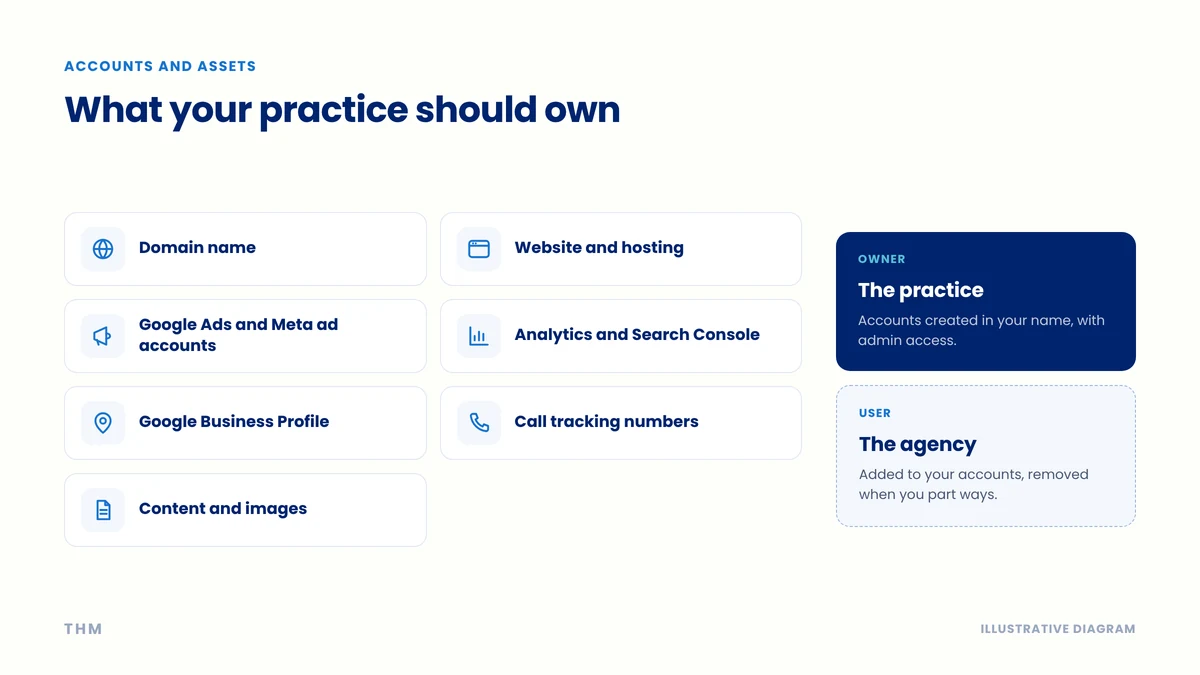
- The domain name, registered to the practice.
- The website and its hosting login, on a platform you could move away from.
- Google Ads and Meta ad accounts, with the agency added as a user.
- Google Analytics 4 and Google Search Console, with admin access for you.
- Google Business Profile, with the practice as primary owner.
- Call tracking numbers, or the right to transfer them.
- All content, images and copy you paid for.
On the contract itself, look for a notice period you can live with, a clear list of what is included each month, and a clause stating that all accounts and work product belong to the practice. If the contract is silent on ownership, ask for it to be added before you sign.
Reporting: what good looks like
A good report answers one question: did marketing bring in new patients this month, and at what cost. Everything else is supporting detail.
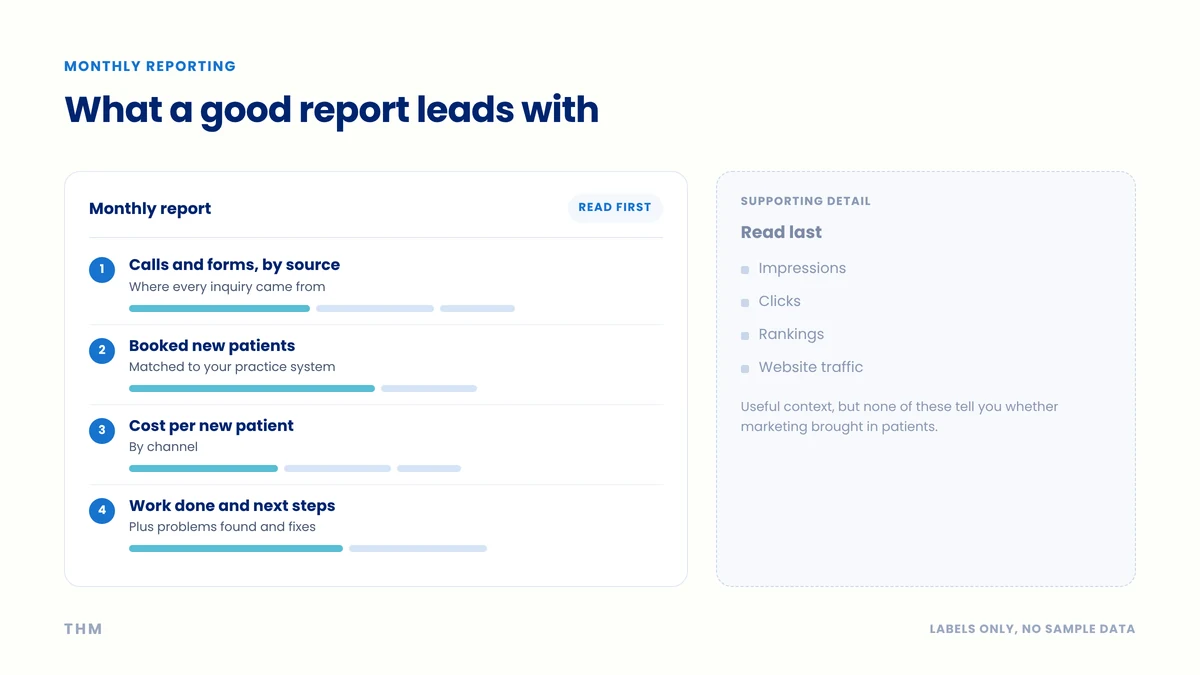
- Calls and form submissions, by source.
- Booked new patients, matched against your practice management system where possible.
- Cost per new patient, by channel.
- What was done this month, and what is planned next.
- Problems found, such as missed calls or a broken form, and what to do about them.
Marketing analytics tools can produce hundreds of charts, and some agencies send all of them. More charts is not better reporting. Ask for a one page summary at the top that a busy practice owner can read in two minutes.
The same goes for marketing software for practices. Call tracking, review tools and booking widgets are useful, but an agency that leads with software rather than with your goals is usually selling a platform, not a plan.
What it costs and what you are paying for
What healthcare marketing costs depends on your market, your competition, how many services and locations you want to promote, and how much ad spend sits on top of the agency fee. Any agency quoting a firm price before it has asked about those things is guessing.
It helps to separate the two parts. The agency fee pays for people, time and expertise. Ad spend goes to Google or Meta. Make sure you know which is which, who pays the platforms directly, and whether the agency takes a percentage of ad spend on top of its fee.
A list of marketing ideas for medical practices costs nothing. What you are paying for is someone to choose the right few, do them properly, measure them honestly and stop the ones that are not working.
The cheapest proposal is rarely the best value, and neither is the most expensive. The useful comparison is what each agency will deliver in the first 90 days for the same budget.
Compare agencies with a simple scorecard
Once you have spoken to two or three agencies, score each one from 0 to 2 on the points below. It is crude, but it stops the most polished pitch from winning by default.
Agency scorecard
- Named the people who would do the work.
- Showed real proof from practices like yours.
- Confirmed in writing that you own all accounts and assets.
- Explained how they handle healthcare ad policies and patient privacy.
- Shared a sample report that leads with patients, not traffic.
- Gave a written plan for the first 90 days.
- Offered a contract you can leave without a penalty.
- Asked you more questions than you asked them.
If two agencies score about the same, pick the one whose people you would rather work with. You will be talking to them every month.
What should happen in the first 90 days
The first three months tell you most of what you need to know about an agency. You will not see the full result in that time, but you should see clear progress and honest communication.
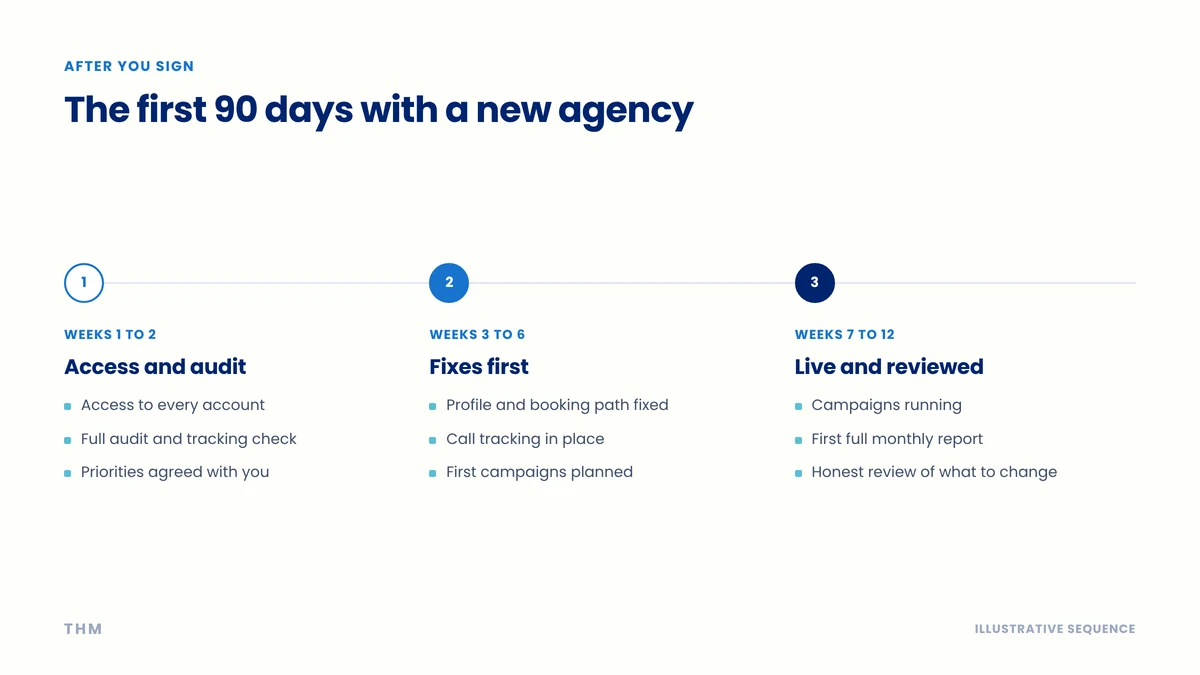
- Weeks 1 to 2: access to every account, a full audit, tracking checked, and a short list of priorities agreed with you.
- Weeks 3 to 6: the obvious fixes done, such as the profile, booking path and call tracking, and the first campaigns or content planned.
- Weeks 7 to 12: campaigns live, a first proper report, and an honest review of what is working and what should change.
If by the end of the third month you still do not know what has been done or what it produced, that is your answer. A good agency makes the first 90 days easy to judge.
Talk it through
Want a second opinion before you sign?
Tell us what you are looking for, or what a proposal you have received includes, and we will tell you what we would ask before signing, whether or not you work with us. For a quick question, message us on WhatsApp and a person will reply.
Frequently asked questions
How do I know if a healthcare marketing agency is any good?
Ask for proof you can check: a sample report, examples from practices like yours, and a reference you can call. A good agency names who will do the work, confirms you own every account, and talks about booked patients rather than traffic. If they cannot show you any of that, keep looking.
What questions should I ask a marketing agency before hiring them?
Ask who will do the work, what you will own, how results are measured, what happens in the first 90 days, and how you can leave. In healthcare, also ask how they handle advertising policies and whether they will need any patient information. Ask every agency the same questions.
Is it better to hire a healthcare specialist agency or a general marketing agency?
A specialist usually understands healthcare advertising restrictions, patient privacy and how patients search, so you spend less time teaching them. A strong generalist can still work if it has real healthcare experience. Judge either one on proof from practices like yours, not on the label.
How much does a healthcare marketing agency cost per month?
It depends on your market, your competition, how many services and locations you promote, and whether ad spend is included. Ask each agency to separate its fee from ad spend and explain what the fee covers. Then compare what each will deliver in the first 90 days for the same budget.
What should be in a healthcare marketing agency contract?
A clear list of what is included each month, a notice period you can live with, and a clause stating that the practice owns all accounts, websites, data and content. If the agency will handle any patient information, ask for a business associate agreement as well.
Who should own my website and ad accounts, me or the agency?
You should. Accounts should be created in the practice’s name with the agency added as a user. That way, if you change agencies, you keep your website, ad history, analytics and reviews. Ask for this in writing before any work starts, and check it again in the first week.
How long should I give a marketing agency before judging results?
Give it around three months to judge the agency itself, even if the full results take longer. By then you should have working tracking, clear reports and visible fixes. If you still cannot tell what was done or what it produced, that tells you most of what you need to know.
What are the warning signs of a bad healthcare marketing agency?
Guaranteed rankings or patient numbers, accounts set up in the agency’s name, reports that focus on traffic instead of patients, long contracts with no exit, and offers to buy or write reviews. Also be wary of any agency that installs tracking without asking about patient privacy.
Does a marketing agency need to understand HIPAA?
If it works with US healthcare providers, yes. Most marketing should never touch patient information, and a good agency designs campaigns that way. Where it will handle protected health information, a business associate agreement is generally required first. Rules differ outside the US, so get local advice.
Should a small practice hire an agency or do marketing in-house?
If the basics are not in place, start in-house: fix your Google Business Profile, ask for reviews and check your booking path. Hire an agency when you need several channels running together and nobody in the practice has the time or skills to manage them properly.
Before you sign anything
When you choose a healthcare marketing agency, most of the work is asking the right questions early and believing the answers you get. Ask who does the work, what you own, how results are reported and how healthcare rules are handled.
Then compare what each agency will actually do in the first 90 days. The right partner will make that easy to judge, and will be just as interested in whether your practice is a good fit for them.