
Most practices do not have a marketing problem. They have a leak problem. The phone rings less than it did two years ago. A competitor three miles away sits at the top of Google Maps, and nobody has time to work out why. Learning how to market a medical practice starts with finding those leaks.
To market a medical practice well, you need to do four jobs. Be findable when someone searches for the care you provide. Give that person a reason to pick you over the practice down the road. Then make booking simple, and answer the phone when it rings. Paid advertising sits on top of those four. It works best once they are solid, and it quietly wastes money when they are not.
Why your medical practice struggles to get new patients online
Practices rarely become invisible for an exotic reason. They become invisible because the basics were set up years ago by whoever built the website. Nobody has touched them since. Meanwhile, the practice down the road added services to its profile and collected reviews every month. It also put a booking button where people can actually see it.
The patterns below come up constantly in medical practice marketing:
- A Google Business Profile with the wrong primary category, old opening hours, and no services listed.
- A website that looks fine on a desktop and buries the booking link on a phone.
- Nine reviews, the newest of them from three years ago.
- No tracking at all, so nobody can say which marketing produced which patient.
- Calls going to voicemail during clinic hours, and voicemails returned two days later.
- An agency invoice that arrives every month with a report nobody in the practice understands.
There is a longer argument about why marketing is important in healthcare. It usually lands on one plain point: a patient cannot choose a practice they never see. Being good at medicine does not put you on the first screen of a phone. You still have to market a medical practice, however good the care is.
Decide who you want more of before you spend anything
Marketing works better when it is pointed at something specific. Before you market a medical practice through any channel, make three decisions. Which services do you want more of? Which patients? And which area can you realistically serve?
Take an orthopedic practice that treats everything from sports injuries to joint replacement. It has spare capacity in its knee clinic and a six week wait for everything else. Marketing the practice as a whole makes the wait longer. Marketing the knee clinic fills the gap. The same logic applies to a family practice opening a second location. It also applies to a dermatology clinic that wants more skin checks and fewer cosmetic inquiries. Splitting patients into useful groups like this is what marketers mean by healthcare market segmentation. Most practices skip this step entirely.
Write down three things on one sheet of paper. List the services you want more of and the type of patient those services suit. Then list the towns or zip codes you can serve without anyone driving an hour. Marketing textbooks turn this into the 5 Ps of healthcare marketing, but you do not need the framework. Every decision later gets easier, because you finally have something to check against.
Start with the Google Business Profile for your medical practice
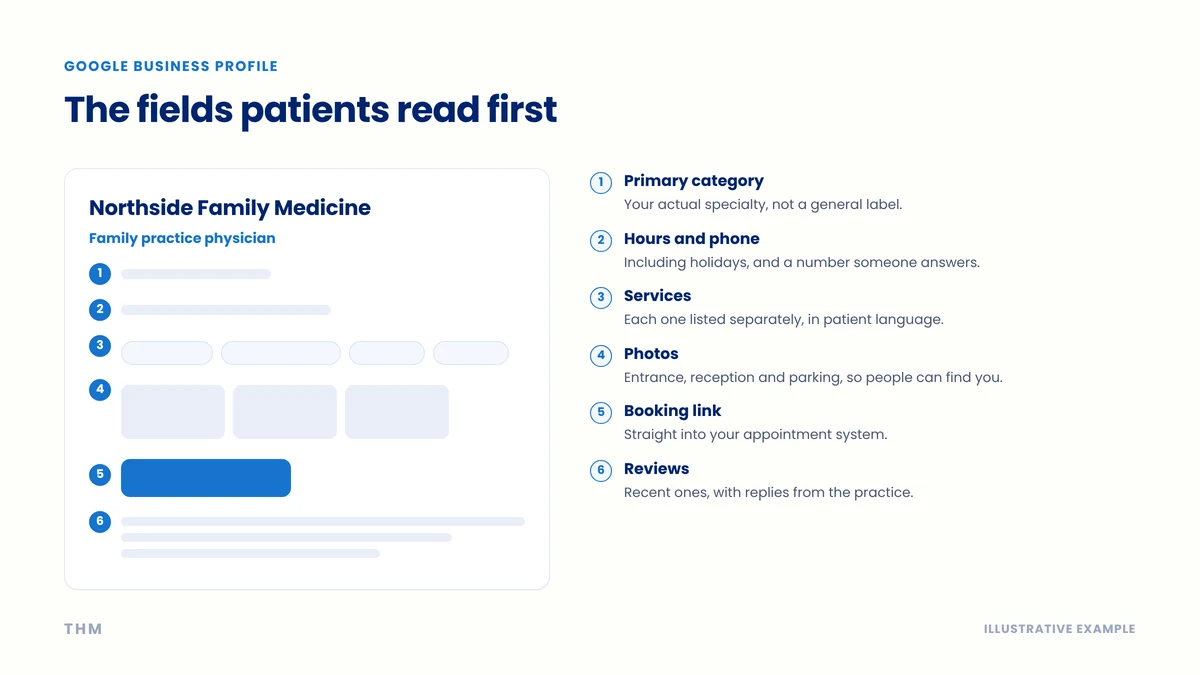
For most practices, the Google Business Profile is the highest-return thing to fix, and it costs nothing. It is the panel that appears beside search results and on Google Maps. For local searches, it is often the only thing a patient looks at before calling. No other free task does more to market a medical practice locally.
Google’s own guide on how to improve your local ranking says local results are based mainly on relevance, distance and prominence. Businesses with complete and accurate information are more likely to show up. You cannot do much about distance. You can do a great deal about the other two.
Work through this in one sitting:
- Set the primary category to what you actually are. A podiatrist listed as a general medical clinic will lose to a podiatrist listed as a podiatrist.
- Add every service you offer as a separate service item, using the words patients use.
- Check hours, including holiday hours, and the phone number that is actually answered.
- Add a booking link if you take online appointments.
- Upload real photos of the entrance, reception and parking. Patients use these to work out whether they can find you.
- Answer the questions in the Q and A section yourself, before someone else does.
- If you have several locations or doctors, give each location its own profile. Keep the details consistent with your website.
Reviews are the part patients actually read
Reviews decide more appointments than any piece of website copy. A patient who has narrowed the choice to three nearby practices will usually pick on reputation. They look at how recent and how numerous the reviews are, not just the score. Reviews are one of the few ways to market a medical practice that patients trust more than your own words.
BrightLocal’s 2026 Local Consumer Review Survey asked just over 1,000 US consumers how they use reviews. Of those, 74 percent only consider reviews written in the last three months. And 47 percent will not use a business with fewer than 20 reviews. The survey covers local businesses in general, not healthcare specifically. Still, it describes the same behavior a practice manager sees on the phone. It also found that 45 percent of consumers now use ChatGPT or similar tools for local recommendations. That is up from 6 percent a year earlier, and those tools lean heavily on review content.
That makes a slow, steady stream of reviews worth more than a one-off push. Thirty reviews in two weeks, then nothing for a year, soon looks stale. The practical method is boring, and it works. Ask every patient at the end of a good visit. Send one follow-up text or email with a direct link. Give the job to a named person rather than to everyone in general.
Review rules every medical practice should follow
Two things to be careful about. Do not offer anything in exchange for a review. Do not ask only the patients you expect to be happy. Both can breach platform policies and, in healthcare, can create problems well beyond marketing. When you reply to a review, thank the person and offer to talk offline. Never confirm that someone is a patient and never mention anything about their care, even to correct them. A defensive reply that reveals a visit happened is a far bigger problem than a one-star rating.
Turn website visits into booked appointments
A practice website has one job: turn an interested stranger into a booked appointment. Most lose people at a few predictable places, and you can check them in ten minutes on your own phone. It is possible to market a medical practice well and still lose the patient at this step.
The path from search to appointment is what marketers call the patient acquisition funnel. The leaks in it are usually unglamorous.
Where a medical practice usually loses patients
Fix the obvious ones first. Put a tappable phone number in the header so a patient can call with one touch. Add online booking if your practice management system supports it. Cut appointment request forms down to name, phone, service and preferred time. Say plainly which insurance you accept, or what a first consultation costs. An unanswered money question sends people back to the search results.
The phone and the front desk
Marketing ends at the moment someone tries to contact you, and this is where the most expensive leaks happen. A missed call during clinic hours is a patient who has already chosen you and then gone elsewhere. Check how many calls went unanswered last week. Decide who covers the phone at lunchtime. Set a rule that any appointment request by form or email gets a reply the same working day. Make the first attempt a phone call rather than an email.
Not sure where your medical practice is leaking patients?
The Healthcare Marketing will review your Google Business Profile, local visibility, website booking path and review profile. Then we send you a short written summary of what to fix first and what can wait. No cost and no obligation.
Rank your medical practice for the services you actually offer
Patients rarely search for a practice by name. They search for a problem, a treatment and a place. Think knee pain specialist near me, pediatric dentist in the next town, or same day GP appointment. If one page on your website lists twenty services in bullets, those searches have nothing to land on.
The fix is to give each service you care about its own page, written in plain language. Answer the questions patients actually ask on that page. What does the appointment involve, and how long does it take? What does it cost, or which insurance covers it? Who will they see, and how do they book? Pages like that work for patients. They also work for search engines, which increasingly pull short answers straight out of them. That makes service pages one of the most durable ways to market a medical practice.
Location matters too. If you serve several towns, say so on the page and mean it. Do not build thin copies of the same page with the place name swapped. Thin location pages have been a weak tactic for years. This is slower work than fixing a profile, but it compounds. That is why most practices eventually treat SEO for medical practices as an ongoing program, not a one-off project.
Referrals still do the heavy lifting
For many practices, especially specialties, most new patients still arrive through another clinician or a former patient. Online marketing should protect that channel, not replace it. Referrals are the oldest way to market a medical practice, and they still work.
On the professional side, make it easy to refer to you. A single page with referral instructions, a direct phone line, and a named contact beats a general contact form. Report back to the referring clinician promptly, because speed of correspondence is one of the main reasons referral patterns move. Keep a simple record of who refers and how often, so you notice when someone stops.
On the patient side, word of mouth works best when you remove the friction. People recommend what they can describe easily, so make sure patients leave knowing the name of the service they received. Send a short follow-up message after a good outcome, with a link to your profile. It turns a pleasant intention into an actual review or a passed-on phone number.
When paid search and paid social are worth it
Paid search puts you at the top of results for a service straight away. That makes it useful for a new practice, a new location or a new service line. It also helps fill a gap in this month’s diary. Paid social is different. People are not on social platforms looking for a doctor. It works better for elective and self-pay services, where you are creating interest rather than catching it.
Marketing private healthcare services, the ones a patient pays for directly, is where paid advertising usually earns its keep. You can see the revenue each booking produces. For insurance-covered visits the maths is harder and the case for fixing organic visibility first is stronger.
The best healthcare marketing campaigns tend to look unremarkable from the outside. They target a small number of specific services. Each click goes to a page about that exact service, not the home page. They run when someone can answer the phone, and they pause when the diary fills. The expensive mistakes are just as consistent. Think broad keywords like dentist, traffic sent to the home page, and nobody checking search terms.
One rule worth holding to. If calls go unanswered and the booking path is broken, paid advertising only raises the cost of the same problem. Ads can market a medical practice quickly, but they cannot fix what happens after the click.
Keep the patients you already have
It is far cheaper to bring back a patient who already knows you than to find a new one. Yet most practices sit on a list they never use. Recalls are the obvious example. Think of the six month dental check, the annual review, or the follow-up that was meant to happen in spring. A simple reminder system fills appointments that would otherwise quietly disappear. Retention rarely gets called marketing, but it is part of how you market a medical practice.
The same applies to a short, genuinely useful email once a month or once a quarter. Seasonal advice, a new service, a new clinician, changes to opening hours. Keep it informational and keep it light. A practice newsletter that only ever sells something gets unsubscribed. In healthcare, the list you lose is hard to rebuild.
Patient privacy: check this before you track or advertise
When you market a medical practice, you handle patient information in ways a restaurant never does. The rules are stricter than most practice owners expect. This is general guidance rather than legal advice. It is worth paying for an hour of a compliance adviser’s time before you launch anything.
In the United States, HHS has published guidance on marketing under the HIPAA Privacy Rule. It explains that, with limited exceptions, using protected health information for marketing generally requires the patient’s written authorization. That has practical consequences. Think before you upload a patient list to an advertising platform or publish a testimonial that identifies someone. The same goes for any review reply that confirms a person is a patient.
Tracking is the other area that catches practices out. Analytics and advertising tags on pages where patients book or read about a condition can capture more than anyone intended. US guidance on online tracking technologies has also been contested in the courts. Check the current position rather than relying on an article. Be skeptical of the phrase HIPAA-compliant marketing as a product label too. A tool can support a compliant workflow. But compliance depends on how you use it, and no vendor can hand you that in a box.
Practices in the United Kingdom, Canada and Australia work under different privacy and advertising rules. These include restrictions on how patient testimonials may be used. Do not assume a US article applies where you are.
How to market a medical practice: what to do first
There is no single right way to market a medical practice. It depends on where you are leaking patients, so the table below is built around situations rather than channels.
| Your situation | Start here | Why |
|---|---|---|
| Brand new practice, no patients yet | Google Business Profile, then paid search on your core services | Organic visibility takes months you do not have. Paid buys time while the rest builds. |
| Established, but invisible in local results | Profile, categories, services, then reviews | Usually a setup problem rather than a spending problem, and it is free to fix. |
| Website gets visits but few calls | Booking path, phone handling, service pages | More traffic will not help until the path from visit to appointment works. |
| One service line underused | A dedicated page for it, then targeted paid search | Narrow targeting fills a specific gap without lengthening other waits. |
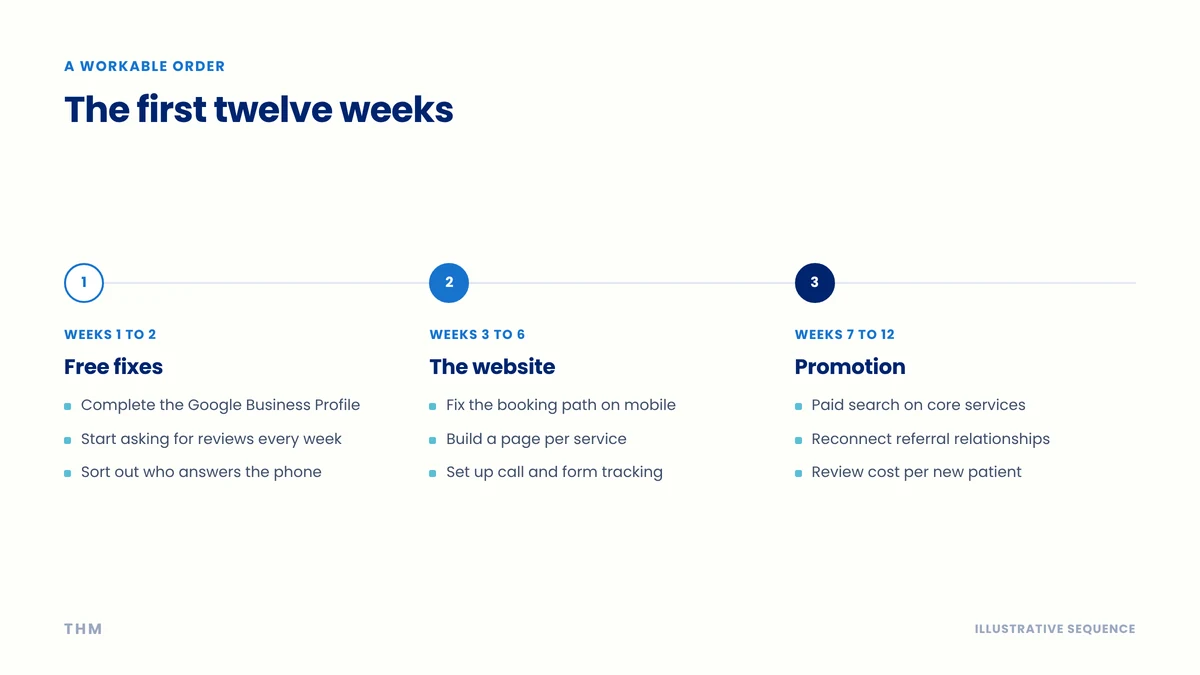
What healthcare marketing costs depends on your market, your competition and how much work your team can do in-house. Anyone who quotes a figure before asking those questions is guessing. The sequence matters more than the budget. Free fixes come first, then the website, then paid promotion once the practice can handle the calls. Want to plan the whole year before touching anything? Our guide to building a healthcare marketing strategy works through positioning, budget and channel choice in order.
Measure booked appointments, not traffic
Traffic is the least useful number in the report. What matters is how many people contacted the practice and how many became appointments. Then look at what each new patient cost to acquire. That is the fairest test of how well you market a medical practice. Generating patient leads is only half the job. A lead that never turns into a booking has cost you money and produced nothing.
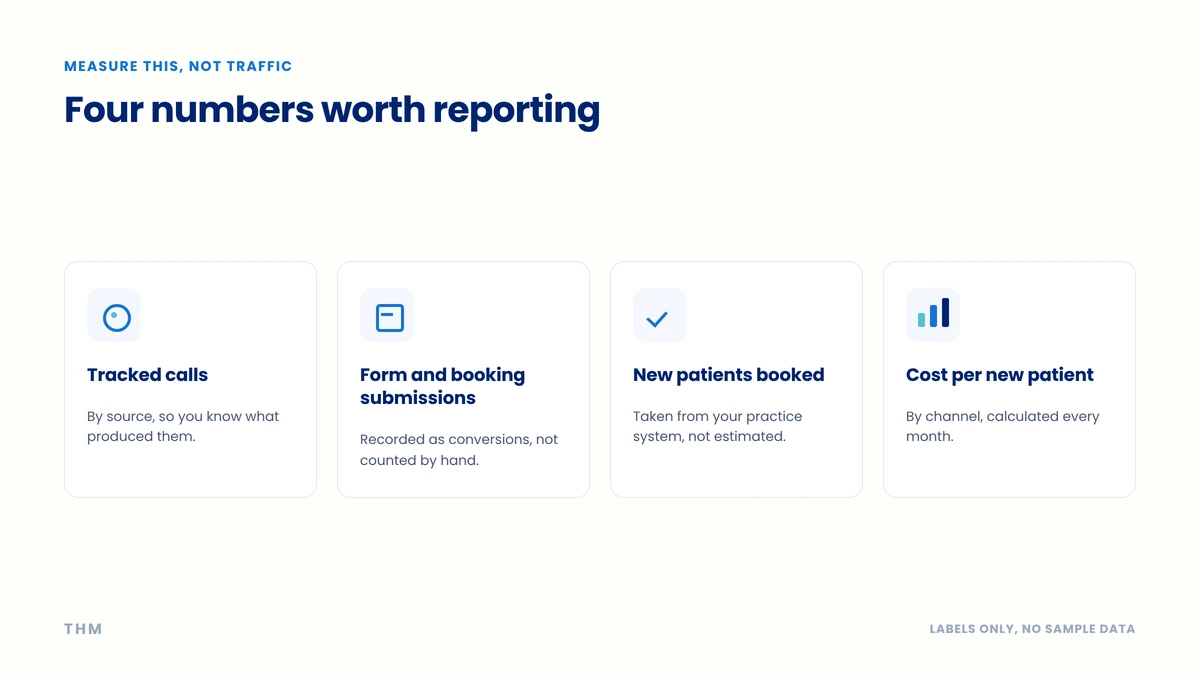
Four things are worth tracking, and all four can be set up without much expense:
- Calls from your website and your profile, using call tracking so you can tell which source produced them.
- Form and booking submissions, recorded as conversions in your analytics rather than counted by hand.
- New patients booked, taken from your practice management system, not estimated.
- Cost per new patient, by channel, calculated monthly rather than when someone asks.
Then ask the front desk a question no dashboard answers. When a new patient calls, how did they hear about the practice? Keep a tally for a month. It is rough data, but it catches things analytics misses. Often it explains the gap between what the report says and what the diary shows.
A ten minute self-check for your medical practice
- Search your main service plus your town on a phone, not a desktop. Do you appear?
- Open your Google Business Profile. Is the primary category right and are services listed?
- Check the date of your most recent review.
- Try to book an appointment on your own website using only your thumb.
- Call your own main number at midday and time how long it rings.
- Send a test inquiry through your contact form and see how long a reply takes.
- Ask whether anyone can tell you how many new patients came from marketing last month.
When to get outside help
Plenty of this is work a motivated practice manager can do without an agency. Profile fixes, review requests, phone cover and a tidier booking path need attention rather than expertise. Many teams market a medical practice in-house for years without trouble. Bring in help when the work needs skills or time the practice does not have. Typical examples are rebuilding a site, running paid campaigns, competing in a crowded market, or opening new locations.
That is the point where an outside team pays for itself. The condition is that the team understands how patients actually choose a practice. Our healthcare digital marketing services cover the whole path, from local visibility to booking and the measurement behind it.
The question of how to choose a healthcare marketing agency comes down to a few unglamorous checks. Ask who will actually do the work, not who turns up to the sales call. Find out what happens to your website, ad account and data if you leave. Make sure you own all three. Ask to see the reporting they would send you, and check whether it talks about patients or only about rankings. Be wary of anyone who guarantees a search ranking or a number of new patients. Nobody can promise either.
The Healthcare Marketing works only with healthcare businesses. That is the main reason we start with an audit rather than a proposal. Sometimes that audit shows a phone problem, not a marketing problem. We would rather tell you that than sell you a retainer.
Want a second opinion on your marketing?
Tell us what you have tried and where the practice feels stuck. We will tell you what we would do first, whether or not you work with us. Prefer a quick question to a call? Message us on WhatsApp and a person will reply.
Frequently asked questions
How can a small medical practice get more patients without a big marketing budget?
Start with the free things that have the most influence. That means a complete Google Business Profile, steady recent reviews and a booking path that works on a phone. It also means someone reliably answering calls. Most small practices find more patients in fixing those than in any new spending.
How do I get my medical practice to show up on Google Maps?
Claim and verify your Google Business Profile, and set the primary category to your actual specialty. List your services, and keep hours and contact details accurate. Google weighs relevance, distance and prominence, so complete information and a regular flow of reviews both help.
How long does it take for medical practice marketing to start working?
Profile and review work can change call volume within weeks. Website and service page improvements usually take two to six months to show in search, depending on competition. Paid search produces inquiries almost immediately, but stops the moment you stop paying for it.
Should my practice start with Google Ads or SEO?
If you need patients this month or you are opening somewhere new, start with ads while organic visibility builds. If you have time and want something that keeps working after the spending stops, start with search visibility. Most established practices eventually run both.
Do online reviews really affect which doctor patients choose?
Yes, and recency matters as much as the score. Patients comparing two or three nearby practices tend to read the newest reviews and look at how many there are. A strong rating from two years ago carries less weight than a steady flow of recent ones.
Is social media worth the time for a medical practice?
For most practices it is a retention and trust channel rather than a source of new patients. People do not browse social platforms looking for a doctor. It earns its place for elective and self-pay services, and for practices with a genuine community presence.
How much should a medical practice spend on marketing?
There is no safe standard figure. It depends on your competition, your market, your services and how much your team can handle in-house. A better approach is to work out what one new patient is worth to you. Then decide what you can afford to pay to win one.
How can I tell if my marketing is actually bringing in new patients?
Track calls and form submissions by source, then match them against new patients booked in your practice management system. Work out cost per new patient for each channel every month. Also ask new patients how they heard about you, because that catches what analytics misses.
How do I market my medical practice without breaking patient privacy rules?
Keep patient information out of advertising tools unless you have proper authorization. Never confirm in public that someone is a patient, and check what your website tracking actually collects. Rules differ between the US, UK, Canada and Australia, so get advice for your jurisdiction.
What should a new medical practice do first to attract patients?
Set up a complete Google Business Profile. Build a simple site with a page for each main service and an obvious way to book. Introduce yourself to local clinicians who might refer, too. Then use paid search to cover the months before organic visibility arrives.
Where to start marketing your medical practice this week
Pick one thing. For most practices it is the Google Business Profile, because it takes an afternoon and costs nothing. For others it is the phone, because the patients are already calling and nobody is picking up.
Learning how to market a medical practice is not about one big project. It is a series of small, boring repairs to the path a patient takes. That path runs from a search on their phone to a seat in your waiting room. Do the repairs in a sensible order and measure appointments rather than clicks. The practice then gets steadily easier to find and easier to choose.