

Healthcare marketing in 2026 is becoming more focused, more data-driven, and more patient-centered than ever before. The old playbook of running a few ads, posting on social media, and waiting for appointments is no longer enough. Patients now expect faster answers, better digital experiences, and more trust before they choose a provider.
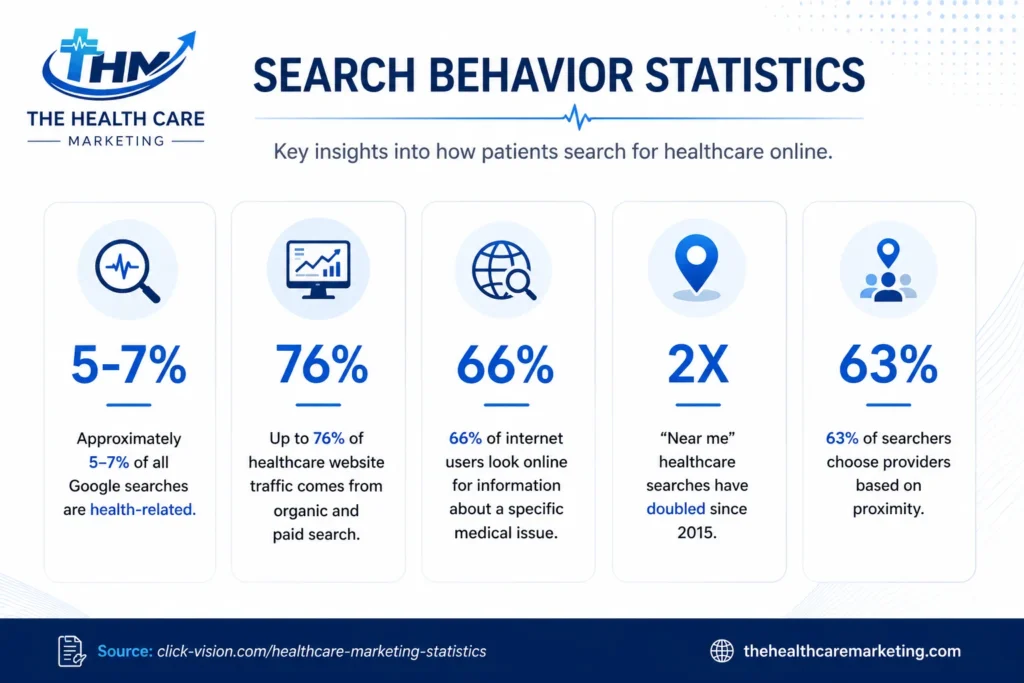
At the same time, healthcare organizations are operating in a more competitive digital environment. Search behavior continues to shape how patients discover providers, compare options, and make care decisions. Around 5-7% of all Google searches are health-related, and up to 76% of healthcare website traffic comes-from organic and paid search, showing just how important search visibility has become for patient acquisition. In addition, 66% of internet users search online for information about a specific medical issue, which means healthcare brands must now create content that is clear, trustworthy, and easy to find.
Local intent is also playing a bigger role than ever. “Near me” healthcare searches have doubled over time, and 63% of searchers choose providers based on proximity, making local SEO, Google Business Profile optimization, and location-focused visibility essential parts of a modern healthcare strategy.
For healthcare providers, clinics, medical groups, and healthcare brands, this means one thing: marketing in 2026 must be smarter, simpler, and built around real patient search behavior.
In this guide, we’ll break down the top healthcare marketing trends shaping 2026, explain why each one matters, and show how healthcare organizations can use them to build sustainable growth.
Quick Summary: Top Healthcare Marketing Trends in 2026
- AI is changing how patients search, compare, and choose providers
- Local SEO remains one of the highest-ROI channels for healthcare growth
- Reputation management is now a core patient acquisition strategy
- Healthcare websites must focus on speed, trust, and conversion
- Personalized patient journeys are replacing generic campaigns
- Content must be built for both humans and AI-generated search experiences
- Omnichannel communication is becoming the standard
Why Healthcare Marketing Trends in 2026 Matter More Than Ever
Healthcare marketing trends in 2026 are not just about staying updated. They directly affect how easily patients can find your practice, how much they trust your brand, and whether they book an appointment or move on to a competitor.
Today’s patients often do the following before choosing a provider:
- Search symptoms or treatments online
- Compare providers in local search results
- Read reviews across multiple platforms
- Visit your website
- Check whether your content feels clear and trustworthy
- Decide based on convenience, confidence, and experience
That means healthcare marketing is now closely tied to patient experience from the very first touchpoint.
If your team still treats SEO, website design, reviews, paid ads, and content as separate efforts, 2026 will be a wake-up call. The winning healthcare brands will connect all of them into one patient-first growth system.
If you want to strengthen your foundation before applying these trends, it helps to revisit the understanding healthcare marketing framework so your strategy stays aligned with patient behavior and business goals.
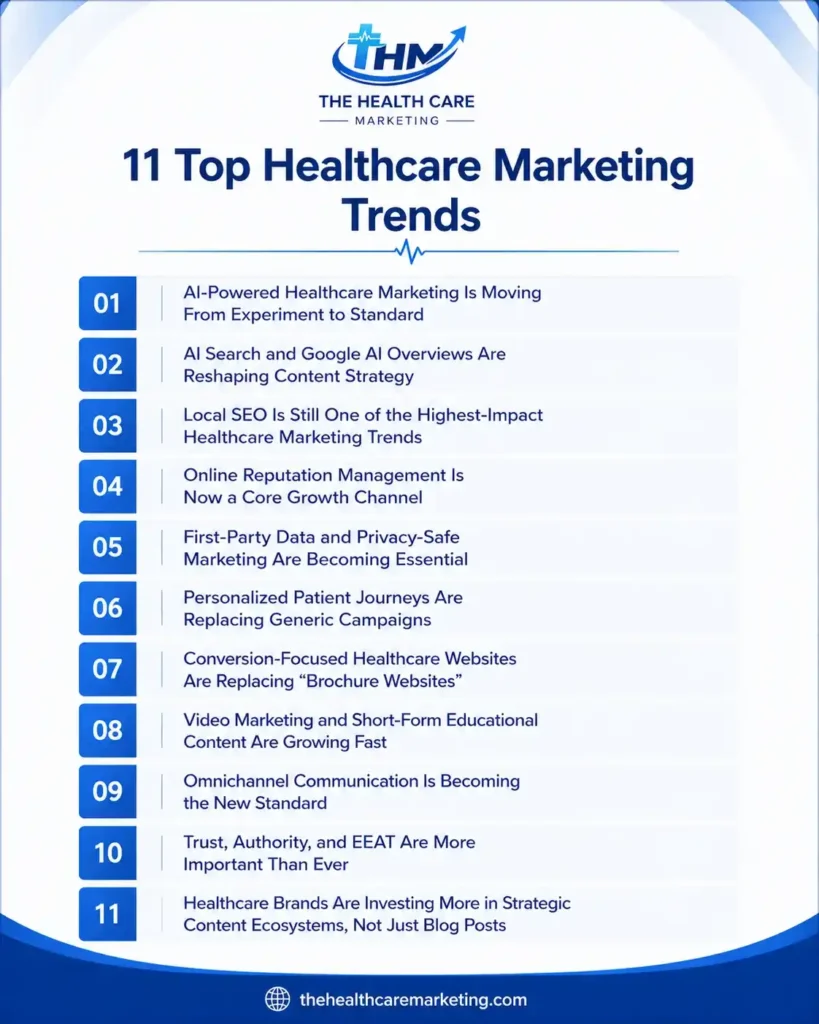
1. AI-Powered Healthcare Marketing Is Moving From Experiment to Standard
One of the biggest healthcare marketing trends in 2026 is the shift from “testing AI” to actually using AI in daily workflows.
In 2024 and 2025, many healthcare marketers experimented with AI for content ideas, ad copy, or automation. In 2026, that changes. AI is becoming part of the core workflow.
Healthcare marketers are now using AI to support:
- Content outlines
- SEO research
- Ad creative variations
- Landing page testing
- Audience segmentation
- CRM automation
- Chat-based lead qualification
- Reporting summaries
PulsePoint’s 2026 report specifically highlights “agentic workflows” and stronger AI integration as a major direction for healthcare marketing this year. (PulsePoint)
Why this matters
AI can save time, speed up testing, and help marketing teams move faster. But in healthcare, speed alone is not enough. Accuracy, compliance, and trust still matter most.
How to apply this trend
Use AI to support execution, not replace strategy.
Best use cases:
- Create first drafts, not final medical claims
- Summarize long content into short patient-friendly versions
- Generate FAQ ideas from search intent
- Analyze review themes
- Build ad variations for testing
- Improve internal reporting and workflow efficiency
Mistakes to avoid
- Publishing AI-written medical content without human review
- Using generic AI outputs with no brand voice
- Relying on AI without compliance checks
- Treating AI as a shortcut instead of a system
2. AI Search and Google AI Overviews Are Reshaping Content Strategy
Another major shift in marketing trends in healthcare is how patients find information through AI-generated answers instead of only clicking traditional search results.
Healthcare content is increasingly being summarized by:
- Google AI Overviews
- AI assistants
- Voice interfaces
- Search snippets
- Chat-style discovery tools
This changes how healthcare marketers should write content.
What content wins in 2026
Content that performs best in AI-driven search is usually:
- Clear
- Structured
- Fact-based
- Easy to summarize
- Written in plain language
- Organized with helpful headings
- Focused on one intent per section
That means long paragraphs, vague opinions, and fluffy intros are becoming weaker.
How to optimize for AI-friendly healthcare content
To align with healthcare marketing trends 2026, your content should:
- Answer one question clearly in each section
- Use direct definitions
- Add short summary paragraphs
- Use tables where helpful
- Include FAQs
- Keep language simple
- Show expertise without sounding overly technical
- Avoid keyword stuffing
This is also why blog content must now serve both human readers and AI summarization systems.
3. Local SEO Is Still One of the Highest-Impact Healthcare Marketing Trends
If your goal is patient acquisition, local SEO is still one of the most important healthcare marketing trends in 2026.
Patients searching for care often use local-intent searches like:
- dentist near me
- urgent care in [city]
- best cardiologist near me
- pediatric clinic open now
- physical therapy in [location]
That means local visibility can directly affect appointments.
What local SEO now includes
In 2026, local SEO is more than rankings. It includes:
- Google Business Profile optimization
- Service page SEO
- Location page strategy
- Review generation
- Local citations
- NAP consistency
- Local schema
- Geo-relevant content
- Localized FAQs
- Map pack optimization
Why it matters
A strong local SEO strategy helps you appear in:
- Google Maps
- Local pack results
- Branded searches
- “Near me” intent searches
- Treatment + city searches
How to apply this trend
Focus on:
- Fully optimized Google Business Profile
- Accurate services and categories
- Consistent clinic details everywhere
- Fresh patient reviews
- Location pages for each office
- Treatment pages tied to local search intent
- Fast-loading mobile experience
For many providers, this single channel can outperform broad awareness campaigns when done well.
4. Online Reputation Management Is Now a Core Growth Channel
In 2026, reviews are no longer just a trust signal. They are a growth channel.
Patients compare healthcare providers quickly, and reviews often shape first impressions before they even visit your site.
This is why reputation management is now one of the most important healthcare marketing trends.
What patients look for in reviews
They want signs of:
- Trust
- Clean experience
- Friendly staff
- Clear communication
- Wait times
- Appointment ease
- Billing transparency
- Outcome confidence
What strong reputation management looks like
A real reputation strategy includes:
- Consistent review requests after appointments
- Review response workflows
- Monitoring Google, Healthgrades, Facebook, and niche platforms
- Identifying negative review patterns
- Sharing review insights with operations teams
- Highlighting positive proof on landing pages
Why this trend matters
Reviews now influence:
- Local SEO visibility
- Click-through rate
- Trust before booking
- Conversion on service pages
- Brand perception across channels
In other words, reputation is not separate from SEO or conversion anymore. It affects both.
5. First-Party Data and Privacy-Safe Marketing Are Becoming Essential
Another major healthcare marketing trend in 2026 is the move toward first-party data.
Healthcare marketers can no longer depend heavily on loose audience targeting or fragmented third-party signals. Privacy expectations are higher. Platform changes continue. Compliance matters more.
PulsePoint’s 2026 report also emphasizes data interoperability and smarter data strategy as key themes for the year. (PulsePoint)
What first-party data means in healthcare
This includes data you collect directly through:
- Website forms
- Appointment requests
- CRM interactions
- Email engagement
- Call tracking
- Patient education downloads
- Chat conversations
- Newsletter signups
- Event registrations
Why this matters
First-party data helps you:
- Build better audience segments
- Improve follow-up messaging
- Reduce wasted ad spend
- Track patient journey quality
- Create smarter remarketing audiences
- Personalize campaigns more safely
Practical steps for 2026
- Clean up CRM and lead tagging
- Track service-level conversion events
- Segment by intent, location, and treatment interest
- Connect forms, calls, and ad platforms where possible
- Build privacy-safe nurture paths
- Review consent language and data usage policies
6. Personalized Patient Journeys Are Replacing Generic Campaigns
Generic healthcare marketing is losing power.
One of the most practical healthcare marketing trends in 2026 is the shift toward personalized patient journeys.
Patients do not all arrive at the same stage. Some are researching symptoms. Some are comparing providers. Some are ready to book. Some need reassurance before treatment.
If you show the same message to everyone, performance drops.
What personalization looks like in healthcare marketing
This can include:
- Different landing pages by service intent
- Different email sequences by treatment interest
- Location-specific messaging
- New patient vs returning patient journeys
- Insurance-related content paths
- Retargeting by page visited
- Content based on procedure awareness stage
Example
A visitor on a cosmetic dentistry page may need:
- Before-and-after proof
- Financing reassurance
- Social proof
- Short consultation CTA
A visitor on an orthopedic surgery page may need:
- Treatment education
- Provider credentials
- Recovery expectations
- Insurance guidance
- Trust-building FAQs
Same website. Very different intent.
Why this matters in 2026
Better personalization improves:
- Conversion rate
- Time on site
- Lead quality
- Patient confidence
- Lower bounce rates
- Better follow-up performance
7. Conversion-Focused Healthcare Websites Are Replacing “Brochure Websites”
One of the most overlooked marketing trends in healthcare is the role of the website itself.
In 2026, a healthcare website must do three things well:
- Build trust fast
- Make information easy to understand
- Make the next step easy to take
If it fails on any of those, traffic is wasted.
What a high-performing healthcare website needs
A strong 2026 healthcare website should include:
- Fast load speed
- Clear mobile UX
- Strong service pages
- Trust signals above the fold
- Doctor credentials and bios
- Clear insurance/payment info where relevant
- Simple CTAs
- Friction-free forms
- Click-to-call options
- FAQs on key pages
- Real patient proof
- Schema markup
Why this trend matters
Paid ads, SEO, social media, and referrals all eventually send traffic to your website. If the site does not convert, the rest of your marketing underperforms.
This is why more providers are investing in websites built around patient behavior, not just branding.
8. Video Marketing and Short-Form Educational Content Are Growing Fast
Video continues to become more important in healthcare marketing.
Patients want fast, easy-to-understand answers. Short videos are often easier to trust and consume than long text blocks.
This trend is supported by the wider move toward digital-first media, including the rise in CTV investment noted in healthcare marketing reporting for 2026. (PulsePoint)
Best video formats for healthcare providers
High-performing formats include:
- Doctor explainers
- Common condition education
- Procedure walkthroughs
- Myths vs facts
- “What to expect” videos
- Short clinic intros
- FAQ clips
- Post-treatment guidance
- Staff culture videos
Where video works best
- Service pages
- YouTube SEO
- Instagram Reels
- Paid social
- Waiting room screens
- Email nurture sequences
- Retargeting ads
Important note
Keep healthcare video:
- simple
- compliant
- helpful
- easy to understand
- focused on trust, not hype
9. Omnichannel Communication Is Becoming the New Standard
Patients do not move in straight lines anymore.
They may:
- find you in Google
- visit your website
- read reviews
- click a social ad later
- call from mobile
- leave without booking
- return from an email reminder
- finally convert after a retargeting ad
That is why omnichannel marketing is one of the strongest healthcare marketing trends in 2026.
PulsePoint’s 2026 and 2024 health marketing resources both reinforce the importance of cross-channel orchestration and omnichannel engagement in modern healthcare marketing. (PulsePoint)
What omnichannel means in practice
It means your messaging is aligned across:
- SEO
- PPC
- social media
- SMS
- website
- remarketing
- call tracking
- CRM follow-up
Why this matters
When channels work together:
- patient journeys feel smoother
- trust builds faster
- lead leakage drops
- reporting improves
- budget decisions become smarter
What to do in 2026
- Align campaigns by service line
- Standardize offers and messaging
- Track first touch and assisted conversions
- Connect CRM and call data where possible
- Build follow-up workflows for non-converting visitors
10. Trust, Authority, and EEAT Are More Important Than Ever
In healthcare, trust is not optional.
That is why one of the most durable healthcare marketing trends 2026 is stronger focus on EEAT:
- Experience
- Expertise
- Authoritativeness
- Trustworthiness
What EEAT looks like on healthcare websites
- Clear author or reviewer information
- Physician-reviewed content where relevant
- Accurate medical claims
- Updated content
- Transparent business details
- Real team bios
- Certifications and credentials
- Trust badges only where legitimate
- Strong about page
- Real patient education, not generic filler
Why this matters now
As AI-generated content grows, search engines and users both look for stronger trust signals.
If your content sounds generic or thin, it may struggle even if it is optimized.
This is why a modern healthcare content strategy should not just target keywords. It should also demonstrate real authority.
If you want to build that foundation properly, the 5p’s of healthcare marketing can help align positioning, people, process, promotion, and patient experience more clearly.
11. Healthcare Brands Are Investing More in Strategic Content Ecosystems, Not Just Blog Posts
The final big healthcare marketing trend in 2026 is the move away from random content publishing.
Winning healthcare brands are no longer asking:
- “Can we post one blog this month?”
They are asking:
- “Do we have a full content system that supports awareness, trust, conversion, and retention?”
What a content ecosystem includes
A strong healthcare content ecosystem may include:
- Pillar pages
- Service pages
- Location pages
- FAQ clusters
- Treatment comparison content
- Blog posts
- Video content
- Doctor bios
- Patient resources
- Email nurture content
- Review snippets
- downloadable guides
Why this matters
A single blog can rank.
A content ecosystem can dominate a service line.
This approach supports:
- SEO depth
- topical authority
- stronger internal linking
- better user journeys
- better AI Overview visibility
- better conversion support
For providers serious about growth, this is where different marketing services for healthcare often need to work together instead of staying siloed.
Traditional vs Modern Healthcare Marketing in 2026
| Traditional Healthcare Marketing | Modern Healthcare Marketing in 2026 |
| Generic messaging for all patients | Personalized journeys by intent, service, and location |
| Static brochure-style website | Conversion-focused website with trust and booking UX |
| Basic SEO with a few pages | Local SEO + service clusters + AI-friendly content |
| Reviews treated as passive feedback | Reputation management as an active growth strategy |
| Channels managed separately | Omnichannel strategy with connected touchpoints |
| Content written only for keywords | Content written for users, search, and AI summaries |
| Limited reporting by channel | Full-funnel reporting tied to patient acquisition |
| Manual workflows everywhere | AI-assisted execution with human oversight |
How Healthcare Providers Should Adapt to These Healthcare Marketing Trends in 2026
The best response to healthcare marketing trends in 2026 is not to chase every new tactic. It is to build a smarter system.
A simple 2026 action plan
- Audit your website for trust and conversion gaps
- Strengthen local SEO and Google Business Profile
- Build a review generation and response process
- Improve service pages for search intent and conversion
- Create AI-friendly content that is easy to summarize
- Use first-party data for smarter segmentation
- Add video to key service and trust-building pages
- Connect SEO, paid media, CRM, and follow-up workflows
- Track real patient acquisition metrics, not vanity metrics
- Review all content for EEAT and accuracy
If your organization needs support with this transition, working with a specialized healthcare marketing agency can help turn disconnected tactics into a more scalable growth system.
Final Thoughts on Healthcare Marketing Trends in 2026
The biggest healthcare marketing trends in 2026 are not just about new tools. They are about changing patient expectations.
Patients want:
- clear information
- local convenience
- trust signals
- better digital experiences
- easier communication
- confidence before booking
That means the future of healthcare marketing belongs to providers who can combine:
- strong SEO
- better websites
- clear content
- real reviews
- smart automation
- personalized journeys
- omnichannel consistency
If your healthcare marketing strategy still depends on outdated tactics, 2026 is the right time to rebuild it.
The healthcare brands that win this year will not be the ones doing the most marketing. They will be the ones doing the most connected, patient-first, trust-driven marketing.
FAQs About Healthcare Marketing Trends
- What are the most important healthcare marketing trends in 2026?
The most important healthcare marketing trends in 2026 include AI-powered marketing, local SEO, personalized patient journeys, online reputation management, omnichannel communication, video content, first-party data strategy, and AI-friendly content built for modern search behavior. These healthcare marketing trends matter because they directly affect visibility, trust, and patient conversion.
- Why are healthcare marketing trends changing so quickly in 2026?
Healthcare marketing trends are changing quickly in 2026 because patient behavior is changing. People now rely more on search, reviews, mobile experiences, AI-generated answers, and digital convenience. As a result, healthcare organizations must adapt their marketing to meet higher expectations and stay competitive.
- How do healthcare marketing trends impact patient acquisition?
Healthcare marketing trends impact patient acquisition by influencing how patients find, compare, and trust providers. Strong healthcare marketing trends like local SEO, review management, and conversion-focused websites can increase appointment requests, improve lead quality, and reduce drop-off during the patient journey.
- Which healthcare marketing trends should small clinics focus on first?
For small clinics, the best healthcare marketing trends to prioritize are local SEO, Google Business Profile optimization, review generation, service page SEO, and a fast, mobile-friendly website. These healthcare marketing trends usually offer the fastest and most sustainable return on investment.
- Are AI tools one of the top healthcare marketing trends for 2026?
Yes, AI tools are one of the top healthcare marketing trends for 2026. AI is helping healthcare marketers with content planning, ad testing, automation, reporting, and audience segmentation. However, these healthcare marketing trends work best when AI supports human strategy, not when it replaces compliance and expert review.
- How do healthcare marketing trends affect SEO strategy?
Healthcare marketing trends affect SEO strategy by shifting focus toward local search, AI-friendly content, EEAT, structured content, service clusters, and patient intent. In 2026, healthcare marketing trends require SEO content that is easier to summarize, more trustworthy, and more aligned with real user needs.
- Why is local SEO still one of the strongest healthcare marketing trends?
Local SEO remains one of the strongest healthcare marketing trends because most patients search for providers near them. Whether they need urgent care, a specialist, or a dental clinic, local-intent searches drive real appointment demand. That makes local SEO one of the most practical and high-impact healthcare marketing trends in 2026.
- How do reviews connect with healthcare marketing trends in 2026?
Reviews are closely connected to healthcare marketing trends in 2026 because they influence local rankings, click-through rates, and patient trust. Modern healthcare marketing trends treat reputation management as an active growth strategy, not just a support task.
- What content formats align best with healthcare marketing trends in 2026?
The best content formats for healthcare marketing trends in 2026 include SEO blog posts, FAQ pages, service pages, comparison pages, short educational videos, local landing pages, doctor bios, and patient-focused guides. These formats work because they support both search visibility and patient trust.
- How can providers build a strategy around healthcare marketing trends long term?
To build a long-term strategy around healthcare marketing trends, providers should focus on strong foundations: local SEO, conversion-focused web design, content quality, EEAT, review systems, first-party data, and omnichannel consistency. The best healthcare marketing trends are not temporary hacks—they are part of a patient-first digital growth system.
