

Healthcare marketing is no longer just about running ads or printing brochures. In 2026, it is one of the most important growth systems for clinics, hospitals, private practices, and healthcare brands. Patients now search online, compare providers, read reviews, visit websites, and make trust-based decisions before they ever book an appointment. That means healthcare organizations need a clear, ethical, and patient-focused way to show up where people are already looking.
If you want to understand what is healthcare marketing and why marketing is important in healthcare, the answer is simple: it helps healthcare providers connect with the right patients, build trust early, improve visibility, and support long-term growth. It also helps people make better healthcare choices by giving them clear, useful, and accurate information.
Recent data makes this even clearer. A 2025 report cited by ZealousWeb noted that 77% of patients use search engines before booking a healthcare appointment, showing how strongly digital discovery now shapes patient behavior. Separately, rater8’s 2025 patient preference research found that 84% of patients check online reviews before choosing a new healthcare provider, which highlights how important trust signals and reputation have become in modern healthcare marketing. (ZealousWeb)
In this guide, we will explain what healthcare marketing means, why it matters more than ever in 2026, which channels work best, common mistakes to avoid, and how healthcare organizations can build a strategy that drives both patient trust and sustainable growth.
What Is Healthcare Marketing?
Healthcare marketing is the process of promoting healthcare services, providers, facilities, or healthcare brands in a way that helps the right audience discover, trust, and choose them.
In simple words, healthcare marketing is how a clinic, hospital, doctor, dental office, specialty practice, or healthcare company makes people aware of its services and encourages them to take the next step.
That next step may include:
- booking an appointment
- calling the front desk
- filling out a contact form
- visiting a location
- signing up for telehealth
- downloading patient information
- subscribing for ongoing health education
Healthcare marketing is different from general marketing because healthcare decisions are more personal, more sensitive, and more trust-driven. Patients are not buying a casual product. They are choosing care, expertise, safety, and support. That means healthcare marketing must be accurate, ethical, clear, and patient-centered.
A strong healthcare marketing strategy usually combines:
- branding
- website optimization
- local SEO
- content marketing
- paid search ads
- social media presence
- online reputation management
- patient communication
- conversion tracking
- retention campaigns
So, when someone asks what is healthcare marketing, the best definition is this:
Healthcare marketing is the strategic process of helping healthcare organizations attract, educate, convert, and retain patients through ethical, trust-based communication across digital and traditional channels.
Why Is Marketing Important in Healthcare?
If you are asking why is marketing important in healthcare, the short answer is that patients now behave like informed consumers. They research first, compare options, and choose providers based on visibility, trust, convenience, reputation, and experience.
Healthcare marketing matters because it helps providers:
- become easier to find online
- build trust before the first visit
- educate patients about services and treatments
- compete in crowded local markets
- improve appointment volume
- strengthen retention and loyalty
- support reputation and brand credibility
- guide patients through a better care journey
In 2026, even excellent healthcare providers can lose patients if they are hard to find, unclear online, or invisible in search results.
Marketing is important in healthcare because great care alone is not always enough. People must first discover you, understand what you offer, feel confident in your credibility, and believe your practice is the right fit.
Here is why that matters so much today:
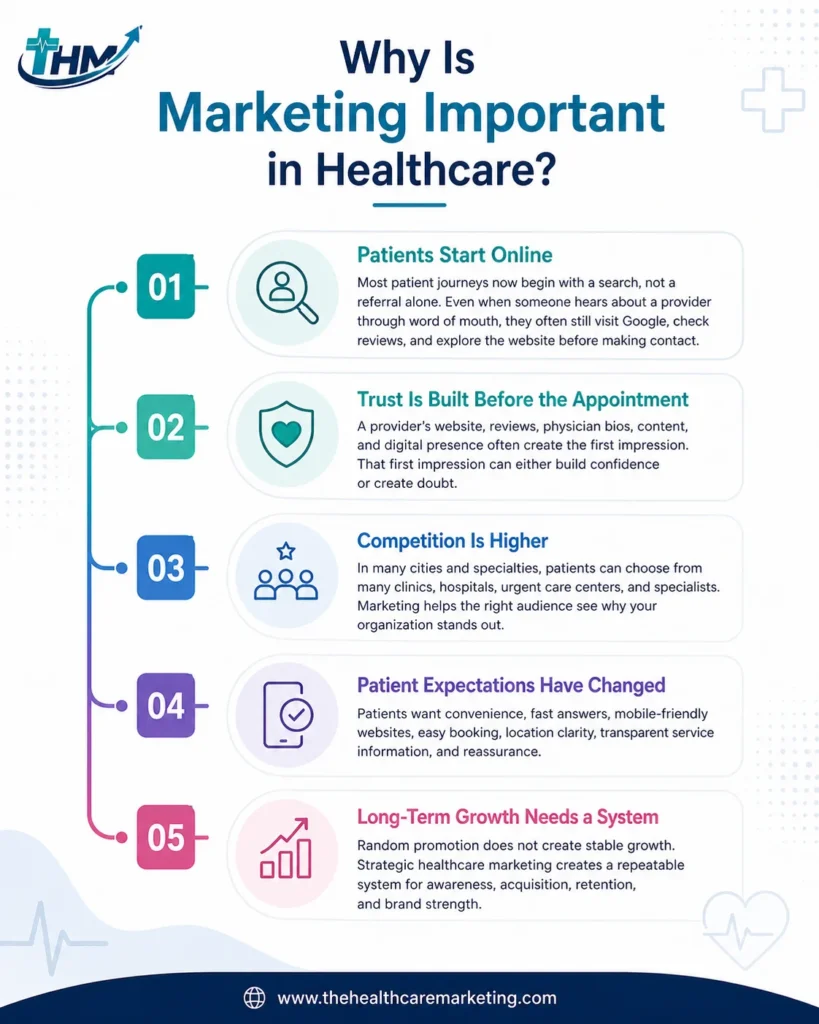
1. Patients Start Online
Most patient journeys now begin with a search, not a referral alone. Even when someone hears about a provider through word of mouth, they often still visit Google, check reviews, and explore the website before making contact.
2. Trust Is Built Before the Appointment
A provider’s website, reviews, physician bios, content, and digital presence often create the first impression. That first impression can either build confidence or create doubt.
3. Competition Is Higher
In many cities and specialties, patients can choose from many clinics, hospitals, urgent care centers, and specialists. Marketing helps the right audience see why your organization stands out.
4. Patient Expectations Have Changed
Patients want convenience, fast answers, mobile-friendly websites, easy booking, location clarity, transparent service information, and reassurance.
5. Long-Term Growth Needs a System
Random promotion does not create stable growth. Strategic healthcare marketing creates a repeatable system for awareness, acquisition, retention, and brand strength.
Healthcare Marketing vs General Marketing: What Makes It Different?
Healthcare marketing follows many of the same core marketing principles, but the stakes are much higher.
In healthcare, you are not just promoting a service. You are helping people make decisions about their health, comfort, safety, and well-being. That changes everything.
Here are the biggest differences:
Healthcare decisions are emotional and trust-based
A patient may feel stress, fear, uncertainty, or urgency. Messaging must feel supportive, clear, and responsible.
Compliance matters
Healthcare marketing must avoid misleading claims, overpromising outcomes, or using risky language around treatments, results, and patient data.
Reputation carries more weight
In many industries, a bad review can hurt sales. In healthcare, a weak reputation can directly reduce patient confidence and appointment conversions.
Patient education is part of marketing
Helpful content is not just a branding tool. It helps patients understand symptoms, services, treatment options, timelines, and expectations.
Experience matters after the click
In healthcare, the patient journey includes booking, staff communication, wait times, follow-up, and care quality. Marketing and patient experience are closely connected.
Core Goals of Healthcare Marketing
Healthcare marketing should never be limited to “get more traffic.” That is too narrow.
A better healthcare marketing strategy is built around business growth and patient trust.
The main goals usually include:
1. Increase Visibility
This means helping your healthcare organization appear where patients are searching:
- Google search
- Google Maps
- local service searches
- social platforms
- healthcare directories
- AI-generated search summaries
- review platforms
2. Build Trust and Credibility
Trust signals include:
- professional website design
- accurate service pages
- physician bios
- certifications and credentials
- patient testimonials (used ethically)
- positive reviews
- educational content
- consistent brand messaging
3. Generate Qualified Patient Leads
Not all traffic is useful. Good healthcare marketing attracts the right people based on:
- location
- specialty need
- insurance fit (where relevant)
- urgency
- service intent
- demographic or life stage
4. Improve Appointment Conversions
Marketing is not complete when someone lands on the site. It should also make it easy to:
- call
- request an appointment
- book online
- find directions
- understand next steps
5. Retain Existing Patients
Retention is often overlooked. Strong healthcare marketing can support repeat visits, follow-up care, wellness programs, seasonal reminders, and long-term loyalty.
6. Strengthen Brand Positioning
A hospital, clinic, or specialty practice needs to stand for something clear in the market:
- compassionate care
- advanced treatment
- convenience
- specialized expertise
- family-focused service
- preventive care leadership
Traditional Healthcare Marketing vs Digital Healthcare Marketing
Healthcare organizations still use both traditional and digital marketing, but digital now plays a much larger role in patient discovery and conversion.
Here is a simple comparison:
| Area | Traditional Healthcare Marketing | Digital Healthcare Marketing |
| Reach | Local and often limited | Local, regional, or wider depending on strategy |
| Speed | Slower to launch and measure | Faster to launch and optimize |
| Tracking | Harder to measure accurately | Easier to track calls, forms, bookings, clicks |
| Cost Efficiency | Can be expensive for broad reach | Often more efficient when targeted well |
| Patient Intent | More passive awareness | Captures active search intent |
| Trust Signals | Depends on offline brand exposure | Reviews, website, content, search presence build trust |
| Flexibility | Harder to change quickly | Easy to test, refine, and scale |
| Best Use Cases | Community branding, local events, awareness | SEO, PPC, local search, content, retargeting, reputation |
Traditional healthcare marketing may include:
- print ads
- brochures
- local newspaper ads
- billboards
- radio
- TV
- direct mail
- community events
- physician referral outreach
Digital healthcare marketing may include:
- SEO
- local SEO
- Google Ads
- social media
- content marketing
- email marketing
- reputation management
- landing pages
- video marketing
- conversion rate optimization
In 2026, the smartest organizations do not choose one or the other blindly. They build a balanced mix based on audience, specialty, geography, budget, and growth goals.
Key Channels Used in Healthcare Marketing
A complete answer to what is healthcare marketing should include the actual channels that make it work.
Here are the most important healthcare marketing channels in 2026.
1. Healthcare Website
Your website is often the center of your digital presence. It should be:
- fast
- mobile-friendly
- easy to navigate
- clear about services
- optimized for local search
- built for trust and conversion
A healthcare website should answer:
- who you are
- what you treat
- where you are located
- why patients should trust you
- how to book
- what happens next
2. Local SEO
For many providers, local SEO is one of the highest-ROI channels.
Patients often search for:
- dentist near me
- pediatrician in [city]
- cardiologist near me
- urgent care open now
- dermatologist in [area]
Local SEO helps you appear in:
- Google Maps
- local pack results
- location-based organic search
- nearby intent searches
It includes:
- Google Business Profile optimization
- local landing pages
- NAP consistency
- reviews
- local citations
- schema
- localized content
3. Organic SEO
SEO helps healthcare websites rank for informational and service-based searches.
Examples:
- treatment-related queries
- symptom-based education
- service pages
- specialty pages
- condition pages
- “best [specialty] in [city]” style intent
This is where a strong content strategy matters. If you want to understand the broader strategic framework behind this, exploring the 5p’s of healthcare marketing can help connect service, pricing, place, promotion, and people in a more complete way.
4. Paid Search (PPC)
Google Ads can help providers show up fast for high-intent searches.
Common PPC goals:
- more appointment calls
- urgent service leads
- new patient acquisition
- specialty procedure interest
- branded defense campaigns
PPC works best when paired with:
- strong landing pages
- call tracking
- geographic targeting
- compliant ad copy
- conversion tracking
5. Content Marketing
Content marketing helps educate patients and build authority.
Common formats include:
- blog posts
- service guides
- FAQs
- treatment explainer pages
- doctor Q&A content
- videos
- downloadable resources
This channel is especially valuable because it supports:
- SEO
- trust building
- AI citation potential
- patient education
- brand authority
6. Online Reputation Management
This is essential in modern healthcare marketing.
Reputation management includes:
- review generation systems
- response strategy
- sentiment monitoring
- provider profile consistency
- testimonial usage policies
Since many patients compare providers using reviews, reputation directly affects both visibility and conversion.
7. Social Media
Social media is not always the main conversion channel, but it can be powerful for:
- awareness
- physician branding
- community trust
- patient education
- event promotion
- culture and credibility
- video snippets
It works especially well for specialties that benefit from education and ongoing engagement.
8. Email and Patient Nurture Campaigns
Email supports retention and reactivation.
Examples:
- annual wellness reminders
- seasonal care reminders
- follow-up education
- screening reminders
- newsletter content
- loyalty and retention touchpoints
9. Analytics and Conversion Optimization
Healthcare marketing should not stop at impressions and clicks.
You also need to measure:
- calls
- forms
- booked appointments
- lead quality
- cost per acquisition
- page performance
- bounce points
- user journey drop-offs
How Healthcare Marketing Helps Clinics, Hospitals, and Healthcare Brands Grow
The exact way healthcare marketing works depends on the type of organization.
Here are simple examples.
Example 1: Local Primary Care Clinic
A local clinic improves its Google Business Profile, adds location pages, collects more reviews, and publishes helpful service pages for preventive care, diabetes management, and annual physicals.
Result:
- stronger local rankings
- more calls from nearby searches
- more trust from new patients
- better repeat visit opportunities
Example 2: Multi-Specialty Hospital
A hospital builds service-line pages, creates specialty content hubs, improves physician profile pages, and runs paid campaigns for high-value departments such as orthopedics, cardiology, and women’s health.
Result:
- stronger visibility across specialties
- better branded and non-branded traffic
- improved referral support
- more qualified appointment demand
Example 3: Dermatology Practice
A dermatology practice combines SEO, paid search, before-and-after education (used ethically and compliantly), and review growth.
Result:
- more discovery for cosmetic and medical services
- stronger trust through educational content
- improved conversion from treatment pages
- better lifetime value through retention
Example 4: Healthcare Brand or SaaS Service
A healthcare technology brand uses thought leadership content, webinars, email nurture, SEO landing pages, and industry-specific case studies.
Result:
- stronger authority
- more qualified inbound leads
- better sales conversations
- higher brand recall in a competitive market
The Real Benefits of Healthcare Marketing in 2026
When done well, healthcare marketing creates benefits that go far beyond website traffic.
Here are the biggest benefits in 2026.
1. Better Patient Acquisition
Healthcare marketing helps attract people who are already looking for care or are close to making a decision.
That means higher-quality leads and better conversion potential.
2. Stronger Trust Before First Contact
Patients often decide whether a provider feels trustworthy before they ever call.
Marketing builds that trust through:
- clarity
- professionalism
- transparency
- consistency
- reviews
- educational value
3. Improved Local Market Visibility
If a competitor shows up in maps, search, and reviews while your organization does not, they will likely win attention first.
Healthcare marketing helps you compete where patient intent happens.
4. More Sustainable Growth
Paid ads can create quick wins, but SEO, content, reputation, and brand positioning build stronger long-term growth.
This is where many organizations start to see the value of learning the latest trends in healthcare marketing so they can adapt before patient behavior changes again.
5. Better Patient Education
Clear content reduces confusion and improves decision confidence.
This is especially useful for:
- elective procedures
- specialty care
- preventive care
- treatment comparison
- post-visit support
6. Higher Retention and Lifetime Value
Marketing is not just for new patients.
It can support:
- reactivation
- follow-up care
- long-term wellness
- preventive reminders
- stronger patient loyalty
7. Stronger Brand Reputation
A well-managed brand becomes easier to remember, easier to trust, and easier to recommend.
That matters in both direct patient acquisition and referral growth.
Common Mistakes in Healthcare Marketing
Many healthcare organizations invest in marketing but still struggle because the strategy is incomplete.
Here are some of the most common mistakes.
1. Focusing Only on Traffic
Traffic alone is not the goal.
If the site does not convert, if the wrong audience is coming in, or if patient trust is weak, traffic will not create real growth.
2. Ignoring Local SEO
Many clinics and local practices miss major opportunities because they underinvest in:
- maps optimization
- local landing pages
- review growth
- geographic relevance
3. Weak Service Pages
A generic service page that says very little will not rank well or convert well.
Strong healthcare service pages should explain:
- what the service is
- who it is for
- common symptoms or needs
- what to expect
- why choose this provider
- how to book
4. Poor Mobile Experience
A large share of healthcare searches happen on mobile. If the site is slow or hard to use, patients may leave quickly.
5. Not Managing Reviews
Reviews shape both rankings and trust. Ignoring them can quietly hurt growth for months.
6. Using Overly Promotional Language
Healthcare marketing should feel professional and responsible, not exaggerated or salesy.
Avoid language that sounds like:
- guaranteed results
- miracle outcomes
- best in the world claims without support
- fear-based pressure tactics
7. No Conversion Tracking
Without call tracking, form tracking, and appointment attribution, it is hard to know what is actually working.
8. Treating Marketing as a One-Time Project
Healthcare marketing is not “build a website and done.”
It is an ongoing system that needs:
- updates
- testing
- SEO maintenance
- content refreshes
- review growth
- performance analysis
How to Build an Effective Healthcare Marketing Strategy
If you want a practical answer to why is marketing important in healthcare, it helps to look at how a real strategy is built.
Here is a strong step-by-step framework.
Step 1: Define Your Growth Goals
Start with business clarity.
Examples:
- increase new patient appointments by 25%
- grow specialty service demand
- improve location-level lead flow
- reduce cost per booked patient
- strengthen local visibility in a new city
Step 2: Understand Your Audience
Different healthcare audiences behave differently.
You should know:
- who the ideal patient is
- what they search for
- what concerns they have
- what information they need
- what trust signals they look for
- what channels they use
Step 3: Build or Improve Core Digital Assets
Before scaling traffic, make sure your foundation is strong:
- website UX
- service pages
- physician pages
- location pages
- mobile speed
- clear CTAs
- online booking paths
- forms and call tracking
Step 4: Prioritize High-Intent SEO
Start with pages that match patient intent:
- core services
- specialty treatments
- location pages
- physician profile pages
- FAQ pages
- urgent or common care needs
Step 5: Strengthen Local Visibility
This includes:
- Google Business Profile optimization
- consistent NAP
- local schema
- review requests
- map relevance
- localized content
Step 6: Use Paid Media Selectively
Paid ads can be excellent for:
- competitive services
- urgent intent
- new location launches
- service-line promotion
- remarketing
But they should support, not replace, long-term brand and SEO growth.
Step 7: Build Helpful Content
Good healthcare content should be:
- accurate
- easy to understand
- reviewed for compliance
- written for real patient questions
- aligned with search intent
- updated over time
Step 8: Improve Reviews and Reputation
Create a repeatable, ethical process for:
- asking for reviews
- monitoring sentiment
- responding professionally
- learning from patient feedback
Step 9: Measure Real Outcomes
Track:
- organic traffic
- local visibility
- calls
- forms
- booked appointments
- no-show rates (if available)
- cost per lead
- cost per acquisition
- retention indicators
Step 10: Optimize Every Quarter
Healthcare markets change. Search behavior changes. Competitors improve.
Your strategy should be reviewed and improved regularly.
Why Trust, Compliance, and Patient Experience Matter in Healthcare Marketing
Healthcare marketing is not just about attention. It is about responsible growth.
That is why trust, compliance, and patient experience matter so much.
Trust
Trust is built through:
- accurate information
- transparent messaging
- professional design
- clear service details
- physician credibility
- real reviews
- consistent communication
Compliance
Healthcare marketing should stay careful with:
- treatment claims
- before-and-after promises
- patient privacy
- testimonial usage
- medical disclaimers
- regulated service language
Patient Experience
Marketing sets expectations.
If your ads promise convenience but your phone lines are slow, trust breaks.
If your website looks polished but booking is confusing, conversions drop.
The best healthcare marketing aligns with the real patient experience from first search to follow-up.
Healthcare Consumer Behavior in 2026: What Has Changed?
To understand what is healthcare marketing in 2026, you have to understand how patients behave today.
Healthcare consumers now expect:
- fast answers
- digital convenience
- mobile access
- strong online reviews
- clear provider information
- transparent service details
- educational content
- easy scheduling
- multiple communication options
This means the patient journey is now more “omnichannel.”
A person may:
- Search on Google
- Read reviews
- Visit your website
- Check your social media
- Compare another provider
- Return through a branded search
- Call or book online
That is why disconnected marketing no longer works well.
Your messaging, brand, service pages, reputation, and conversion paths all need to feel consistent.
The Role of AI Overviews and AI Search in Healthcare Marketing
In 2026, healthcare search is not only about ranking in the traditional blue links.
Patients increasingly see:
- AI summaries
- featured snippets
- knowledge panels
- map packs
- review summaries
- direct answer blocks
That means your content should be built for:
- clarity
- structured headings
- concise definitions
- factual accuracy
- strong service pages
- helpful FAQs
- semantic relevance
This is one reason healthcare brands are investing more in content that is easy for search engines and AI systems to understand and cite.
Short-Term Tactics vs Long-Term Healthcare Marketing Strategy
Many providers chase quick wins and ignore long-term assets.
Here is the difference:
| Focus | Short-Term Tactics | Long-Term Healthcare Marketing Strategy |
| Main Goal | Fast leads | Sustainable growth and trust |
| Examples | Quick ad boosts, temporary promos | SEO, content, reviews, brand, conversion systems |
| Time Horizon | Days to weeks | Months to years |
| Risk | Can stop working fast when spend stops | Compounds over time |
| Trust Impact | Limited if not supported by strong assets | Builds authority and credibility steadily |
| Best Approach | Useful in specific moments | Essential for stable growth |
The best strategy usually combines both.
Use short-term tactics for momentum. Build long-term assets for durability.
What a Strong Healthcare Website Should Include
Since the website is central to healthcare marketing, here is what a high-performing healthcare website should include.
Essential pages
- homepage
- about page
- service pages
- location pages
- physician/provider pages
- contact page
- insurance or payment info (if relevant)
- FAQ pages
- blog or resource center
Trust elements
- credentials
- provider bios
- accreditations
- awards (if valid)
- testimonials or reviews (used responsibly)
- clear contact details
- secure forms
- transparent policies
Conversion elements
- click-to-call buttons
- appointment request forms
- online booking
- sticky CTAs on mobile
- maps and directions
- office hours
- easy navigation
When Should a Healthcare Organization Hire Expert Help?
Many healthcare teams try to manage everything internally and eventually hit a ceiling.
If you notice any of these issues, it may be time to work with a specialized healthcare marketing agency:
- traffic is growing but appointments are not
- local rankings are weak
- competitors dominate Google Maps
- service pages do not rank
- paid ads are expensive but inconsistent
- reviews are not improving
- leadership wants clearer ROI
- your internal team lacks healthcare SEO or conversion expertise
For organizations that want a broader roadmap, it also helps to understand the different marketing services for healthcare so each channel is aligned with the same growth goal.
The Future of Healthcare Marketing in 2026 and Beyond
Healthcare marketing will keep changing, but the core direction is clear.
The future belongs to healthcare organizations that are:
- easy to find
- easy to trust
- easy to understand
- easy to contact
- easy to choose
Here are the biggest trends shaping the future:
1. Search Will Become More Answer-Driven
AI-generated summaries and direct answers will continue to influence discovery.
2. Reputation Will Matter Even More
Reviews, provider sentiment, and digital trust signals will play an even bigger role in selection.
3. Patient Experience Will Become a Ranking Factor in Practice
Not necessarily as a formal search engine ranking signal, but through reviews, engagement, and conversion behavior, patient experience will increasingly shape visibility and growth.
4. First-Party Data Will Become More Valuable
Healthcare organizations will rely more on owned audiences through email, CRM systems, and patient reactivation.
5. Content Quality Will Beat Content Volume
Thin, generic, AI-generated content will struggle more over time.
Clear, expert, patient-helpful content will perform better.
6. Local Intent Will Stay Critical
Even as AI changes search interfaces, location-based care discovery will remain a major driver for clinics and providers.
Final Thoughts
So, what is healthcare marketing and why is marketing important in healthcare?
Healthcare marketing is the system that helps providers, practices, hospitals, and healthcare brands become visible, trusted, and chosen in a market where patients now research first and decide carefully. It is not just a promotion. It is a blend of patient education, digital visibility, reputation, trust-building, and conversion strategy.
In 2026, healthcare organizations that invest in clear messaging, strong local SEO, helpful content, better patient journeys, and ethical brand building will have a major advantage. The goal is not simply more clicks. The goal is more trust, better patient connections, and sustainable growth.
If a healthcare business wants stronger long-term performance, the smartest move is to build a marketing system that supports both patient needs and business goals at the same time.
FAQs
What is healthcare marketing and how does it work?
What is healthcare marketing refers to the process of promoting healthcare services, providers, or brands so patients can discover, trust, and choose them. It works through channels like SEO, local SEO, content marketing, paid ads, reviews, websites, and social media. The goal is to guide patients from awareness to appointment while keeping communication ethical, accurate, and easy to understand.
Why is marketing important in healthcare for clinics and hospitals?
Why is marketing important in healthcare because clinics and hospitals need visibility, trust, and a clear patient journey to grow. Many patients now search online, compare reviews, and evaluate websites before booking. Marketing helps healthcare organizations show up in search results, communicate clearly, build confidence, and improve appointment conversions in a competitive market.
What is healthcare marketing in simple words?
What is healthcare marketing in simple words means helping people find the right healthcare provider or service at the right time. It includes making your website easy to use, improving Google visibility, earning good reviews, sharing helpful health content, and giving patients confidence to contact you. It is about connecting care with the people who need it.
Why is marketing important in healthcare in 2026?
Why is marketing important in healthcare in 2026 because patient behavior is now more digital, more research-driven, and more trust-based than ever. Patients often check search results, reviews, provider profiles, and websites before making a decision. In 2026, healthcare organizations need a stronger online presence to stay visible, credible, and competitive in both local and specialty markets.
What is healthcare marketing for private practices?
What is healthcare marketing for private practices means using targeted strategies to attract and retain patients for a specific provider or specialty. This can include local SEO, Google Business Profile optimization, service pages, review generation, paid search, and educational content. For private practices, healthcare marketing often focuses heavily on local visibility, trust, and appointment conversion.
Why is marketing important in healthcare for patient trust?
Why is marketing important in healthcare for patient trust because marketing often creates the first impression before a patient ever visits a clinic or hospital. A strong website, clear service information, physician credentials, positive reviews, and helpful educational content all reduce uncertainty and build confidence. Good healthcare marketing makes patients feel informed, safe, and more comfortable taking the next step.
What is healthcare marketing strategy?
What is healthcare marketing strategy is the plan a healthcare organization uses to attract, convert, and retain patients over time. It includes goal setting, audience research, SEO, local SEO, content, paid media, reputation management, and conversion tracking. A good strategy is not random promotion. It is a structured growth system designed for both patient needs and business outcomes.
Why is marketing important in healthcare compared to other industries?
Why is marketing important in healthcare more than many other industries because healthcare decisions are personal, emotional, and trust-sensitive. Patients are not just choosing a product. They are choosing care, expertise, safety, and experience. That means visibility, reputation, ethical communication, and patient education all matter more. Marketing in healthcare must be more responsible and more trust-driven than standard marketing.
What is healthcare marketing made of today?
What is healthcare marketing today usually includes websites, local SEO, search engine optimization, content marketing, Google Ads, social media, review management, email campaigns, physician profile optimization, and analytics. In 2026, it also includes content that is easy for AI Overviews and search engines to understand, summarize, and cite, which makes structure and clarity even more important.
Why is marketing important in healthcare for long-term growth?
Why is marketing important in healthcare for long-term growth because it creates repeatable systems instead of depending only on referrals or short-term advertising. Strong SEO, content, local visibility, reputation, and conversion optimization can keep generating results over time. When healthcare marketing is done well, it helps organizations grow sustainably, improve patient retention, and build stronger brand authority year after year.
