

Healthcare marketing is different from normal business marketing.
In most industries, people buy based on price, convenience, or preference. In healthcare, patients choose based on trust, reputation, experience, accessibility, and confidence. That is why understanding the 5 p’s of healthcare marketing is so important.
If you are asking what are the 5 p’s of healthcare marketing, the short answer is simple:
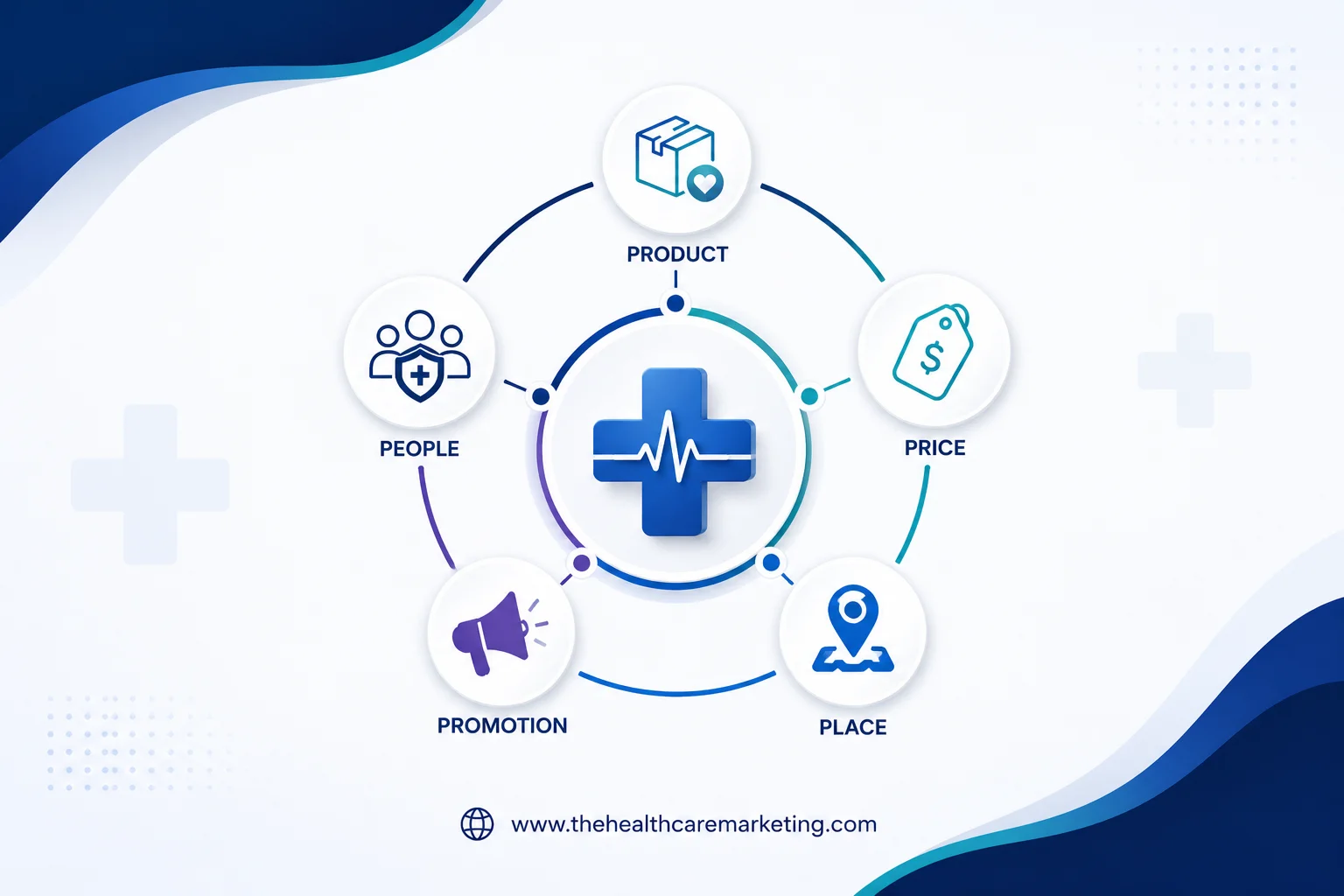
The 5 P’s of healthcare marketing are:
- Product
- Price
- Place
- Promotion
- People
These five elements shape how patients find your practice, compare your services, trust your brand, and decide whether to book an appointment.
For hospitals, clinics, private practices, dental offices, med spas, and healthcare brands, the 5 p’s of healthcare marketing are not just theory. They are a practical framework for:
- Patient acquisition
- Better conversion rates
- Stronger local visibility
- Improved trust
- Higher patient retention
- Sustainable long-term growth
In 2026, this matters more than ever. Patients are researching providers online, checking reviews, comparing options, and expecting a smooth digital experience before they ever call your clinic.
If your healthcare brand wants more patients and stronger long-term growth, learning what are the 5 p’s of healthcare marketing is one of the smartest places to start.
Quick Answer: What Are the 5 P’s of Healthcare Marketing?
If you want the direct answer to what are the 5 p’s of healthcare marketing, here it is:
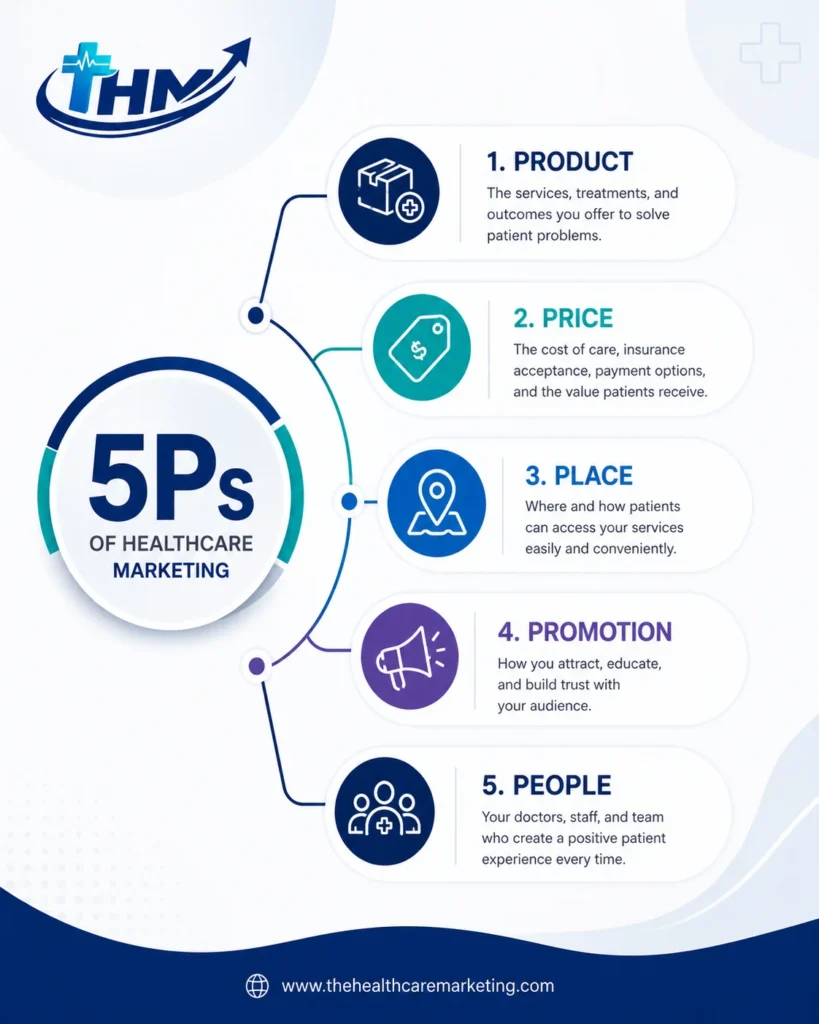
The 5 p’s of healthcare marketing are the five core parts of a successful healthcare growth strategy:
- Product – The services, treatments, specialties, and patient outcomes you offer
- Price – The cost of care, insurance compatibility, payment options, and perceived value
- Place – Where and how patients can access your services, both offline and online
- Promotion – How you attract and educate patients through SEO, ads, content, reviews, and digital marketing
- People – Your doctors, staff, front desk, and every team member who shapes the patient experience
In healthcare, these five elements work together. If one is weak, patient growth often slows down.
For example:
- Great doctors but weak website = lost opportunities
- Strong ads but poor front-desk handling = wasted budget
- Good location but weak reviews = lower trust
- Great services but unclear pricing = lower conversions
That is why the 5 p’s of healthcare marketing are essential for modern patient growth.
Why the 5 P’s Matter More in Healthcare
Healthcare is not just about selling a service. It is about earning trust.
A patient is not simply buying a product. They are choosing someone to help with:
- Pain
- Fear
- Recovery
- Appearance
- Mental health
- Long-term wellness
- Family care
- Life-changing medical decisions
That is why the 5 p’s of healthcare marketing matter more in healthcare than in many other industries.
Here’s why they matter so much:
- Patients need trust before they book
- Reviews influence decisions heavily
- Healthcare searches are often local and urgent
- Patient experience affects referrals and retention
- Staff interactions directly impact reputation
- Digital convenience now affects conversions
- Reputation can outperform price alone
If you want a stronger foundation before applying this framework, it helps to first understand understanding healthcare marketing & its importance, because healthcare marketing is really about guiding the full patient journey—not just generating leads.
The 5 P’s of Healthcare Marketing Explained
Now let’s break down each of the 5 p’s of healthcare marketing in a practical and SEO-friendly way.
1. Product in the 5 P’s of Healthcare Marketing
In healthcare, a product is not just a physical product.
It includes:
- Medical services
- Treatments
- Procedures
- Specialties
- Care plans
- Patient outcomes
- Overall care experience
So when someone asks what are the 5 p’s of healthcare marketing, the first “P” refers to what healthcare value you provide and how clearly patients understand it.
Examples of Product in Healthcare
Your healthcare “product” can include:
- Dental implants
- Orthopedic consultations
- Physical therapy programs
- Telehealth visits
- IVF services
- Dermatology treatments
- Cosmetic procedures
- Preventive health screenings
- Pediatric care plans
- Urgent care services
Why Product Matters in Healthcare
Patients do not book because you “offer services.”
They book because they want a result.
They want:
- Pain relief
- Faster recovery
- Better appearance
- More comfort
- Better mobility
- Accurate diagnosis
- Less stress
- More confidence in their care
That means your website and marketing should not just list services. It should explain:
- What problem you solve
- Who the service is for
- What makes your care different
- What patients can expect
- Why they should trust your team
Common Product Mistakes
Many healthcare providers make these mistakes:
- Using too much medical jargon
- Listing services without explaining benefits
- Not creating dedicated service pages
- Not showing outcomes or patient value
- Weak provider positioning
- No clear differentiation from competitors
Best Practices for Product in 2026
To improve the “Product” part of the 5 p’s of healthcare marketing, you should:
- Create dedicated pages for each major service
- Use simple, patient-friendly language
- Focus on symptoms, solutions, and outcomes
- Add provider expertise and credentials
- Include FAQs under each service page
- Add clear calls to action
- Show what makes your care unique
Quick Tip
Instead of saying:
“We provide cardiology services.”
Say:
“We help patients get expert heart care with early diagnosis, preventive treatment, and long-term cardiac support.”
That is more patient-focused and more conversion-friendly.
2. Price in the 5 P’s of Healthcare Marketing
The second part of the 5 p’s of healthcare marketing is Price.
In healthcare, price is not only the treatment fee. It also includes:
- Consultation fees
- Procedure cost
- Insurance acceptance
- Payment plans
- Financing options
- Membership models
- Transparency
- Perceived value
- Time cost (travel, wait time, booking difficulty)
Why Price Matters in Healthcare
Patients are not always looking for the cheapest option.
They are looking for:
- Clarity
- Predictability
- Trust
- Affordability
- Confidence
- Value
In healthcare, unclear pricing can create friction quickly.
If a patient cannot understand:
- whether you take insurance,
- whether financing is available,
- or what the likely cost range is,
they may leave your site and choose another provider.
Common Price Mistakes
Common issues include:
- No pricing guidance at all
- “Call for pricing” on every service
- No mention of insurance
- No financing visibility
- Hidden-fee perception
- No explanation of value
- No pricing FAQ
Best Practices for Price in 2026
To improve “Price” in the 5 p’s of healthcare marketing, consider:
- Showing starting prices where possible
- Mentioning accepted insurance plans
- Explaining financing or payment plans
- Clarifying what is included in consultation fees
- Using pricing FAQs
- Explaining premium value when relevant
- Reducing uncertainty for high-ticket procedures
Better Example
Instead of:
“Call for pricing.”
Use:
“Consultations start at $99. Final treatment cost depends on your diagnosis and treatment plan. Financing options are available.”
That feels clearer and more trustworthy.
Important Note
In healthcare, “Price” is not only about money.
It is also about perceived value.
Patients often judge value based on:
- Provider expertise
- Reviews
- Technology used
- Website quality
- Staff professionalism
- Speed of access
- Overall confidence
That is why Price and People often work together.
3. Place in the 5 P’s of Healthcare Marketing
The third element in the 5 p’s of healthcare marketing is Place.
Traditionally, “Place” meant physical location.
In healthcare today, “Place” means how easily patients can access your care, both offline and online.
Place Includes:
Physical Access
- Clinic location
- Parking
- Accessibility
- Office hours
- Nearby service area
- Multi-location availability
Digital Access
- Website experience
- Mobile usability
- Online booking
- Google Maps visibility
- Telehealth access
- Click-to-call buttons
- Contact forms
- Appointment speed
- Location landing pages
Why Place Matters So Much
Healthcare is highly local.
Patients often search for:
- Dentist near me
- Orthopedic doctor in [city]
- Urgent care open now
- Pediatrician near me
- Dermatologist nearby
That means “Place” directly impacts:
- Local SEO
- Map rankings
- Calls
- Appointment bookings
- Walk-ins
- Conversion rates
Common Place Mistakes
Many healthcare brands struggle here because of:
- Slow websites
- Poor mobile design
- No online booking
- Weak local SEO
- No city/service pages
- Missing location pages
- Inconsistent business listings
- Hard-to-find office details
- No telehealth information
Best Practices for Place in 2026
To improve “Place” in the 5 p’s of healthcare marketing, you should:
- Optimize your Google Business Profile
- Create location pages for each office
- Add city + service pages where relevant
- Make booking easy on mobile
- Add clear office hours and directions
- Use click-to-call on mobile
- Improve site speed
- Add telehealth options where relevant
- Reduce steps from search to appointment
Quick Rule
If a patient cannot:
- find your location,
- trust your online presence,
- and book quickly,
Your “Place” strategy is costing you patients.
4. Promotion in the 5 P’s of Healthcare Marketing
The fourth part of the 5 p’s of healthcare marketing is Promotion.
This is the part most people think of first when they hear “marketing.”
Promotion is how you attract and educate patients using channels like:
- SEO
- Google Ads
- Meta Ads
- Social media
- Blog content
- Email marketing
- Video marketing
- Local SEO
- Reputation management
- Review generation
- Retargeting
- Community outreach
- Referral campaigns
Why Promotion Is Different in Healthcare
In healthcare, promotion should not feel aggressive or overly salesy.
It should feel:
- Helpful
- Educational
- Trustworthy
- Clear
- Ethical
- Reassuring
Patients are usually asking:
- Can you help me?
- Are you qualified?
- Is your practice trusted?
- Are you nearby?
- Is booking easy?
- Can I afford this?
- What happens next?
That means your promotion should answer questions better than competitors—not just advertise louder.
The Best Promotion Channels for Healthcare in 2026
1. SEO
Best for long-term patient acquisition.
Use SEO for:
- Service pages
- Local pages
- Blog content
- FAQs
- Provider pages
- AI Overview-friendly content
2. Google Ads
Best for high-intent services like:
- Dental implants
- IVF
- Urgent care
- Pain management
- Cosmetic dermatology
- Orthopedic procedures
3. Local SEO
Essential for maps visibility, local trust, and near-me searches.
4. Reputation Marketing
Reviews, ratings, testimonials, and response management directly influence conversions.
5. Content Marketing
Great for:
- Education
- Search visibility
- Topical authority
- Patient trust
- AI citation opportunities
6. Social Media
Useful for:
- Brand trust
- Community engagement
- Visual specialties
- Retargeting
- Humanizing the brand
If you want to stay competitive, it is smart to align your strategy with the latest trends in healthcare marketing, especially as AI search and patient behavior continue to evolve.
Common Promotion Mistakes
Common issues include:
- Running ads without fixing website conversion
- Posting random social media content
- Ignoring local SEO
- Publishing weak blogs with no intent
- No review generation system
- No tracking
- Weak CTAs
- Generic messaging
- Not matching content to patient journey
Best Practices for Promotion in 2026
To improve “Promotion” in the 5 p’s of healthcare marketing, focus on:
- Search-intent-driven SEO
- Trust-focused service pages
- Strong local SEO
- Review generation systems
- Helpful blog content
- Conversion-focused landing pages
- Retargeting for lost visitors
- Educational video content
- Email/SMS nurture for follow-up
- Strong analytics and attribution
If you want all of this connected properly, think in terms of different marketing services for healthcare instead of isolated tactics.
5. People in the 5 P’s of Healthcare Marketing
The fifth and most overlooked part of the 5 p’s of healthcare marketing is People.
In healthcare, “People” includes:
- Doctors
- Specialists
- Nurses
- Front desk staff
- Patient coordinators
- Call handlers
- Billing staff
- Practice managers
- Care navigators
- Support staff
Why People Is So Important
In healthcare, your staff is part of your marketing.
Patients often remember:
- how they were spoken to,
- how fast someone responded,
- how helpful the front desk was,
- how clearly things were explained,
- and how safe they felt.
That means even if your SEO and ads are excellent, a poor staff experience can reduce:
- Conversion rates
- Reviews
- Referrals
- Retention
- Overall trust
Common People Mistakes
Healthcare brands often make these mistakes:
- No phone handling training
- Slow response to leads
- Weak follow-up
- Poor front-desk empathy
- Generic provider bios
- No team visibility on the website
- No review response system
- Marketing and operations not aligned
Best Practices for People in 2026
To improve “People” in the 5 p’s of healthcare marketing, you should:
- Train front desk for empathy + conversion
- Improve phone and chat response speed
- Publish strong provider bios
- Use real team photos
- Align marketing promises with real experience
- Improve review request workflows
- Track missed calls
- Build better follow-up systems
- Respond professionally to patient reviews
Simple Truth
In healthcare, patients often judge your brand before they meet the doctor—and they continue judging it after every staff interaction.
That is why people can make or break your growth.
5 P’s of Healthcare Marketing Summary Table
| P | What It Means in Healthcare | Main Patient Question | Main Goal |
| Product | Services, treatments, outcomes, care experience | Can you help me? | Clarify value |
| Price | Cost, insurance, financing, value | Can I afford this? | Reduce friction |
| Place | Access, location, website, booking, local SEO | How easily can I reach you? | Improve convenience |
| Promotion | SEO, ads, content, reviews, social | Why should I trust you? | Build demand + trust |
| People | Doctors, staff, support teams | Will I feel safe and respected? | Improve experience + retention |
Traditional Marketing vs Healthcare Marketing
Here is why the 5 p’s of healthcare marketing must be applied differently in healthcare.
| Area | Traditional Marketing | Healthcare Marketing |
| Main buying driver | Price, desire, convenience | Trust, safety, outcomes, reputation |
| Purchase timeline | Often fast | Often emotional and research-driven |
| Reviews | Helpful | Often decisive |
| Staff impact | Moderate | Extremely high |
| Local SEO importance | Varies | Very high |
| Content role | Persuasion | Education + reassurance |
| Conversion factor | Offer + ad | Trust + access + experience |
How to Apply the 5 P’s of Healthcare Marketing in 2026
Understanding what are the 5 p’s of healthcare marketing is helpful.
But the real value comes when you apply them in your clinic, hospital, or healthcare brand.
Step 1: Audit Your Current Marketing Using the 5P Framework
Ask these five questions:
- Product: Are our services clearly explained in patient-friendly language?
- Price: Is pricing, insurance, or financing easy to understand?
- Place: Is booking fast and simple on mobile?
- Promotion: Are we attracting the right patients and building trust?
- People: Does the patient experience match our marketing promise?
This simple audit often reveals why traffic is not turning into appointments.
Step 2: Map the Patient Journey
A typical patient journey looks like this:
- A symptom or need appears
- The patient searches online or asks for a referral
- They visit your website or Google profile
- They compare reviews and services
- They try to call or book
- They visit your clinic
- They judge the experience
- They decide whether to return or refer
Now connect that journey to the 5 p’s of healthcare marketing:
- Search visibility = Promotion + Place
- Website clarity = Product + Promotion
- Pricing confidence = Price
- Booking ease = Place
- Staff trust = People
- Experience + retention = Product + People
This is how real strategy is built.
Step 3: Improve Service Positioning
For each core service:
- Create a dedicated page
- Explain symptoms and benefits
- Clarify who it is for
- Add FAQs
- Add provider trust signals
- Add a clear CTA
Avoid having only one generic “Services” page.
Step 4: Reduce Pricing Friction
Make sure patients can quickly understand:
- If you take insurance
- If you offer financing
- Whether consultations have a starting price
- What affects treatment cost
- What value they receive
Even small improvements in clarity can improve conversion rates.
Step 5: Strengthen Access and Local Visibility
This is one of the fastest ways to improve patient growth.
Focus on:
- Google Business Profile optimization
- Local landing pages
- City + service pages
- Mobile site speed
- Online scheduling
- Click-to-call buttons
- Clear hours and location details
- Telehealth options where relevant
Step 6: Build a Trust-First Promotion System
A strong promotion system should include:
- SEO for long-term growth
- Google Ads for high-intent services
- Blog content for education and authority
- Review generation
- Reputation management
- Social proof
- Retargeting
- Email or SMS follow-up
If you want a specialized partner for this, working with a focused healthcare marketing agency can help you build a strategy that actually fits healthcare instead of generic local business marketing.
Step 7: Train Your Team for Conversion and Experience
This is where many healthcare brands lose growth.
Train your team for:
- Faster response time
- Better phone handling
- Empathy during first contact
- Clear scheduling
- Better follow-up
- Review requests
- Missed-call recovery
- Patient communication consistency
A great campaign can fail because of one weak front-desk interaction.
Step 8: Track the Right KPIs
Do not only track clicks and traffic.
Track:
- Calls
- Appointment requests
- Booked appointments
- Cost per booked appointment
- Show-up rate
- Organic traffic by service page
- Local pack visibility
- Review volume and rating trend
- Conversion by location
- Conversion by service
- Patient retention and reactivation
This is how the 5 p’s of healthcare marketing become measurable and profitable.
Common Mistakes Healthcare Providers Make With the 5 P’s
Even strong clinics make avoidable mistakes.
Here are the most common ones:
- Focusing only on promotion
Running ads or posting on social media without fixing the website, booking flow, or patient experience. - Using generic service pages
Weak pages with no differentiation, no outcomes, and no trust signals. - Hiding pricing or insurance details
This creates uncertainty and lowers conversions. - Ignoring local SEO and access
Great services mean little if patients cannot easily find or reach you. - Using complex medical language
Patients need clarity, not technical overload. - Not training staff for first impressions
Your front desk can influence reviews, referrals, and conversion. - No review generation system
Reviews are often a major trust signal in healthcare. - No alignment between marketing and operations
If your ads promise one experience and your clinic delivers another, trust drops quickly.
What the Best Healthcare Brands Do Differently
The best-performing healthcare brands usually do these things well:
- They explain services clearly
- They reduce patient friction
- They make booking easy
- They invest in local SEO
- They create trust-focused content
- They build strong provider credibility
- They actively generate reviews
- They align marketing with real patient experience
- They track real business outcomes, not vanity metrics
Final Thoughts: The 5 P’s Are the Hidden Formula Behind Patient Growth
So, what are the 5 p’s of healthcare marketing?
They are the five essential parts of a patient-focused healthcare growth strategy:
- Product – What you offer and the outcomes patients care about
- Price – What patients pay and how clearly they understand the value
- Place – How easy it is to find, access, and book your services
- Promotion – How you attract, educate, and build trust online
- People – The team and experience that shape every patient interaction
The reason the 5 p’s of healthcare marketing matter so much is simple:
Healthcare growth is not just about traffic.
It is about trust, access, clarity, convenience, and patient experience.
In 2026, the healthcare brands that win will not just be the ones with the biggest ad budget.
They will be the ones that:
- explain their value clearly,
- reduce patient friction,
- create better experiences,
- and build trust at every touchpoint.
If your hospital, clinic, or healthcare brand wants sustainable patient growth, the 5 p’s of healthcare marketing are one of the best frameworks you can use.
Want a Smarter Healthcare Marketing Strategy?
If your clinic, hospital, or healthcare brand wants more qualified patients, better visibility, and long-term growth, the right strategy goes beyond ads.
At The Healthcare Marketing, we help healthcare businesses build growth systems that improve:
- SEO rankings
- Local visibility
- Patient acquisition
- Website conversions
- Brand trust
- Long-term retention
Explore our different marketing services for healthcare or connect with a trusted healthcare marketing agency that understands how healthcare buyers really make decisions.
FAQs About the 5 P’s of Healthcare Marketing
- What are the 5 p’s of healthcare marketing?
The 5 p’s of healthcare marketing are Product, Price, Place, Promotion, and People. These five elements help healthcare providers attract patients, improve trust, increase conversions, and support long-term growth.
- Why are the 5 p’s of healthcare marketing important?
The 5 p’s of healthcare marketing are important because healthcare decisions depend on trust, reputation, accessibility, and patient experience. They help hospitals and clinics create a stronger and more effective patient journey.
- What are the 5 p’s of healthcare marketing for a clinic?
For a clinic, the 5 p’s of healthcare marketing include:
- Product (services offered)
- Price (fees, insurance, financing)
- Place (location, booking, local visibility)
- Promotion (SEO, ads, reviews, content)
- People (doctors and staff experience)
- What are the 5 p’s of healthcare marketing in simple words?
In simple words, what are the 5 p’s of healthcare marketing means:
- What you offer
- What it costs
- Where patients can access it
- How you promote it
- Who delivers the experience
- How do the 5 p’s of healthcare marketing help patient growth?
The 5 p’s of healthcare marketing help patient growth by improving service positioning, pricing clarity, local visibility, trust-building, patient experience, and conversion pathways.
- Is SEO part of the 5 p’s of healthcare marketing?
Yes. SEO mainly fits under Promotion and Place in the 5 p’s of healthcare marketing because it improves search visibility, local rankings, and patient discovery.
- Which of the 5 p’s of healthcare marketing is most important?
All five matter, but many healthcare providers see the biggest impact from People and Place because patient experience and easy access strongly affect conversions, reviews, and referrals.
- Do the 5 p’s of healthcare marketing work for small practices?
Yes. The 5 p’s of healthcare marketing work especially well for small clinics and private practices because they help prioritize trust, local SEO, reviews, accessibility, and better conversion systems.
- How can hospitals apply the 5 p’s of healthcare marketing in 2026?
Hospitals can apply the 5 p’s of healthcare marketing by improving service-line pages, clarifying pricing and insurance, strengthening local access, building trust-focused SEO and content, and improving staff experience across all patient touchpoints.
- What are the 5 p’s of healthcare marketing and how do they affect digital marketing?
The 5 p’s of healthcare marketing directly affect digital marketing because they influence how services are positioned, how trust is built, how easily patients can book, how well a practice ranks locally, and how strong the overall patient experience feels.
